

In the span of 12 days, two councils were formed that claimed to lead Myanmar to peace and unity. They could not be more different – and the contrast between them is the clearest argument why Washington and the international community must stop defending and start acting.
On March 30, the Steering Council for the Emergence of a Federal Democratic Union known as SCEF was established by the Kachin Independence Organization (KIO), the Karen National Union (KNU), the Karen National Progressive Party (KNPP), the Chin National Front (CNF) and the National Unity Government (NUG).
It adopted six codified policy objectives, including repealing the 2008 Constitution, placing all armed forces under civilian command, and establishing transitional justice mechanisms. Its three-pillar structure—states and ethnic revolutionary organizations, the popular movement, and women—institutionalizes involvement rather than leaving it to goodwill.
NUG Acting President Duwa Lashi La called it “a milestone of the Spring Revolution”.
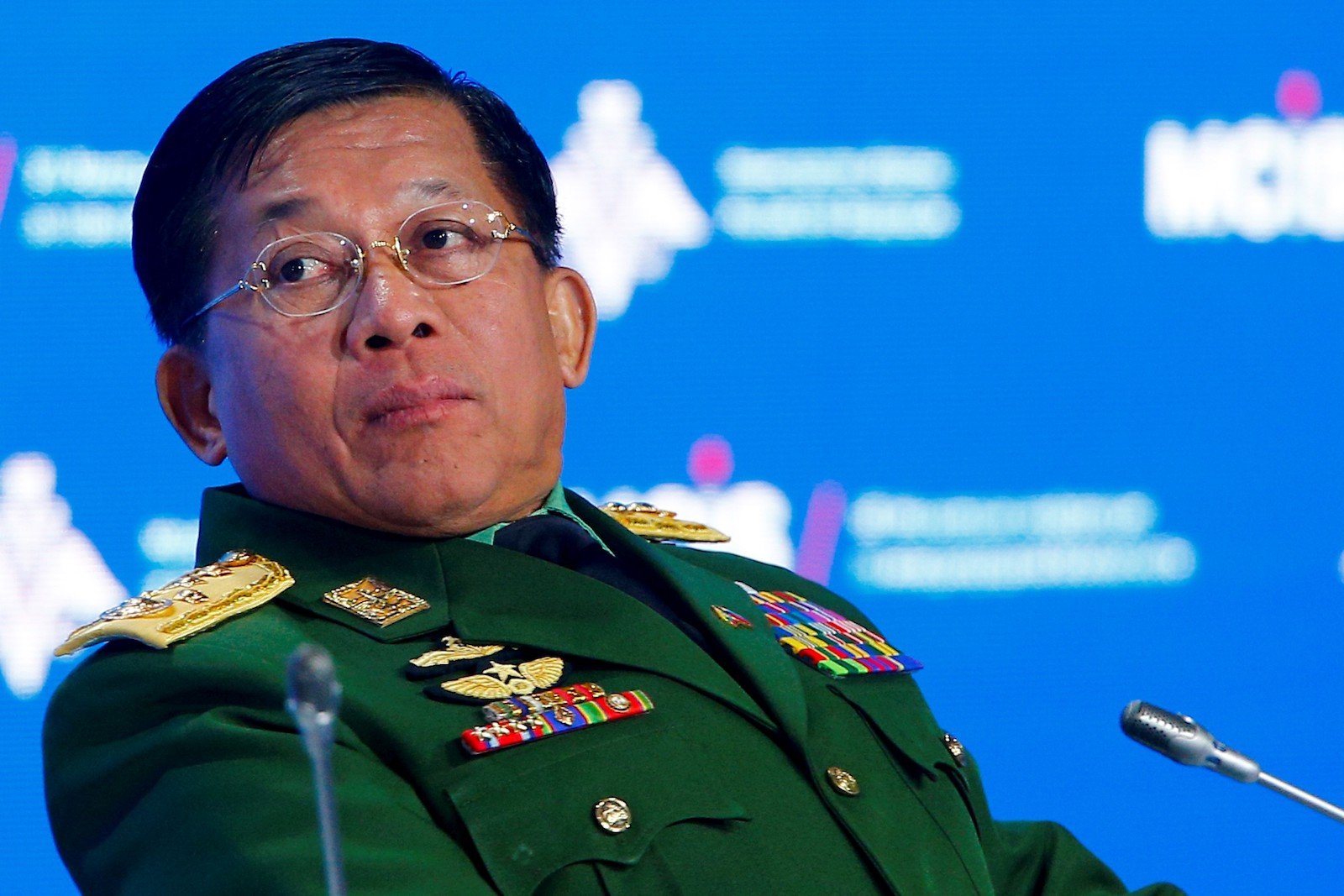
On April 11, Senior General Min Aung Hlaing signed Order No. 36/2026 on the establishment of the Central Committee of National Unity and Peacemakers – NSPCC – and was appointed chairman. Of its 15 members, nine are individually sanctioned by the United States, the European Union, the United Kingdom, Canada, Australia or Switzerland.
The chairman himself is sanctioned by the six and faces a order— filed in November 2024 and still unpublished after 16 months.
A council was built from below, by organizations that control or contest roughly 79% of the territory of Myanmar. The other was decreed from above by a man who cannot transit countries with ICC cooperation agreements and staffed with generals who cannot travel to the countries with which they must negotiate.
A day before forming his peace committee, Min Aung Hlaing delivered an 18-minute inaugural address to the bicameral national-level Pyidaungsu Hluttaw legislature. Every big claim in it was false.
He repeated the claim that Myanmar’s 2020 elections were tainted by fraud. The Asian Network for Free Elections, which sent observers to 430 polling stationshe found the election day “calm and orderly”. of The Carter Center positively evaluated the voting behavior in 94% of the centers. Human Rights Watch called the army’s allegation of fraud “baseless”.
Min Aung Hlaing also announced the constitutional coup. However, the International Commission of Jurists documented at least four violations of Article 417: the president was arrested before any emergency declaration; electoral fraud does not constitute an armed seizure of sovereignty as provided for in the provision; civilian members of the National Defense and Security Council were detained; and parliament was physically prevented from meeting.
He went on to declare the 2026 elections “free, fair and dignified”. However, the National League for Democracy (NLD) – which won 82% of contested seats in 2020 — has been dissolved by force and has not contested. Parties holding more than 90% of the 2020 seats were excluded.
of Law on Protection of Elections Criminalized criticism of the 2026 elections, held in stages in December 2025 and January 2026, with penalties including death. A joint ANFREL/SAC-M report found that voting took place in only 265 out of 330 villages – just 42% of Myanmar’s territory.
The EU announced the elections”not free, fair, inclusive or reliable.” Even the Association of Southeast Asian Nations (ASEAN), known for its “non-interference” in the internal affairs of its members, did they don’t know surveys.
Min Aung Hlaing pledged economic development. However, since his coup, gross domestic product (GDP) has fallen 13% below pre-pandemic levels. Kyat, the local currency, has collapsed 240%. Poverty has almost doubled 50%. Myanmar, meanwhile, has been blacklisted by the Financial Action Task Force for failing to combat money laundering and terrorist financing.
What the general’s speech did not mention was 22,818 political prisoners, 6764 civilians killed, 1022 airstrikes on civilian targets, 3.58 million displaced people and 630,000 Rohingya classified as Phase 9: Extermination by Genocide Watch. He did not even mention the ICC order hanging over his head.
This is the man who the next morning appointed himself chairman of a peace committee.
List of one-letter sanctions
The NSPCC is not an anomaly. It is the culmination of a pattern evident from all that Min Aung Hlaing has assembled since being sworn in. Of his cabinet, 13 out of 30 Union ministers, or 43%, are individually sanctioned. A further four face block-level restrictions, bringing total sanctions exposure to 57%.
His Union Consultative Council, announced on inauguration day, has six of 11 individually sanctioned members, or 55%. Officials allegedly removed from the cabinet were simply repositioned. Nine of the NSPCC’s 15 members, or 60% of the body, are individually sanctioned.
Each successive body concentrates more sanctioned figures than the last. The regime’s peace committee has the highest sanctions saturation of any institution Min Aung Hlaing created.
Its vice president is sanctioned by the EU and Canada. Its members include the new commander-in-chief, General Ye Win Oo, sanctioned by five governments, and two ministers sanctioned by six governments each.
The operational absurdity of the NSPCC speaks for itself. Nine of its 15 members cannot travel to the EU, UK, Canada, Australia or Switzerland without risking an asset freeze. The President cannot transit through countries with cooperation agreements with the ICC.
The Committee cannot credibly interface with any Western-aligned mediator, any international peace mechanism, or any donor government implementing its own sanctions. The Nationwide Ceasefire Agreement that is apparently intended to be revived has been called “piece of paperby its six signatories Transnational Institute rated it “to most intents and purposes, gone.”
The alternative exists
The junta has spent millions to convince Washington otherwise. US Foreign Agents Registration Act (FARA) filings show that the DCI Group has a $3 million annual contract with Myanmar’s Ministry of Information.
A propaganda website – MyanmarDemocracyNow.com – appeared within hours of the April 3 election, describing it as a “peaceful transition of power”. Its bottom contains mandatory FARA disclosure.
The SCEF is exactly the credible, inclusive federal opposition that skeptics have long sought. It unites the main ethnic armed organizations with the NUG under a common constitutional vision.
Its six objectives are codified and vague. It represents the populations and territories the junta does not control – which, according to the military’s own election data, is most of the country.
The BRAVE Burma Act unanimously passed the US House of Representatives and was introduced in the US Senate with bipartisan sponsorship by Senators Van Hollen, Young, McConnell and Merkley.
The US Commission on Interreligious Freedom (USCIRF) has recommended that Congress bar countries of particular concern from hiring US lobbyists. Courts in Indonesia, Argentina and Timor-Leste have accepted or initiated genocide proceedings against Myanmar.
When Vietnam’s National Assembly elected To Lam as President on April 7, the US State Department sent congratulations on the same day. When Min Aung Hlaing was sworn in three days later, Washington sent nothing.
Japan – which froze all new official development aid after Myanmar’s 2020 coup – sent nothing. ASEAN did not recognize the inauguration; The Philippines has made it clear that Min Aung Hlaing will not receive political representation at the bloc’s summit in May.
The question is no longer whether there is an alternative to the generals. Rather, it is whether Washington will recognize it before the paid lobbying machine succeeds in normalizing a regime that responds to international pressure not by reforming but by repackaging the same sanctioned officials into new institutional forms—each with a higher concentration of sanctioned individuals than the last.
James Shwe is a Myanmar American professional engineer and advocate for democracy in Myanmar who is affiliated with the Los Angeles Myanmar Movement.



