
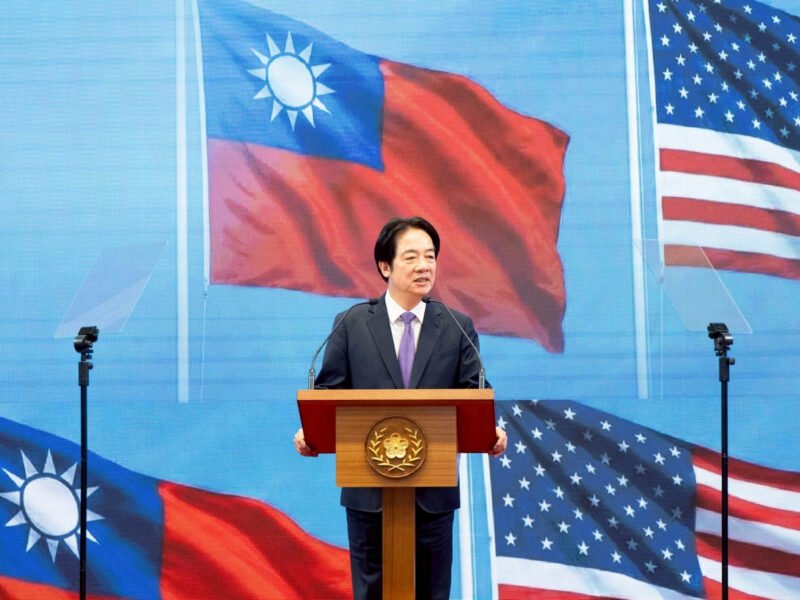

The US, like all countries with formal ties to China, does not recognize Taiwan as a country, but has been the island’s strongest supporter and arms supplier.
TAIPEI, Taiwan (AP) — Taiwan’s president stressed Sunday that arms purchases by the United States are the “most important deterrent” to regional conflict and instability, after President Donald Trump questioned continued U.S. support for Taiwan following his visit to China.
US arms sales to Taiwan and security cooperation between the two sides are not only guided by the law, but also a catalyst for regional peace and stability, President Lai Ching-te said in a statement.
“We thank President Trump for his continued support for peace and stability across the Taiwan Strait since his first term in office, including the continued increase in the scale and quantity of arms sales to Taiwan,” he said.
His statement came days after Trump raised doubts about his willingness to continue selling arms to Taiwan, the island democracy that China claims as its breakaway province, to retake by force if necessary.
The US, like all countries with formal ties to China, does not recognize Taiwan as a country, but has been the island’s strongest supporter and arms supplier. Washington is bound by its own laws to provide Taiwan with the means to defend itself and views all threats to the island as a matter of concern.
Trump shocks Taiwan with ‘bargaining’ comment
Trump already approved in December a record $11 billion arms package for Taiwan, including missiles, drones, artillery systems and military software.
In an interview that aired Friday on Fox News, just as Trump wrapped up a high-stakes visit to China, he said he had not yet received the green light for a new $14 billion arms package for Taiwan and that it was “up to China.”
“It’s a very good bargaining chip for us, frankly,” he said.
His comments raised concerns on the island, which the Taiwanese government has sought to break up, noting that official US policy on Taiwan has not changed.
“Taiwan will not provoke or escalate conflict, but also will not give up its national sovereignty and dignity, or its democratic and free way of life, under pressure,” Lai said in his statement, calling China “the main cause of undermining regional peace and stability and trying to change the status quo.”
US House Speaker Mike Johnson praised Lai’s statement, saying, “I thought that was a reasonable thing for the leader there to say.” Johnson said on Fox News Sunday, “China can’t just take land, and we’re going to stand strong and stand firm on that. I know Congress will.”
U.S. Trade Representative Jamieson Greer said on ABC’s “This Week with George Stephanopoulos” on Sunday that the president is “considering how to move forward” with arms sales to Taiwan, noting that previous U.S. presidents have halted sales in the past and Trump will have to weigh many factors. “When the president makes a national security decision, it’s based first on America’s security needs,” Greer said.
China has described Taiwan as “the most important issue in China-US relations” during Chinese President Xi Jinping’s recent talks with Trump.
In one of his strongest statements to date, Xi on Thursday warned Trump of “clashes and even conflicts” if the Taiwan issue was not handled properly.
China and Taiwan have been governed separately since 1949, when the Communist Party came to power in Beijing after a civil war. Defeated Nationalist Party forces fled to Taiwan, which later transitioned from martial law to multiparty democracy. Associated Press writer Didi Tang in Washington contributed to this report.
Subscribe to our free newsletters
Our weekly newsletter Closing arguments provides the latest on ongoing trials, major litigation and decisions in courts around the US and the world, while monthly Under the lights feeds legal dirt from Hollywood, sports, Big Tech and the arts.



