
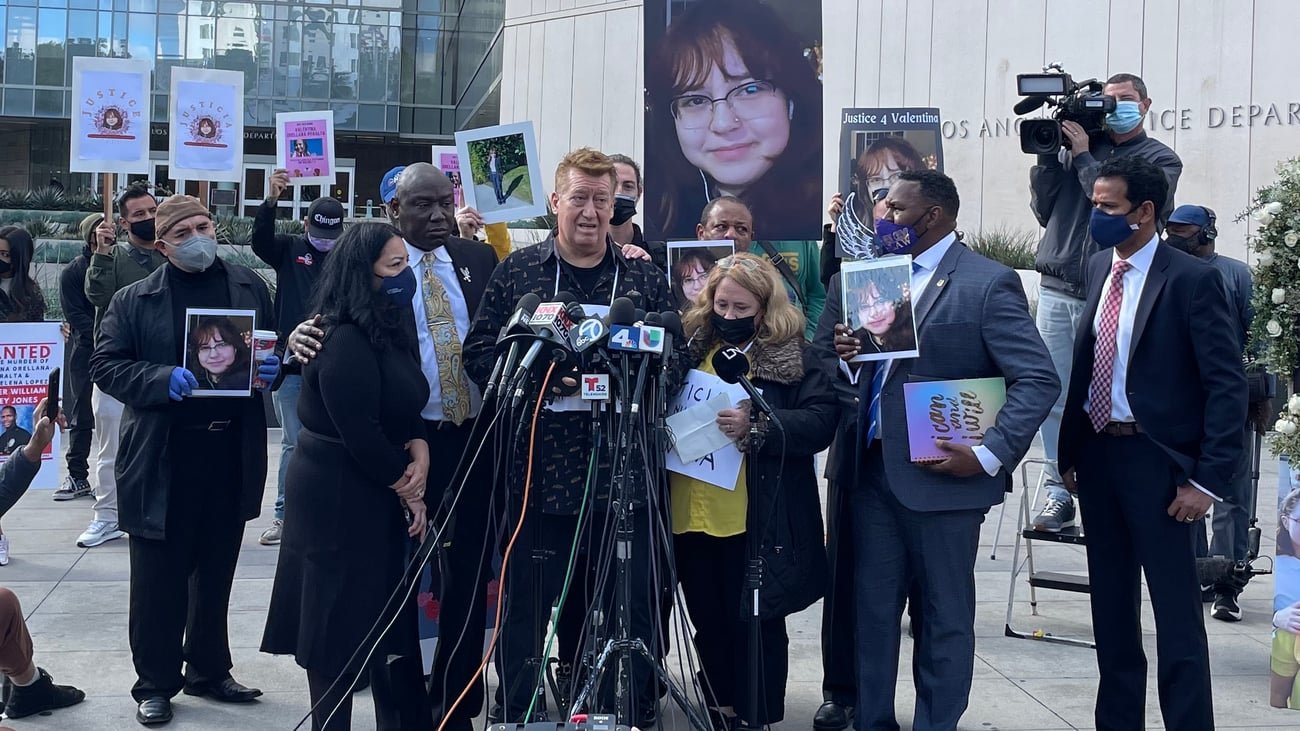

Valentina Peralta’s parents are suing the city of Los Angeles, alleging negligence, after their daughter was killed by a stray bullet in a 2021 shootout.
LOS ANGELES (CN) – The LAPD officer who accidentally shot 14-year-old Valentina Peralta at a convenience store in 2021 testified in court Monday as part of a civil lawsuit filed by Peralta’s parents against the city of Los Angeles.
Four patrolmen responded to reports of an assault with a deadly weapon inside the Burlington Coat Factory in North Hollywood. They moved up in close formation, the senior officer giving the orders. He told the officer, who was carrying a special weapon designed to fire less-than-lethal rounds such as bean bags, to take first aim at the suspect, an apparently mentally disturbed man who beat at least one customer with a large bicycle lock.
Officer William Jones arrived on the scene shortly after the other officers, along with his partner. Jones grabbed an AR-15 assault rifle from his trunk, having just completed the training course required to carry that weapon weeks earlier. He hurried up and pushed his way to the front of the formation. As he did so, the senior officer told him, “Habe him! and to ‘slow down.’
Jones put the assault rifle belt around his neck but kept his position at the front of the now five-man lineup. As soon as he spotted the suspect, he immediately fired three shots in less than a second. One of the bullets hit the suspect in the back, killing him. Another ricocheted off the ground, cutting through the thin wall of an assembly room and killing Peralta, who was hiding in one of the rooms with her mother. Peralta died in her mother’s arms.
Plaintiff’s attorney Haytham Faraj has suggested that the AR-15 was an inappropriate weapon to use in the situation — indoors, with innocent bystanders and thin walls. From the witness stand, Jones disputed that, calling the assault rifle “the optimal weapon.”
“With its actuarial and range, this is the big gun you want up front,” Jones said.
Faraj asked Jones if he was “excited” to have the opportunity to use the rifle, which he had just been trained to use.
“Absolutely not,” Jones said. “That’s the last thing I want to do. … If somebody’s out there shooting and we have a mass shooting two days before Christmas, I have to do what I’m sworn to do.”
At least one of the communications from a police radio dispatcher claimed that there were shots fired at the store. But none of the officers at the scene said anything about a gun; instead, everyone shouted warnings about a suspect with a bike lock.
As for the order to “holster” his gun, Jones testified that he thought of it as putting the belt around his neck, rather than removing the rifle.
“If he had wanted me to take it off, he would have said, ‘Jones take it away,'” he said. Jones also denied that it was the commanding officer’s responsibility to decide which officer should take the point.
“The team leader didn’t have the vantage point that we had at the time,” Jones told the jury. “I would have the clearest view.”
The other witness disagreed. Richard Bryce, a former Ventura County Sheriff’s Department second-in-command who testified for the plaintiffs as an expert witness, told the court that the decision about which officer should lead the formation rested with the senior officer at the scene.
“The use of deadly force in this case was unjustified and unnecessary,” Bryce testified, “because there was no immediate threat of death or bodily harm to the officer when he fired the shots.” The three-shot shooting, he said, was “excessive” and “endangered the lives of individuals.” He pointed out that Jones told investigators, in an interview after the incident, that he thought he had only fired two shots.
Jones will resume the position later in the week. The trial, which began Wednesday, expected to last about seven days. This is just the first phase of the trial, in which a jury will determine whether or not the shooting was negligent, which would make the city of LA responsible for the murder. If the jury finds the city liable, there will be a second phase to determine damages — that is, how much money the city will be ordered to pay the Peralta family.
Because of this duplication, Peralta’s parents are unlikely to testify in the first phase of the trial, which will rely largely on body camera footage and testimony from police officers at the scene, as well as use-of-force experts. Plaintiffs are not even allowed to show video footage that includes the sounds of Peralta’s mother screaming. The plaintiff’s lawyers have said that the mother will testify in the second phase of the trial, if there is one.

Subscribe to our free newsletters
Our weekly newsletter Closing arguments provides the latest on ongoing trials, major litigation and decisions in courts around the US and the world, while monthly Under the lights feeds legal dirt from Hollywood, sports, Big Tech and the arts.



