
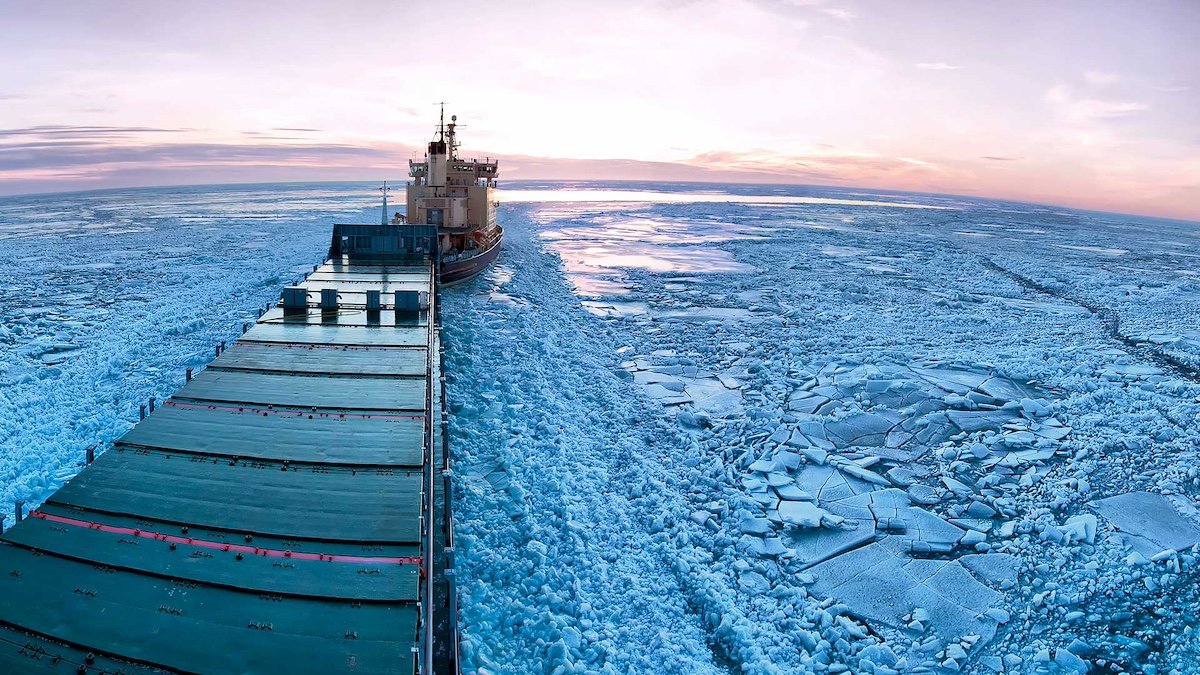

The Strait of Hormuz crisis will be remembered for many things, but its most important legacy may be one that has barely entered the public debate. It has accelerated Asia’s geographic orientation away from the Middle East and toward a region that most Asian capitals have so far treated as peripheral: the Arctic.
When with the flag of Oman The tanker Voyager arrived at Imabari carrying Russian oil on 5 Maythe symbolism was read narrowly, as Japan was seizing emergency supplies during the Gulf standoff. However, the geographical implication was greater. The cistern did not come from the Middle East.
It did not transit through Hormuz, the South China Sea or any of the choke points that have defined Asian maritime security for half a century. He came from Sakhalin, in the far north of Russia. And the path it represents is the leading edge of a structural transformation that has been quietly building for a decade and is now rapidly accelerating.
Consider what the Hormuz crisis has really exposed. Asian economies were importing, on average, more than 80% of their crude oil through a single 33-kilometer choke point controlled politically by an actor capable of denying transit at will, and physically by a coalition whose conflict with that actor triggered it.
The structural lesson is not that Asian buyers should diversify within the Gulf. The lesson is that the entire Asian energy security architecture centered on the Middle East was built on a geopolitical foundation that the region does not control and cannot protect. This foundation has now been publicly cracked.
Japan adopted this earlier than most of its neighbors. Tokyo’s 2018 Third Framework Plan on Ocean Policy explicitly incorporated the Arctic into Japanese strategy, identifying the region as critical to maintaining a free and open maritime order based on the rule of law. This language entered Japanese politics three years before Indo-Pacific became fashionable diplomatic vocabulary and eight years before Hormuz was closed.
Japan’s investment in Sakhalin-1 and Sakhalin-2, major hydrocarbon projects in Russia’s Far East, was a node in a deliberate northern strategy that already includes the Northern Sea Route, sustainable Arctic research programs and the first deployment of the Maritime Self-Defense Force in the Arctic in 2020.
The Northern Sea Route, which runs along Russia’s Arctic coast, shortens shipping distances between Asia and Europe by 36% to 40%, roughly 7,200 kilometers, compared to the Suez-Hormuz corridor.
In 2025, the road recorded 103 transit voyages by 88 unique vessels carrying approximately 3.2 million tons of cargo. These remain small numbers in global terms, but the trajectory is unmistakable.
The Arctic is becoming a viable trade corridor faster than its skeptics predicted, partly because climate change is melting it and partly because Hormuz has made it necessary.
China understood this trajectory and acted on it before Japan. Beijing declared itself a near-Arctic state in 2018 despite sitting thousands of kilometers from the Arctic Circle, has built five icebreakers, runs its Polar Silk Road as an official extension of the Belt and Road Initiative, and sends increasingly regular research expeditions whose dual-use profile is barely disguised.
The Hormuz crisis has now proven this whole attitude. China has weathered the energy shock because its overland Russian pipelines, investments in northern resources and 1.4 billion barrels of strategic reserves were positioned for just this scenario.
Iran’s late March decision to grant transit rights to a select list of friendly nations led by China should be read in this light: a recognition that Beijing alone among major Asian capitals had built a parallel energy geography that did not require Iranian goodwill to begin with.
What Hormuz has revealed, in other words, is that the great geographic divide in Asia’s energy future is not between aligned and nonaligned states, nor between democracies and autocracies.
It is between the states with operational presence in the northern energy theater and the states without. Japan and China have it. Russia, the holder of the resource, controls it. South Korea is racing to build it. India is debating whether it will want it.
Much of Southeast Asia has neither the capital nor the state capacity to absorb it, and it is precisely these countries, the Philippines, Vietnam, Thailand and Bangladesh, that have suffered the worst of the current crisis.
The implications extend far beyond energy. The Indo-Pacific framework, which has organized US-led strategic thinking for the past decade, was always a naval construct centered on the choke points of the South China Sea, Malacca and Hormuz.
He assumed that Asia’s economic lifelines would continue to run through these waters and that great power competition would be a race for control. The Arctic, on this map, was a future peripheral concern, a place for scientific cooperation and gradual Russian provocation, not an immediate strategic priority.
This assumption is now obsolete. If Asian energy security increasingly passes through Sakhalin, Murmansk, Yamal and the Bering Strait, then the strategic geography of the region has changed radically.
The Indo-Pacific is not being replaced, but being complemented, and perhaps relativized, by what might be called an Indo-Arctic-Pacific framework, in which the northern theater becomes an equal arena of Asian strategic concern. Japan’s FOIP doctrine has already begun this expansion, even if its allies have not yet caught up.
It is not difficult to identify the losers in this reorientation. Countries whose energy security depends on supplying the Middle East via the southern sea lanes will face a permanently elevated risk premium that no amount of diversification within the Gulf can resolve.
Indonesia, despite being a hydrocarbon producer, lacks both the capital position and the geographic logic to enter the Arctic theater meaningfully. Its disjointed tradition, designed for a world where energy choices ran north-south across the Indian Ocean, fits awkwardly with a future where important strategic choices run east-west across the Arctic.
of The Philippines, importing 98% of its oil from the Gulfthere is even less optionality. These are not passing concerns; they are structural disadvantages that will increase over the next decade.
The winners are those who have already invested. Russia, paradoxically, emerges as the key energy pillar of Asia, not because of warming political relations, but because it possesses the geography that the new energy map requires.
Japan, despite being a US treaty ally, has built up a position in that geography sufficient to extract waivers, support supply and project influence. China has built parallel infrastructure of even greater proportions.
Now the shape of Asian energy supply routes in the 2030s is being drawn, in coordinates that no one was looking at when Hormuz dominated the news. The Strait of Hormuz will be reopened. Tankers will resume transit, prices will be reduced and the daily news cycle of the region will continue.
However, the geographic reorientation that this crisis has accelerated will not change. Asia’s energy center of gravity is moving north, and states that recognize this and build accordingly will determine the strategic order of the next decade.
Those who continue to think in southern, Gulf-centric terms will find that the maps they were using have now been redrawn.
Irvan Maulana is a researcher at the Center for Economic and Social Innovation Studies (CESIS), a think tank based in Jakarta.



