
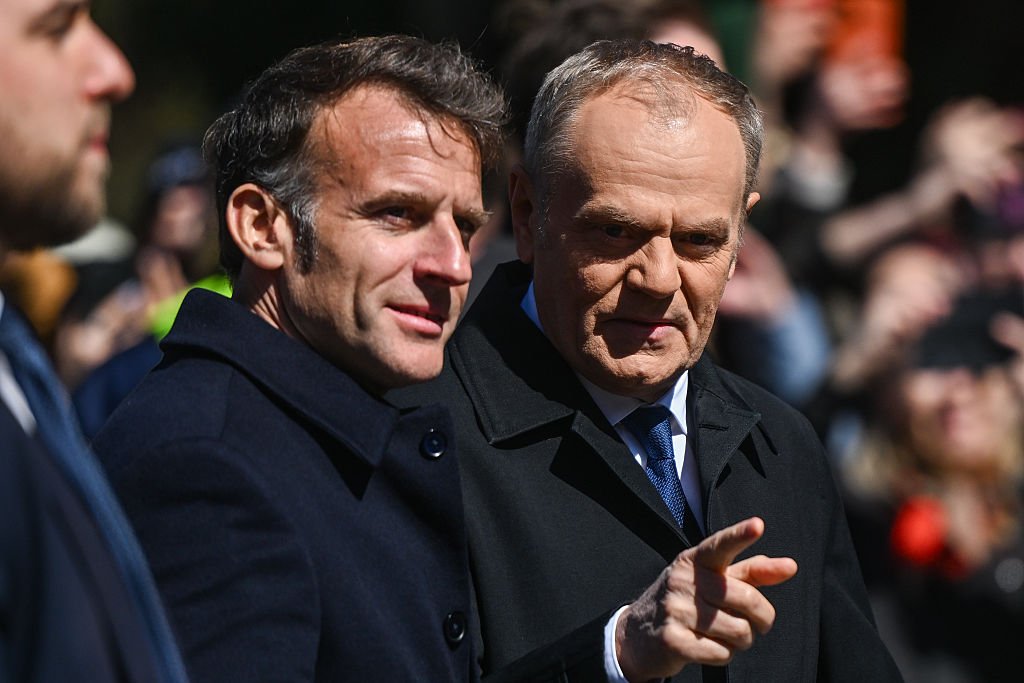

WARSAW – French President Emmanuel Macron traveled to Poland on Monday for talks with Prime Minister Donald Tusk focused on defense cooperation, as the two countries respond to the Russian threat and growing doubts over US security guarantees.
Senior ministers from both governments also attended the meeting in the Baltic Sea port of Gdańsk – the first joint cabinet session under the Treaty of Nancy, a bilateral pact signed in 2025 that binds the two countries to annual ministerial meetings.
The treaty was designed to repair strained bilateral relations during the previous Law and Justice administration in Warsaw. Discussions focused on strengthening military cooperation between the two countries.
“We see the geopolitical landscape the same way and share the same concerns about geostrategic instability,” Tusk said at a joint press conference with Macron. “We agree on the need to defend European sovereignty, stand by Ukraine and preserve the transatlantic link – but none of us are under any illusions. The world has changed and Europe must stay united.”
The two leaders also discussed the possibility of a Polish role in France’s nuclear deterrent.
Marta Prochwicz-Jazowska of the European Council on External Relations said Euractiv that the change in France’s stance on nuclear deterrence “could be the most significant development in European defence”. Poland’s openness to cooperation in this area, she added, “is absolutely unprecedented – a clear signal that both sides are serious about deepening relations.”
Although Paris has made it clear that it will retain sole authority over any decision to use force, Warsaw can play a supporting role in areas such as early warning systems.
The two sides also signed an agreement under which a consortium of Airbus Defense and Space and Thales Alenia Space, along with Poland’s Radmor, will jointly build a geostationary military satellite.
“Our freedom depends on our ability to defend ourselves, protect our children and preserve our independence,” Macron said in Gdańsk, adding that Franco-Polish relations had reached “a historic level”.
However, important differences remain – above all on how to manage ties with Washington. While Paris continues to defend strategic autonomy, officials in Warsaw take a more cautious stance.
“If Russia moves against Europe, it is Poland that will be in the firing line – not France,” said a senior Polish source. Euractiv. “That’s why we need to cultivate American and European relations.”
(aw)



