
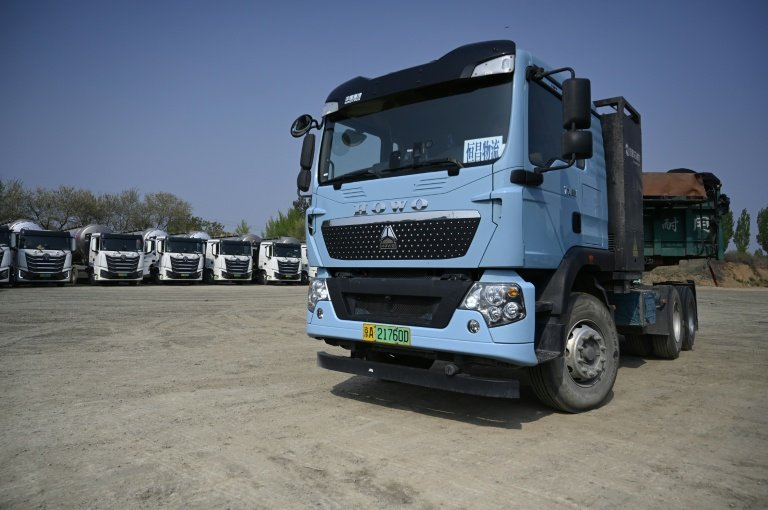

Adoption of alternatives to diesel trucks in the world’s second-largest economy has accelerated sharply in recent years – Copyright AFP WANG Zhao
Peter CATTERALL
In a dusty spot an hour outside Beijing, a steady stream of vehicles come and go for a quick battery charge — just one node in China’s rapidly expanding network of electric trucks.
While the country’s prowess in electric passenger vehicles has long been recognized globally, electric trucks have only recently gained ground.
Now powered by extensive charging and battery-swapping infrastructure, cost structures clearly favor electric models, experts say, in a potentially fatal blow to conventional diesel equipment.
“Last year was the breakthrough for electrified heavy vehicles in China,” Lauri Myllyvirta, co-founder of the Center for Energy and Clean Air Research and an expert on China’s energy consumption, told AFP.
“If the infrastructure is there, the economy is there for an increasing number of roads and logistics requirements,” he said.
Adoption of alternatives to diesel trucks in the world’s second-largest economy has accelerated significantly in recent years.
New-energy models accounted for 29 percent of all domestic truck sales in China last year, up from 14 percent in 2024, according to data from Beijing-based market intelligence provider Commercial Vehicle World.
The penetration rate was less than one percent by 2021, according to the firm.
Manufacturers say they expect this share to continue to grow, potentially reaching a majority of sales in just a few years.
At the busy station in Beijing’s Miyun district, 43-year-old truck driver Wang told AFP how his job had changed since he started driving an electric model last year.
“It’s such a breeze!” he said after plugging in the charging cables.
“My old car had over 10 gears and it was so cumbersome to operate. But with this one, you don’t have to do anything – it’s all automatic.”
– “All About Speed” –
Asked why he thought logistics firms like his were increasingly switching to electric trucks, Wang said it was a combination of national policies and simple market logic.
“It’s just survival of the fittest. Now, with shipping costs and everything, people are trying to make a little bit more, and that has lower operating costs.”
Another driver at the charging station, surnamed Zhang, told AFP that he has been driving an electric truck for about two months after switching from a natural gas truck.
His work mainly involves transporting sand and stone on short trips around Beijing, Zhang told AFP, noting that the truck is not suitable for longer deliveries.
The new sky-blue model Zhang drives – manufactured by the Howo brand of state-owned firm Sinotruk – has a maximum range of 240-250 kilometers (149-155 miles), he said.
“The power is quite strong, the acceleration is quick. It’s all about the speed, but the range is a bit lacking,” he said.
As domestic adoption of electric trucks grows, Chinese firms are thinking more about overseas markets.
“Similar to passenger vehicles, China’s heavy truck manufacturers are beginning to see export markets as an inevitable strategy due to increasing competition and eventual saturation in the Chinese market,” said Christopher Doleman, an analyst at the Institute for Energy Economics and Financial Analysis.
– ‘Electric is superior’ –
The recent disruption in global energy markets as a result of the war in the Middle East is a “potential accelerator” for this trend, Doleman told AFP.
“There is likely to be greater demand for heavy-duty electric vehicles as fleet owners try to minimize their vulnerability to volatile oil costs,” he said.
According to Han Wen, founder of electric truck start-up Windrose Technology, the war has “already” increased demand.
Founded in 2022, Belgium-based Windrose is looking to leverage China’s advanced EV supply chains to position itself in the emerging global market for long-haul electric trucks – competing with Tesla’s electric Semi.
“For trucks, distance is far from the limiting factor,” Han told AFP, noting that Windrose trucks can currently drive about 700 kilometers on a full charge, with plans to extend that to 1,000 kilometers in 2030.
Having secured road approval in Europe, China, the United States and South America, Windrose is now looking to ramp up production.
“We will build about 1,000 trucks this year,” Han said, followed by goals of 10,000 next year and 100,000 in 2030.
“Economically, there is no longer any doubt that electric is superior,” he added.
“I think we’re on the verge of a total extinction of diesel trucks as a product category.”



