
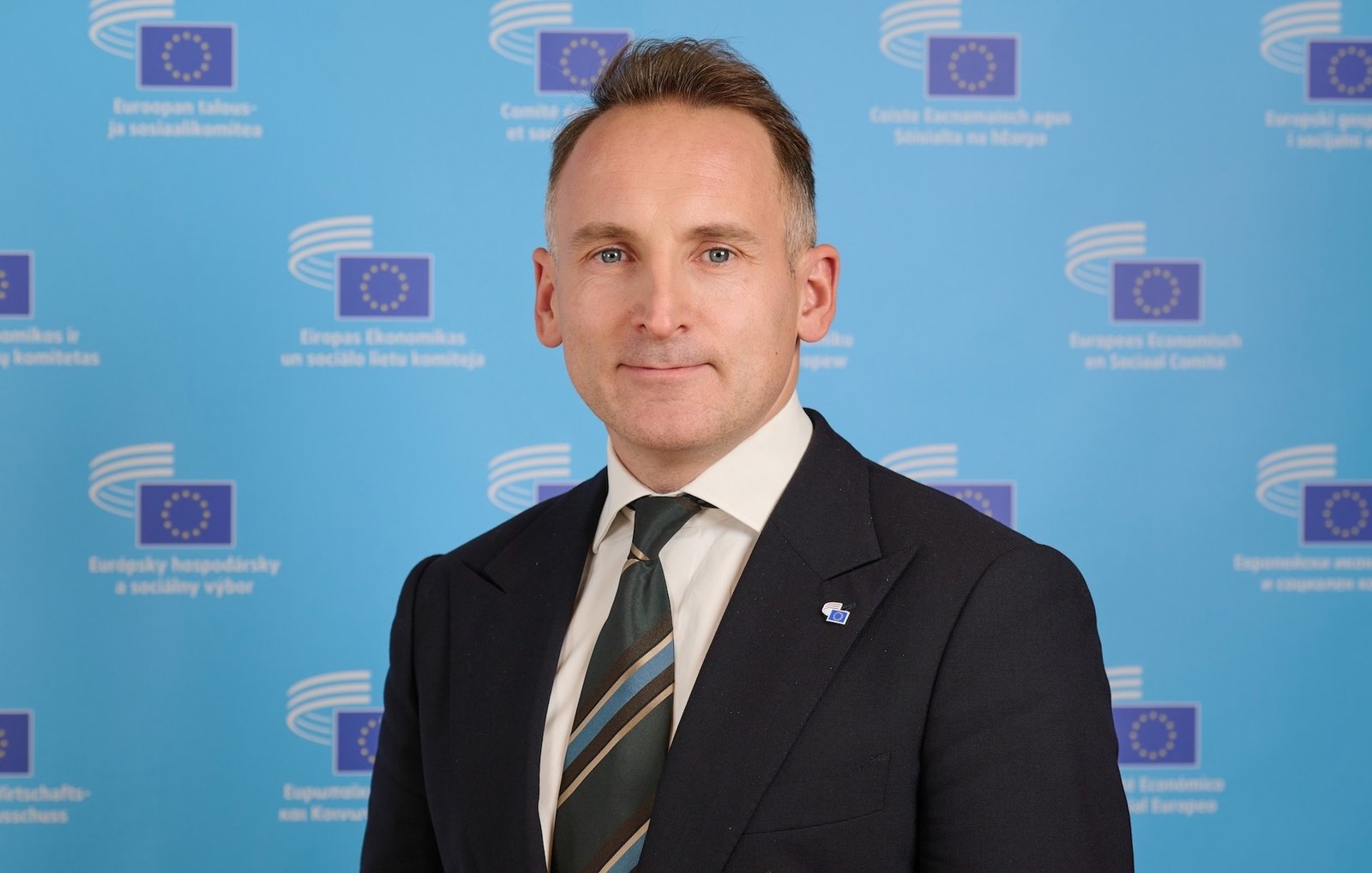

As the EU emphasizes its focus on security, energy sustainability and social cohesion, infrastructure policy is increasingly being pulled in multiple directions, with an emphasis on finding synergies – especially through dual-use investments that serve both civil and defense needs.
In an interview with Euractiv, Marcin Nowacki, president of the transport, energy and infrastructure (TEN) section of the European Economic and Social Committee, argues that strengthening military mobility, modernizing electricity networks and addressing Europe’s housing crisis all require more coordinated EU action.
From protecting workers in defense logistics to preventing distortions in grid funding and curbing housing speculation, Nowacki calls for a balanced approach that combines investment, regulation and social protection to deliver both resilience and competitiveness.
EV: The EESC calls for increased EU funding for dual-use infrastructure. How should this be prioritized against the main needs of civil transport?
MN: The EESC strongly believes that dual-use infrastructure that serves both military and civilian purposes is the most cost-effective and resilient way to tackle Europe’s transport and security challenges. However, this priority should be strategic and transparent, using existing EU instruments such as the Connecting Europe Facility (CEF).
With dual use as a guiding principle, every euro spent on military mobility should maximize civilian benefits. Railroad improvements, for example, should improve military transport and freight and passenger capacity; border crossing facilities should serve both military logistics and commercial trade; and digital infrastructure must support both defense operations and civilian crisis response.
Our ‘Amendment 2’ explicitly includes innovative technologies such as drones and clean propulsion as part of this approach, helping to reduce reliance on traditional assets and freeing up resources for civilian needs.
Targeting the eastern flank and key chokepoints, such as the Suwałki Corridor, Black Sea ports and Nordic routes, is also essential, as these areas face military risks and civilian transport bottlenecks.
At the same time, civilian needs must be protected. Our ‘Amendment 3’ ensures that public service obligations such as passenger railways, be protected from disruption, while compensation mechanisms should ensure that civilian operators affected by military prioritization are fairly reimbursed, while maintaining their willingness to cooperate.
EV: Increased support from civilian operators is essential for military mobility. How can the EU ensure rapid deployment without undermining workers’ rights and conditions?
MN: EU support to civilian operators for military transport is inevitable, given the scale of potential deployments. However, this should not be done at the expense of workers’ rights.
The Emergency Mobility Support Regulation (EMERS) allows for temporary exemptions from rules such as emergency driving and rest periods. While some flexibility is necessary, the EESC insists on clear activation thresholds and strict proportionality. Avoidances must remain limited and take into account the driver’s well-being.
Compensation and protection mechanisms are equally important. If civilian operators suffer financial loss due to military superiority, Member States must compensate them under tort law. For high-risk operations, such as the transport of military cargo in conflict zones, the EESC calls for mandatory life and health insurance, including coverage for surviving relatives. Civilians supporting military mobility should not be treated as expendable.
Responsibility must also be shared. Drivers cannot be held solely responsible for the safety of loads, and adequate infrastructure, including parking and safe rest facilities, is needed to reduce fatigue and safety risks.
More broadly, structural labor shortages in transport remain a critical vulnerability. Addressing them requires investment in training, upskilling workers for dual-use logistics and improving career prospects. Promoting the attractiveness of the sector, including women and younger workers, is equally important.
Finally, clear selection criteria for civilian operators and strong safeguards against corruption in procurement are essential to guarantee transparency and trust. The EESC insists that social partners and civil society must be involved from the start, so that operational efficiency does not come at the expense of working conditions.
EV: Section TEN frames electricity networks as an important security asset. What changes at EU level are needed to reflect this in planning and governance?
MN: EU coordination in network planning needs to be strengthened to reflect the strategic importance of electricity infrastructure. While Member States should bear responsibility where costs are borne at national level, stronger alignment is needed at EU level to ensure coherence with the integration of renewables, energy mix targets and long-term system needs.
Greater emphasis should also be placed on optimization and resilience. Existing networks must be used more efficiently before capacity can be expanded, supported by flexibility, storage and digitization solutions.
Cost-reflective fees are another key element. Their expansion on the generation side can provide clearer investment signals, support flexibility and help contain costs for consumers.
At the same time, governance must support decentralization and public acceptance. Energy communities and distributed generation can reduce pressure on grids and limit the need for large-scale expansion.
Strong stakeholder involvement and administrative capacity are equally important. Early and transparent engagement should be standard practice, while permitting procedures should be simplified without weakening oversight.
Ultimately, treating networks as a security asset also requires a broader socio-economic perspective, ensuring that infrastructure investments support regional development and just transition.
EV: You support stronger public co-financing for network development. How can this be designed to avoid distortion of competition between Member States?
MN: The EESC supports a more balanced distribution of network investment costs across Member States, especially through improved cross-border cost allocation and stronger mechanisms such as the Inter-TSO Compensation Fund.
Public co-financing should complement, not replace, market principles. Instruments such as European Investment Bank financing or state-backed hybrid capital can reduce costs through public guarantees while remaining accessible across the EU.
To avoid distortions, these tools should be designed and coordinated at EU level, applied transparently and based on the relatively low risk profile of network operators.
Most importantly, the financial benefits should be passed on to consumers through lower tariffs. With appropriate regulatory harmonization, public co-financing can strengthen investment security and security of supply while maintaining fair competition in the internal market.
EV: The EESC has called for more ambitious EU action on housing. Where should the EU’s role begin and end, given subsidiarity concerns?
MN: The housing crisis has strong local dimensions, but its effects are increasingly similar across Europe. Therefore, the role of the EU should focus on establishing the right framework conditions and promoting best practices, supporting Member States through financial means such as loans and guarantees.
Improving planning processes and enabling efficiencies at the local level is also critical.
At the same time, the EESC remains committed to building a more coherent European approach to affordable housing. We are contributing to future Commission initiatives, including work on the new European Bauhaus and the EU Housing Strategy, and engaging in wider policy processes such as the first EU Housing Summit.
EV: KESE emphasizes the increase in financing in housing markets. What EU tools can curb speculation without discouraging investment in supply?
MN: A central driver of the housing crisis is the insufficient supply of affordable and sustainable housing. Increasing supply must remain a priority.
At the same time, financialization has led to rising property values and increasing inequality, especially in urban areas. The EESC has called on the Commission to support Member States with targeted recommendations to address these trends.
Addressing the issue also requires addressing structural constraints, including high construction costs, administrative complexity and limited land availability.
In this context, cohesion policy should play a stronger coordinating role, mobilizing public and private investments. The objective should be to channel capital towards sustainable housing supply while limiting speculative dynamics that undermine affordability.
(BM)



