

There is more common ground in Britain’s energy debate than Westminster often admits. Most people do not want precious resources to be wasted; most want lower bills, stronger communities and a more independent energy system. Most would rather see British industry, engineering and infrastructure working harder for British homes than continue to send money abroad for fossil fuels exposed to global shocks.
This is the promise of large-scale heating highways: British heating for British homes. This is not a particularly net zero idea. Net zero is a benefit, but it’s not the starting point. The starting point is energy security, lower bills and British common sense.
Recent polls show that the public is ready for this transition: 79 percent support capturing and reusing waste heat from industry to warm homes through district heating networks; 74 percent agree that businesses should share excess heat where networks exist; 61 percent choose large-scale heating networks as a hedge against future energy price rises – and these findings were consistent across right-leaning and left-leaning voters.
Heating highways are hidden energy infrastructure. Under our feet. Out of sight. Providing peace of mind. Like the gas system before them, they can evolve from local networks to a greater national asset: pipelines in the ground, a reliable service and less technical and climate responsibility placed on each household.
Heat sources are everywhere: factories, waste-to-energy plants, water treatment works, substations, data centers, power plants, geothermal and excess renewable electricity that can be converted into stored heat and not restricted. Almost every unit of electricity used by a data center becomes heat. If caught and split, the energy is used twice. Previous research by EnergiRaven and Danish consultancy Viegand Maagøe found that existing and planned data centers could supply heat to more than six million homes, provided the infrastructure is in place. Where a data center is built near a city, the surrounding community should not be forced to live with the brutalist monolith without any community benefit.
Our industrial areas and rural fringes can become exporters of heat to our villages, towns and cities. Useful heat becomes a commercial asset: lower operating costs, new income and a stronger case for investing in Britain. Denmark shows how well this works in practice. In Copenhagen, large-scale central heating is normal. It boasts a city-wide system that supplies the vast majority of buildings and approximately half a million households with waste-to-energy, combined heat and power, large heat pumps and heat recovery.
Manchester motorway heating
The same opportunity is now evident in Greater Manchester. In all ten municipalities, useful heat is already being produced and lost: from power generation, industry, wastewater, energy infrastructure and the next generation of data centers. Much of it is simply vented to the sky, while homes and businesses continue to pay for heating from imported fossil fuels.
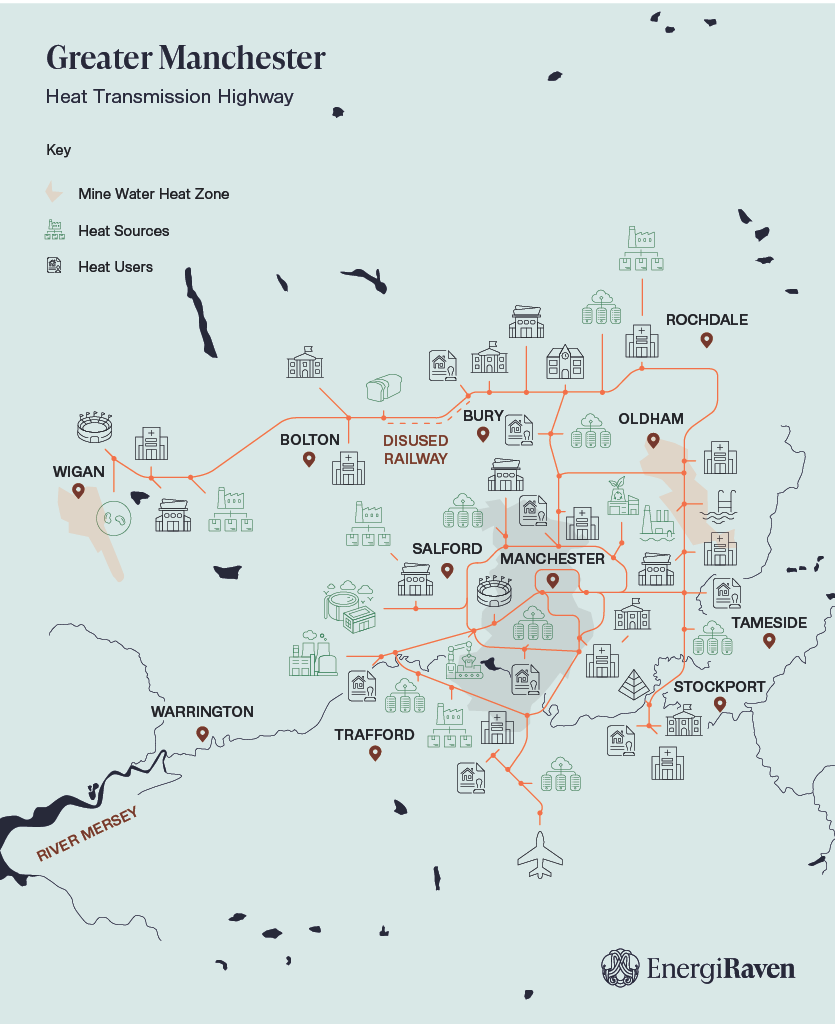
Carrington Power Station alone wastes around £24 million worth of heat each year. The planned data centers at Carrington and Heywood are expected to draw about 1.5 gigawatts of grid power between them, with almost all of that power ultimately rejected as heat. That’s enough heat to heat over 600,000 homes. Building energy-hungry infrastructure on this scale, without a serious plan to capture and use its waste heat, risks turning a huge opportunity into a huge oversight.
Based on a detailed study of heat sources and residential and commercial address data from the Ordnance Survey’s National Geographic Database (NGD), EnergiRaven has designed a Manchester Heat Highway: a regional backbone linking heat sources with heat demand across Greater Manchester. Heat would move from where it is wasted to where it is needed and stored when it is not. This is not speculative technology. It is a type of infrastructure already proven over decades in northern Europe and comparable in scale to the Copenhagen network.
Manchester industrialized heat once upon a time. Can do it again. With major development already underway across Greater Manchester, the choice is whether we continue to treat waste heat as an invisible by-product, or turn it into a long-term regional asset: lower bills, stronger local infrastructure and useful British heat serving British homes. Instead of large-scale heat pumps alone, using waste heat could save Greater Manchester more than £18 billion over a 20-year period in capital expenditure and energy generation.
A holistic approach
Local heating networks distribute warmth throughout our towns and cities. But instead of each small, disconnected grid producing expensive heat on the ground, district heating highways allow low-cost waste heat to be supplied as a service: harvested from the wider region and distributed to local grids where it’s needed most.
Once the backbone is in place, new resources can be connected over time. Regions become exporters of green heat while helping cities overcome one of the biggest barriers to cost-effective decarbonisation: access to affordable, scalable and renewable heating.
Electrification is essential, but not every heating problem needs to be pushed through the electricity system. In Greater Manchester, the analysis shows there is enough available waste heat to cover up to 85 per cent of heating demand, with only 15 per cent coming from electrification. By using excess heat in this way, heating highways can reduce the pressure on an already expensive network to build. The analysis also shows annual net savings of £2.4 billion across the wider electricity system, including half a billion in distribution savings. Fewer unnecessary poles, less unnecessary reinforcement and more infrastructure that does its job quietly underground should appeal across political lines.
This is where Britain can learn from Denmark: not because Denmark has avoided electricity overhead lines altogether, but because it has often taken a more joined-up approach to electricity, heating, storage and community benefit. This is not anti-electrification; it’s smarter electrification: using electricity where it’s best, heating where there’s heat, and storage where the system needs flexibility.
The policy steps are clear. Get ready to get heat from the big heat producers by default. Data centers, wastewater treatment works and major industrial areas are required to share useful heat where networks exist or are planned. Use regional heat zoning to connect the dots between heat sources and heat demand. Fund the backbone with long-term, low-interest, government-backed infrastructure financing. Heating highways need public interest management. The backbone must remain scalable, responsive and built to serve the region for generations.
The place does not lack useful heat; enough heat is wasted each year to heat every home. Britain lacks the hidden infrastructure to capture, store and share. Build that pillar and we can spend less, import less, strengthen regions, support industry and give families lower, more stable bills and confidence that the system is working for them.



