
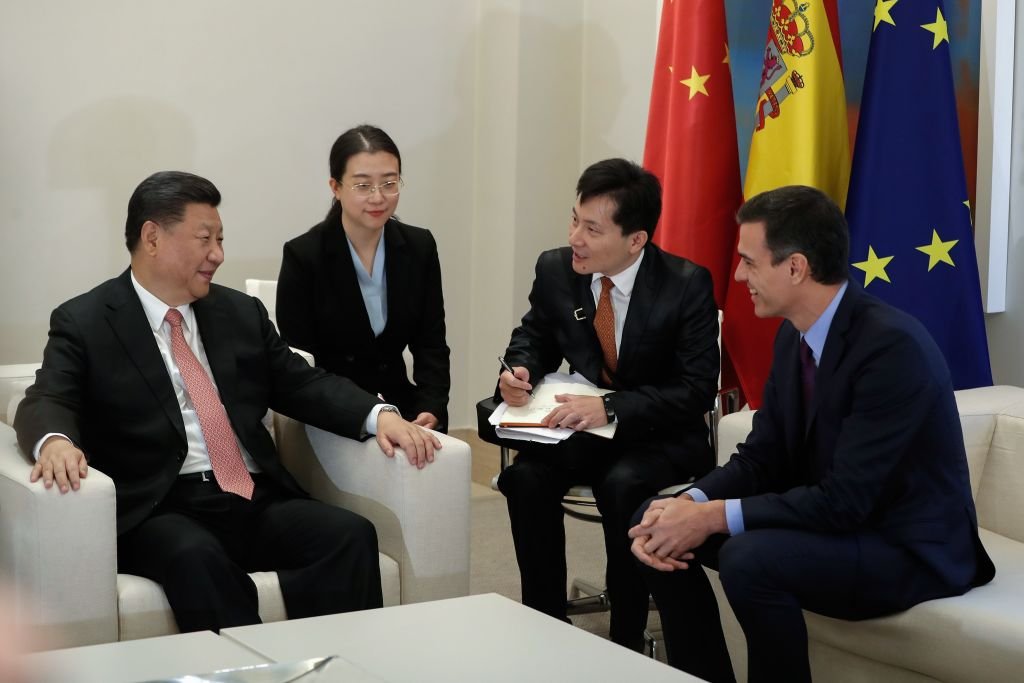

Ursula von der Leyen’s relations with China have been characterized by one confrontational and critical tonewith little to show for it. Spain’s Pedro Sánchez’s trip to China could be an important diplomatic reset and provide a model for communication practices more in line with Chinese tradition.
In recent years, senior EU officials have found themselves forced to highlight the glaring differences between our political systems when engaging with Chinese counterparts. However, their approach raises several questions: Do these statements serve to promote democracy in China? Is the public sphere the right place for such denunciations? Are they addressing the Chinese government or the Chinese people? Or are European politicians making these statements to attract media attention and appease their future European voters?
China’s population is finding the Western democratic model less and less attractive. After the US role in the Iraq War and now in the Iran war – along with many other situations that have weakened democracies around the world – EU protests about the lack of democracy or human rights violations in China they are perceived by a large part of the population as an insult. This is seen as a double standard and only serves to reinforce Chinese anti-Western nationalism.
People in China have a variety of political sensibilities. Some desire internal democratization of the Chinese Communist Party, while others see the need for a strong central authority. The Party’s legitimacy is rarely questioned and party cadres are highly educated – more so than many members of European democratic parties.
Moreover, China is a massive society that has been for centuries under the rule of a strong and centralized power. Many people prioritize stability and security over greater freedom, which can also have undesirable consequences. Most of the population would favor a rule of law that guarantees equality before the law and greater judicial independence from the Party, without implying direct elections for top political leaders, as China remains skeptical that democracy is a guarantee of better governance.
Given the size of China’s population and its importance on the world stage, what measures should EU officials take in their engagement with China?
Ways of communication are shaped by habits, customs and values that develop over centuries. European communication reflects practices dating back to the classical period of Athenian democracy (6th-4th centuries BC). Those who wanted to gain or maintain power were the ones who spoke, trying to convince their audience with their principles and arguments.
The tradition of European political communication unfolds in a public arena, with open demonstrations and monologues. In contrast, traditional Chinese communication has developed in private settings, in the form of dialogue, and with a small number of participants.
Spain pulls back on China, risking clashes with Trump – and the Europeans
MADRID – Pedro Sánchez travels to China for the fourth time in three years to…
4 minutes

While direct speech is valued in Europe, indirect speech is highly valued in China. The goal is not to convince a subordinate, but an equal or a superior. For this reason, direct language is considered an indicator of a lack of culture and good manners.
To express an opinion that differs from that of the interlocutor, you must find ways to elegantly express the disagreement, to the point of gaining the sympathy of the person you want to contradict. In addition, indirect speech requires leaving nothing to chance and paying attention to every detail in the communication process.
Does this mean that human rights or the rule of law should not be discussed with China? Of course not, but a greater understanding of its communication traditions is essential. For words to have any effect, discussions must take place in a cordial atmosphere, away from cameras and microphones. Unproductive public statements should be avoided in favor of engaging in more productive discussions.
Taciana Fisac is a professor of Chinese language and literature at the Autonomous University of Madrid (Spain). She traveled to China for the first time in 1978 and has been closely following China’s developments ever since.



