
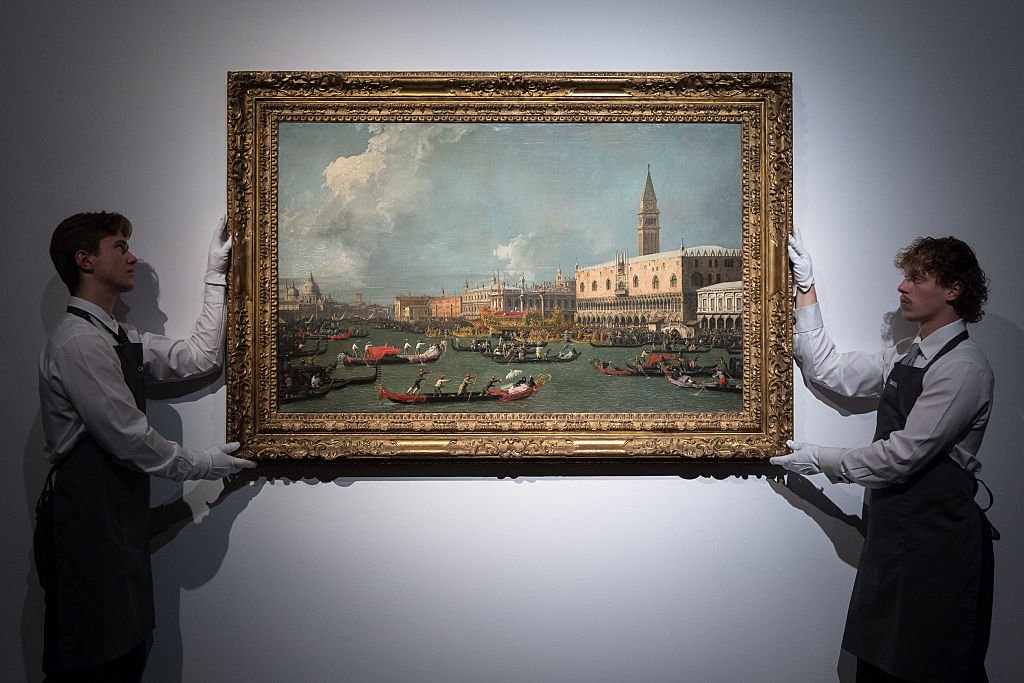


Imagine examining an auction catalog description that read, “Old painting, looks Dutch (or something).” But describe the same picture as a “Follower of Rembrandt” or “In the manner of Rembrandt” and the buyer’s interest is piqued. Maybe it’s an unknown Rembrandt, or as close to a Rembrandt as you’ll ever get. “The name of an important artist still excites people, even if a work may not be by that artist.” Monica Brownmanaging director of fine art at of Freeman The auction house, the Observer said.
In a 2025 sale by Freeman of Old Masters and 19th-century art, a painting, View of Bacino with Bucintoro and Gondolas attributed as “The manner of Canalettoit realized $25,600, well over its estimate of $4,000-$6,000. Canaletto was a highly regarded Venetian painter whose canvas around 1732 Venice, Bucintoro’s Return on Ascension Day set an auction record for the artist in July last year in Christie’searning $43.9 million—but how do you rate a photo that just looks like his work? In the same auction was another painting, The Grand Canal looking south from the Molo with a view of Santa Maria della Saluteattributed to a “Follower of Canaletto,” which also sold for $25,600. One might guess that the same person bought both pictures, perhaps hoping to arrive at a more accurate attribution for a work that, if it turned out to be a genuine Canaletto, could also be worth tens of millions of dollars. It would be like buying a scratch-off ticket at the gas station that turned out to be a Mega Millions winning ticket.
According to Richard Wrightpartner and CEO of the Rago/Wright auction house conglomerate. “Really, it’s a way of saying ‘We really don’t know.'” This terminology of ignorance has its own hierarchy, as explained in The Official Sotheby’s Glossary. Works of art that cannot be fully authenticated are placed on a sliding scale of information and confidence:
1 GIOVANNI BELLINI In our opinion a work of the artist. (When the artist’s name(s) are unknown, a series of asterisks, followed by the artist’s last name, whether preceded by an initial or not, indicates that in our opinion the work is by the named artist.
2 Attributed to GIOVANNI BELLINI In our opinion, possibly a work by the artist, but less certainty as to authorship is expressed than in the previous category.
3 STUDIO OF GIOVANNI BELLINI In our opinion a work by an unknown hand in the artist’s studio which may or may not have been executed under the direction of the artist.
4 THE CIRCLE OF GIOVANNI BELLINI In our opinion a work by an as yet unidentified but distinct hand, closely related to the artist mentioned, but not necessarily to his pupil.
5 THE STYLE OF…………; Follower of GIOVANNI BELLINI In our opinion a work by a painter working in the artist’s style, contemporary or near contemporary, but not necessarily his pupil.
6 THE MANNER OF GIOVANNI BELLINI In our opinion a work in the style of the artist and of a later time.
7 BY GIOVANNI BELLINI In our opinion a copy of a well-known work by the artist.
Only the first designation, “By Giovanni Bellini“is both art-historical and legal. In the first place, attribution is proven by the documentation of a particular painting – known as provenance, ensuring a chain of ownership from the artist’s studio to the consignor nowadays—and/or the opinion of recognized experts in the artist’s work, such as academic or independent researchers.
“A consignor brings in a Giacometti and we send photographs of it and any documentation to Paris to prove it,” Wright explained. Paris here refers to the Giacometti Foundation, based in France, which has an authentication committee that verifies the authenticity of Swiss-born paintings, sculptures, drawings and objects of decorative art. Alberto Giacometti. “Otherwise, we need the sales data.”
He added that the auction houses he oversees have research teams that ask experts or, in the absence of known experts, dealers in particular artists’ works for their opinions. Often, these opinions are provided free of charge, but sometimes experts ask for a fee, usually between $150 and $5,000. If a payment is required, “there’s usually a negotiation with the consignor as to who pays. It’s usually the consignor,” although the cost can be shared if the work is proven to be by the particular artist. “If the piece is proven, it will usually sell.”
Without full attribution, a work represents a gamble for both the auction house and consignor and buyer. According to Wright, a work attributed to Giacometti can sell for $100,000, while one attributed to the artist alone can be valued at $2,000-$3,000.
Marianne BerandiEuropean art director at Heritage auctionstold the Observer that the cost to the consignor is usually lower if the experts contacted are willing to offer opinions based on photographs of an artwork. However, “many artists’ foundations, especially those in France, want to see the original, which requires sending the work” abroad, adding significantly to the cost of authentication.
Claiming that a particular piece of art is “by” a specific artist is ultimately a matter of law—a warranty—since the Uniform Commercial Code in all 50 states requires that items be what the seller claims they are, or the seller—in this case, the auction house, though it could be an art gallery—is obligated to take that money and refund it. Artwork attributed to… or “Studio of…” or “Circle of…” or anything else has no similar protection.
Auction houses regularly deal with works of art whose consignors claim to be by well-known artists, and in many cases, these consignors are given spam. At the same Freeman sale, a consignor claimed the painting A Capriccio with figures gathered around the Obelisk of Augustus, a view of the Pantheon, the Statue of Marcus Aurelius and the Temple of the Sybil, Tivoli was from Giovanni Paolo Paniniand “we showed it to some specialists who said it was by Panini and others who said they couldn’t be sure, but it might be the ‘School of Panini,'” Brown said. “It was inconclusive, so we attributed it to ‘Giovanni Paolo Panini and Studio.'” The painting sold for $76,700, well below the $100,000-$150,000 estimate — the art market’s way of saying ‘Maybe, maybe not.’
Informing consignors that their works have not been authenticated by the artists they claim can be burdensome. “Some consignors take their works back, perhaps to try their luck at another auction house,” she said. “However, if the rating doesn’t change based on the attribute, shippers are usually happy and let us sell it.”
Then there are works of art that are only partially by the artist. John Constablesaid Berandi, painted numerous portraits during his career and had a studio of apprentice artists assisting him. “You wouldn’t expect Constable to paint every square inch of those portraits, but you can make out some areas that clearly look like Constable’s hand.” In those cases, the artwork would be attributed to “John Constable and Studio”.
Buyers of works of art with uncertain attribution vary in their motivations. Some winning bidders are dealers of particular artists, or collectors looking for treasures, willing to do some research to prove the art is authentic. “Some buyers seem to have more information than we do,” Wright said. “They’re not just buying a lottery ticket.” He showed a work in a 2021 sale at Rago Auctions identified as by an “Unknown Artist” titled Infanta Margarita Teresa of Spain. It resembled Diego Velázquez paintings and was estimated at $2,000-$3,000, but sold for $27,500. Perhaps in the future, it will appear in a major auction house as a Velázquez with a multi-million dollar estimate. Similarly, someone gambled on a painting of feathered creatures in Freeman’s Nov. 4 sale, which was untitled and attributed to a “Follower of Melchior de Hondecoeter (1636-1695) | It is attributed to Philips van Kouwenberg (1671-1729),” when it fetched $89,400 against an estimate of $15,000-20,000.
Part of the Old Masters dealer’s job is to find rare or underpriced works by well-known artists, doing to artwork what hedge fund traders do to securities. One of the most prominent examples of a misattribution occurred in 2006 when Sotheby’s London sold a painting titled The Cardsharpslabeled in the catalog as by a follower of the Italian Baroque artist Caravaggiofor £42,000; it was later reattributed as a genuine Caravaggio, prompting a lawsuit. The auction house had consulted with Caravaggio experts, who claimed that the consigned painting was a copy of another exhibited at the Kimbell Art Museum in Fort Worth, Texas. The consignor claimed the auction house had been negligent, but in early 2015, London’s High Court ruled that Sotheby’s “reasonably came to the view that the quality of the painting was not high enough to indicate that it could be by Caravaggio”.
But some buyers simply like the look of a particular piece of art, believing it will suit the overall decor of their home or fit well into an existing art collection. Berandi said interior decorators often “explain” works in the “Way of…” and “Style of…” categories that suit their clients’ tastes. If the bid price isn’t that high, there’s no real harm in buying it, and “you can get a lot of paintings for your money.”
More knowledge about the art market



