
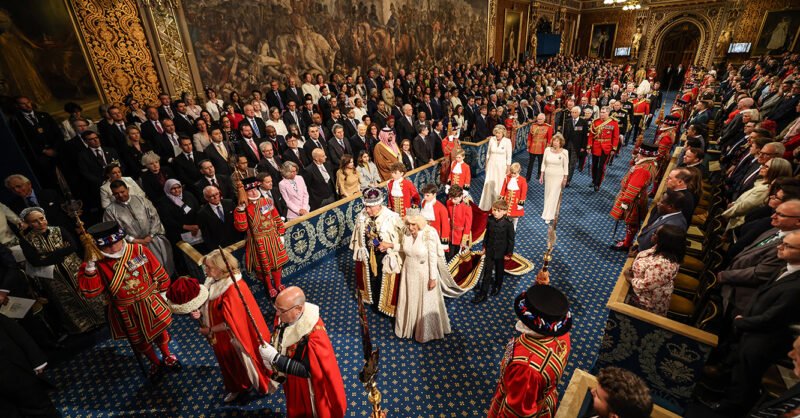

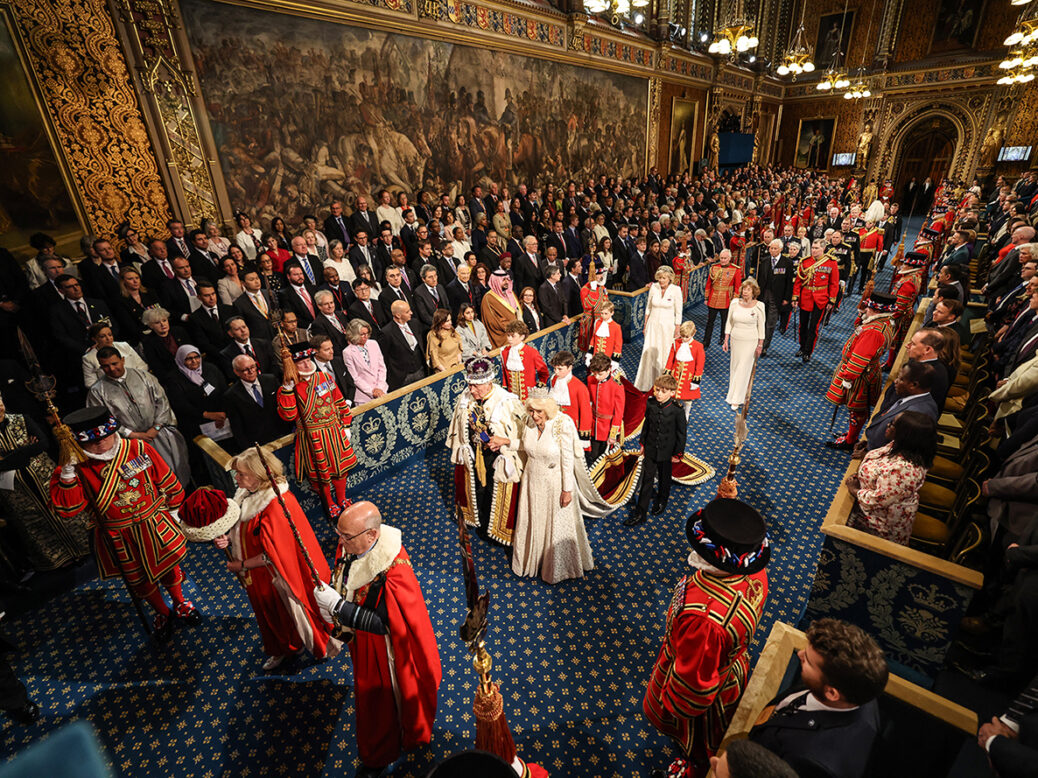
Under normal circumstances, the state opening of parliament would be a blockbuster event on the political calendar. But these are not normal circumstances. The King’s speech gave the government a moment of calm in a week in which the Prime Minister looked more vulnerable than ever. By Tuesday evening (12 May) almost 90 MPs had called on him to resign, including four junior ministers. Buckingham Palace has even reportedly asked Number 10 if they would like to delay, due to the events. But the King’s Speech went ahead, giving Keir Starmer’s government the opportunity to set out the policy agenda it intends to pursue in this upcoming, newly opened session of parliament.
Sitting on his throne in the House of Lords, King Charles began his third King’s Speech (the second under Starmer) by warning of a “dangerous and unstable world”. Highlighting the war in the Middle East, the King said the government will introduce legislation heavily focused on measures to protect national security through increased defense spending and measures to improve energy security and housing.
It was the government’s first opportunity to respond directly to voters after a damaging set of local election results. However, there were few surprises. Among the 37 bills announced today were promises to abolish NHS England, give the UK energy independence, a pledge to introduce the Hillsborough Act and end the tenancy system in England and Wales. The speech hinted at the return of previous controversies: legislation to reform the jury trial system, the introduction of digital identity cards and plans to make it harder for immigrants to obtain residency status will all return to the Commons. After the events of recent weeks, it is unlikely that the government will find it any easier to overcome these measures to get over its disgruntled supporters.
Following Starmer’s pledge on Monday to take another look at the UK’s relationship with the EU, the King’s Speech included a bill that will lay the groundwork to enact more European regulations. Education Secretary Bridget Phillipson’s work on reforms to special education provision will also continue as planned, as will the government’s promises to reform Right to Buy. The government’s pledge to increase defense spending was included, as well as a promise to continue promoting the “two-state solution in Israel and Palestine”. And Ed Miliband’s work on clean energy and energy security will be strengthened by an energy independence bill.

Subscribe to the New Statesman today and save 75%
Starmer had hoped to use the moment as another reset for his beleaguered administration. It was quickly eclipsed by Wes Streeting. Soon after the king finished speaking, reports emerged that Streeting will resign immediately from the cabinet to announce his long-awaited leadership bid. The Health Secretary met the Prime Minister this morning in Downing Street, possibly in an attempt to ease tensions. (It obviously failed. The meeting lasted only 16 minutes.)
But that was not the only reason this speech failed to usher in a new era for this government. In a speech on Monday, Starmer told an assembled group of Labor campaigners and lobbying journalists that “Incremental change won’t cut it”. However, much of the legislation announced in the King’s Speech today appears to be just that – a continuation of work the government was already doing. However, Westminster’s eyes are unlikely to be on the fallout from this latest iteration of the Starmer project. They’re watching Wes Streeting instead.
(Further reading: Within two dramatic days that almost brought down Keir Starmer)
Content from our partners



