
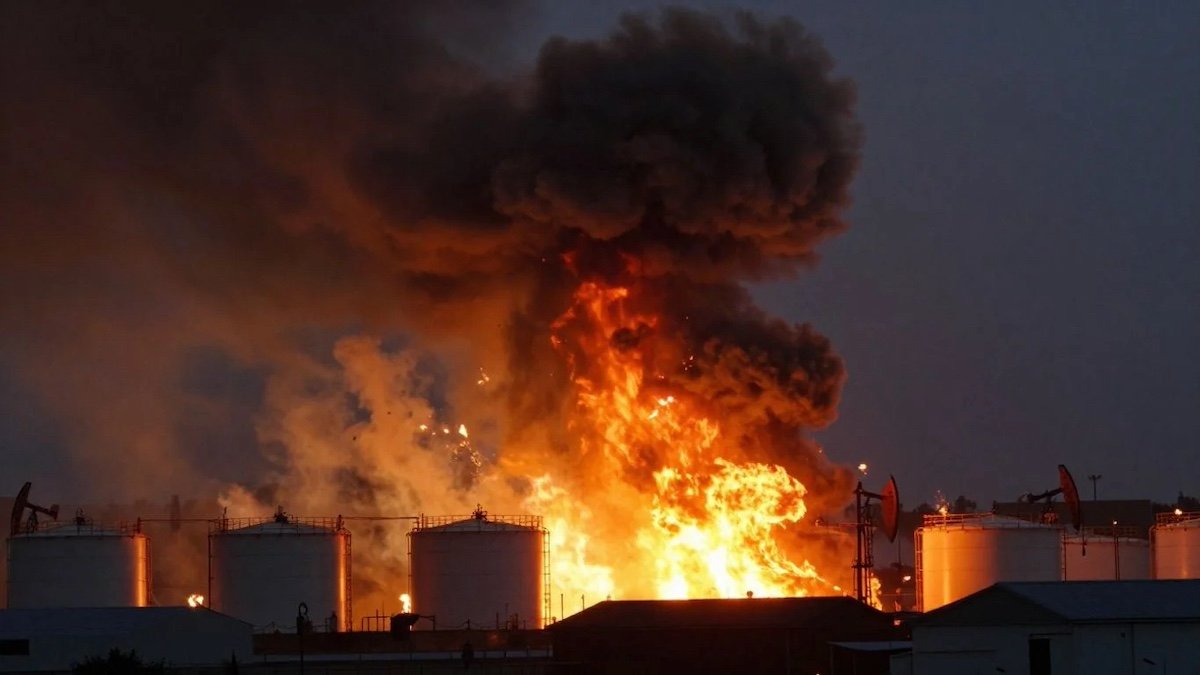

Residents of the Iranian capital Tehran woke up to an apocalyptic scene on Sunday after the United States and Israel bombed the city’s oil storage facilities. or high pillar fire appeared as a result, toxic smoke covered the sun AND black rain fell in this city of about 10 million people.
Only the environmental consequences could push Tehran to breaking point – it is already struggling with one severe lack of water which earlier led President Masoud Pezeshkian to consider ordering an evacuation.
This may be exactly what the US and Israel want, however, to put maximum pressure on Iran unconditional surrenderas Trump recently requested. Bombing critical infrastructure such as oil storage facilities will make it significantly more difficult for the authorities to maintain daily life in Tehran.
Meanwhile, strike at the police stationwhich have also been reported, will make the city less safe. Therefore, many residents may leave soon, depopulating the capital.
Even if Iran still does not surrender unconditionally, the optics of the US and Israel striking its capital may be presented to their respective publics as further proof that they are winning. warboosting morale at home amid lingering questions about the endgame.
The rapid displacement of even a significant portion of Tehran’s population would also exacerbate the country’s deepening humanitarian crisis, placing serious stress on its security services, especially if the displaced begin to riot in desperation.
It was one thing for them to use lethal force against an unspecified number of anti-government rebels — whom the authorities claimed were linked to terrorist groups and foreign intelligence agencies — as they rampaged through Tehran in January, and quite another to use lethal force against starving citizens rioting in displacement camps.
Such footage could widen speculative divisions between the government and security services, including the Islamic Revolutionary Guard Corps (IRGC) and allied militias, drastically eroding pro-government sentiment among the wider population.
Iran may still not surrender unconditionally, however, in which case the US and Israel could expand their campaign of collective punishment to other major Iranian metropolises after testing it in Tehran, continuing until they get what they want.
Whether they will do so is debatable, but what is happening in Tehran is an indisputable expansion of the conflict from purely military to semi-military targets in ways that seriously endanger civilians.
To be clear, energy and other critical infrastructure are legitimate targets, as Russia has argued in defense of its strikes against Ukraine’s power grid over the past four years, but the deliberate destruction of oil storage facilities near densely populated areas is morally questionable at best.
Under the guise of depriving the armed forces of the fuel they need to continue fighting, the US and Israel are posing credible threats to civilians, even if those threats remain environmental for now.
If this does not lead to Iran’s unconditional surrender, it cannot be ruled out that the US and/or Israel could systematically target civilians under the pretext of what CENTCOM posted on social media – that Iran “is using heavily populated civilian areas to conduct military operations…This dangerous decision endangers the lives of all civilians in Iran, as locations used for military purposes lose their protected status and can become legitimate military targets under international law.”
The war could get much uglier.
it ITEM was first published on Andrew Korybko’s Substack and is republished here with editing for clarity, fluency, and updates on Trump’s response on Friday. Become a subscriber to Andrew Korybko’s newsletter here.



