

China and the United States are expanding their rivalry beyond artificial intelligence and space into fusion energy, widely seen as a virtually limitless, carbon-free energy source. Both are racing to build domestic capabilities by securing supply chains for future reactors.
To advance, Washington and Beijing are turning to Europe, whose expertise in superconducting magnets, lasers, robotics and tokamaks is critical to scaling fusion projects from research to deployment. Tokamaks are donut-shaped chambers that use magnetic fields to confine superheated plasma.
But experts are divided. Some urge Europe to join the US in preventing China from securing a potentially limitless source of energy that could reshape the global order, while others argue that the complexities of fusion require broad international cooperation, including China.
Laban Coblenz, chief strategic advisor of the International Thermonuclear Experimental Reactor (ITER), is a proponent of international partnerships in the development of fusion energy.
“China has the ability to build the Hualong-1 reactor in five years for $5 billion, while the US and Europe build theirs over budget,” Coblenz told Asia Times in an interview in London. “What’s different? It turned out there were 140 French companies involved in the Chinese supply chain.”
“I hope that when Trump and Xi meet next month, some of the barriers will start to fall and we will start to see how things can be complementary instead of competitive,” he said, referring to barriers as challenges in a contract negotiation between ITER and US firms.

China began construction of the Hualong-1 fission reactor in Zhangzhou, Fujian, in 2015 and completed it in 2020. It is the country’s first third-generation fission reactor, offering significantly higher safety levels than a second-generation reactor. The country began construction of the Hualong-2 reactor in 2024 and is expected to complete it in four years.
US President Donald Trump plans to visit China and meet with Chinese President Xi Jinping on May 13 and 14. Trade issues, geopolitical conflicts and technology export controls are expected to be among the main items on the agenda of their meeting.
In a speech at Fusion Fest, hosted by Economist Impact, on April 14, Coblentz described how US Senator Joe Manchin, who has publicly criticized Chinese scientists for allegedly stealing intellectual property from US labs, expressed strong support for the ITER project after visiting its assembly hall in southern France in 2022.
Coblentz quoted Manchin as saying that he saw, for the first time in years, a “light at the end of the tunnel” and even the possibility of world peace, arguing that many past conflicts had been driven by access to energy and alliances. Manchin made the comments at a meeting with 30 US staff members at ITER.
Coblenz recalled Manchin pointing to the mix of languages spoken in the country, including Mandarin, French, Italian, English and Russian, as evidence that if the merger succeeds, it could fundamentally reshape geopolitics.
From concept to megaproject
The ITER project dates back to 1986, when Euratom, Japan, the Soviet Union and the US agreed to jointly design a large international fusion facility. Work on the concept began in 1988, with members approving the final design in 2001, laying the foundations for one of the world’s most ambitious scientific collaborations.
Construction began in 2013 with a budget of 6 billion euros ($6.8 billion), but costs have risen sharply. ITER puts the total at around €22 billion in 2021, while the US Department of Energy expects total costs could reach $65 billion by 2039 when full fusion operations are targeted.
The European Union is set to finance around 45.6% of the project, while China, India, Japan, South Korea, Russia and the US will each contribute around 9.1%.
However, some US thaw experts warn that the West risks falling behind China, which has close ties to US adversaries such as Russia, Iran and North Korea.
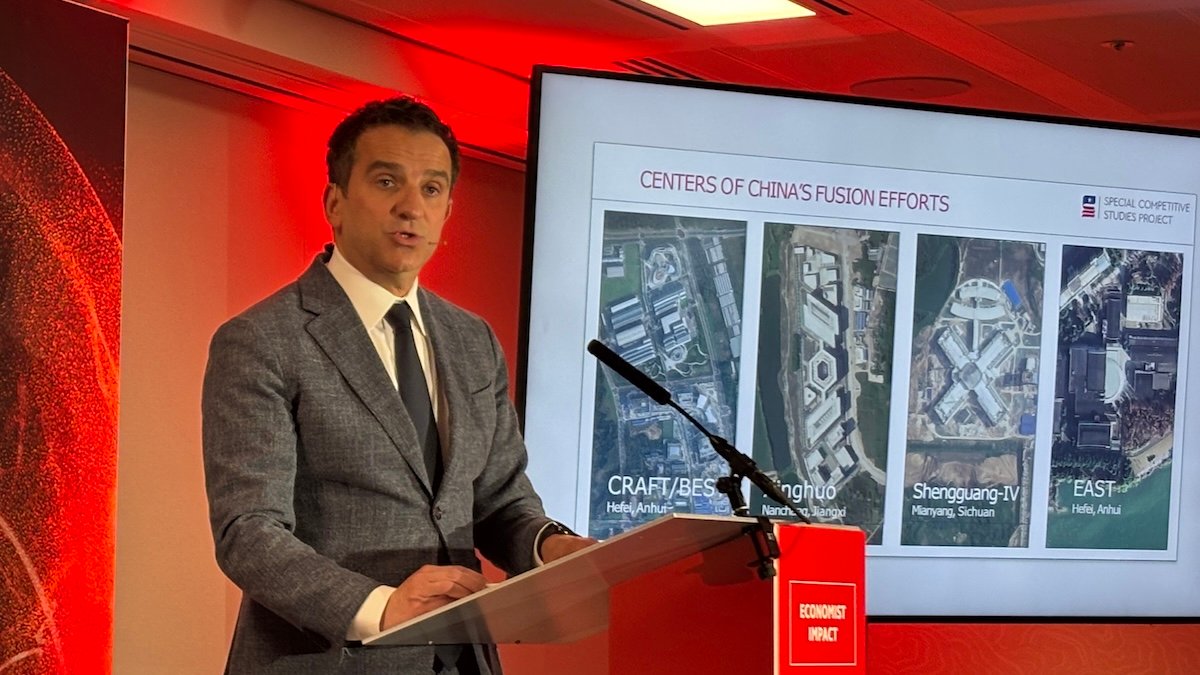
Ylli Bajraktari, president and chief executive officer of the Special Competitiveness Studies Project (SCSP), a nonpartisan US think tank, delivered a speech titled “What if China Wins the Meltdown Race?” at the same event, warning that the West risks repeating past mistakes in new energy industries.
“China didn’t make the scientific breakthroughs that brought the first electric vehicles, solar panels or 5G towers to market. They focused on subsidies and scaling up production, and it paid off,” he said. “China is not building solar panels because they want to reach net zero. They are selling solar panels at a loss to take on the world’s debt.”
He said the same situation will happen in the fusion energy sector if the US and the EU do not move quickly and together.
“China’s recent spending puts our nation to shame. They have spent $6.5 billion on fusion infrastructure since the Lawrence Livermore National Ignition Plant first produced power three years ago. Less conservative estimates put the number at $10 billion or even $13 billion,” he added.
Bajraktari highlighted four major projects that support China’s unification push:
- The China Fusion Engineering Test Reactor (CRAFT) and Plasma Burning Experimental Superconducting Tokamak (BEST) in Hefei, Anhui, a large integrated research campus and next-generation tokamak designed to transition from component testing to demonstrating net fusion power and electricity generation this decade.
- Xinghuo (Chinese for spark) in Nanchang, Jiangxi, a fission fusion hybrid reactor targeting about 100 megawatts of output in the early 2030s.
- Shengguang-IV in Mianyang, Sichuan, a large-scale laser melting facility estimated to be significantly larger than the US National Ignition Facility and aimed at advancing inertial melting of insulation.
- Experimental Advanced Superconducting Tokamak (EAST) in Hefei, Anhui, a long-term experimental tokamak that continues to set global records and anchors China’s fusion research program.
He said China is also investing heavily in its supply chain, scaling up production of high-temperature superconductors for fusion magnets, strengthening control over critical materials such as gallium and germanium, securing access to copper and other resources through overseas investment, and building capabilities in precision manufacturing and advanced components.
“Control of the supply chain is an existential threat to the energy future of the West,” he said. “We will not go out of China, China. For the West to win, we must cooperate.”
He said Western allies could combine their forces to compete more effectively, with the UK leading the way in magnetic isolation and radiation-resistant robotics; US in inertial confinement, beryllium supply and venture-backed innovation; Germany in laser technologies; and Japan in high-quality superconductors.
“The time has passed for treating fusion power as a scientific project. It is no longer a curiosity. We must take it as seriously as China does. It is a matter of national infrastructure that we simply must build,” he said.
Self-sufficiency
In general, fusion research is progressing along two main paths: magnetic confinement fusion (MCF) and inertial confinement fusion (ICF).
MCF, the most established approach, includes designs such as tokamaks, which use powerful magnetic fields in a donut-shaped chamber to confine and heat the plasma, and stellarators, which rely on complex twisted coils to achieve greater plasma stability.
ICF, on the other hand, uses high-energy lasers or particle beams to compress and heat fuel pellets to cause fusion, an approach followed at facilities such as the US National Ignition Facility.
China’s state-owned enterprises are pursuing a broad portfolio in these approaches, with projects including tokamaks, stellarators and ICF-type systems.
Among its projects, the EAST project in Hefei, often called the “artificial sun”, has attracted the most attention after it kept plasma at 100 million degrees Celsius for 1,066 seconds in January 2025. The program largely mirrors work at France’s WEST (Environment Tungsten in Environmental Sustainability), and relies on testing steady-state components. support ITER.
Through the ITER project, China is not only absorbing European tokamak technology, but is also emerging as a major supplier to the program. In April 2025, China shipped super-large key components for the ITER tokamak magnet supply system to southern France.
In contrast, the US Department of Energy is supporting a more market-driven model, funding private firms such as Commonwealth Fusion Systems for tokamak development, Type One Energy Group for stellar, and Xcimer Energy for laser-based fusion.

Jennifer Arrigo, senior adviser for fusion energy sciences at the US Department of Energy, said China is a major player, but stressed that the West’s strength lies in public-private cooperation.
“China is one of the big players in the room. But if you look at the US and what’s happening across Europe, the private sector in partnership with governments is just as powerful,” she said. “It’s critical that we support our industry and lead in international cooperation. That’s how we win the fusion race, making sure it remains a global effort with the U.S. at the center of that effort.”
In a question-and-answer session, Arrigo told Asia Times that a key element of the U.S The Guide to Fusion Science and Technologylaunched last October, is to build a domestic and allied supply chain. She said the Department of Energy is working with companies in fusion-related industries, supporting spin-outs and industrial capacity, with the goal of reducing dependence on Chinese parts, components and services and providing alternative sources throughout the US and its partners.
Last month, Duan Xuru, chief fusion energy scientist at the China National Nuclear Corporation, said The global commercialization of fusion is accelerating. Based on China’s current technology trajectory, he said the country aims to complete its first engineering test reactor around 2035 and a commercial demonstration reactor by 2045, reflecting what he described as a phased and pragmatic strategy to reduce technical risks and steadily advance toward commercialization.
Read: China aims to build world’s first fusion reactor by 2031
Follow Jeff Pao at X at @jeffpao3



