
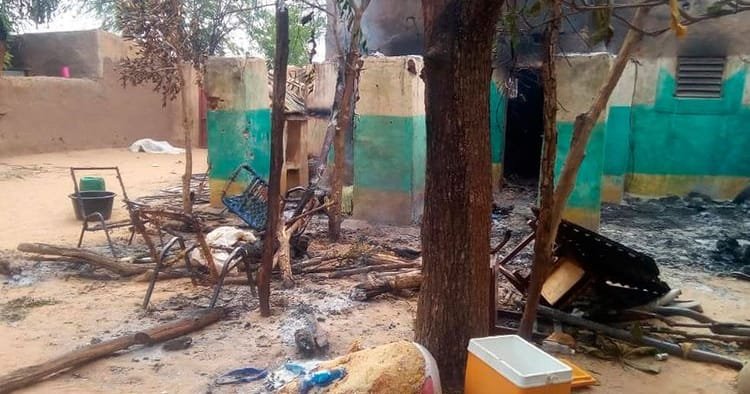

Two attacks in central Mali claimed by al-Qaeda-linked militants have killed more than 30 people, local security and administrative sources told AFP on Thursday.
The two attacks came less than a fortnight after a wide-ranging, coordinated offensive by militants and separatists on junta positions plunged the West African country into a new security crisis.
Almost simultaneous attacks
“At least 35 people were killed on Wednesday in simultaneous attacks” in the villages of Korikori and Gomossogou, a youth official said.
A security source and an administrative source both reported more than 30 dead in the attacks, claimed by the Islamic and Muslim Support Group (JNIM).
WAMAPS, a group of West African journalists specializing in Sahel security, said the provisional toll was more than 50 villagers killed and some still missing.
“Villages have been looted and some properties have been burned,” the group added.
The security source said Thursday’s attacks were in retaliation for acts committed by Dan In Ambassagou militia, the most popular self-defense groups formed by local communities in response to the attacks that plague central Mali.
“The victims are mostly militia. But there are also teenagers and children,” the source told AFP.
Army operations
It consists mainly of traditional ethnic groups Long hunters, Dan Nan Ambassagou has refused an order to disperse from authorities, who accused the militia of a massacre in the central village of Ogossagou that left 160 dead.
Mali’s army said on Thursday it had carried out “a targeted operation against armed terrorist groups” in the area and about a dozen fighters were “neutralised”.
He did not provide further details.
In a statement on Thursday, the governor of the Bandiagara region “condemned these heinous and inhumane acts in the strongest possible terms”.
The central violence of Mali
The devastating attacks on April 25 and 26 by JNIM and the Azawad Liberation Front (FLA), an ethnic Tuareg separatist movement, targeted strategic towns including Kidal in the northern desert and Kati, a garrison town near the capital Bamako.
Defense Minister Sadio Camara, the 47-year-old architect of Mali’s military alliance with Russia, was killed by a car bomb at his residence.
Kidal and other towns and villages in the north were captured and are now under the control of the FLA and the militants, who have since imposed a blockade on Bamako.
In recent years, central Mali has also been the theater of deadly violence.
Following the 2019 massacre, Ogossagou was the scene of a February 2020 raid that killed around 30 Fulanis, a nomadic people often accused across the Sahel of aiding militants.
The UN has accused Mali’s army and allied foreign fighters – possibly Russian mercenaries from the Wagner paramilitary group – of executing at least 500 people in March 2022 during an anti-militant operation in the town of Moura, a claim the Malian junta has denied.
And in June of that year, more than 130 civilians were killed in the town of Diallassagou in attacks attributed to JNIM militants.
Wave of arrests, kidnappings
On Wednesday, security, legal and family sources told AFP that several opposition figures and military personnel had been arrested or kidnapped following large-scale attacks on the junta.
The military prosecutor’s office said last week it had “strong evidence” of the “complicity” of some members of the military, accusing them of helping to “plan, coordinate and execute” the attacks.
But a political official said the spate of arrests and kidnappings was a witch hunt.
“Everything suggests that these events are being used as an opportunity to carry out a purge within the political opposition and the military,” the official told AFP, requesting anonymity for security reasons.
Since 2012, Mali has faced a deep security crisis fueled in particular by violence from fighters linked to al-Qaeda and the Islamic State group, as well as local criminal gangs and pro-independence groups.
On April 30, JNIM called for a “united front” to “end the junta” and initiate a peaceful and inclusive transition. The country has been under military rule since the coups in 2020.



