
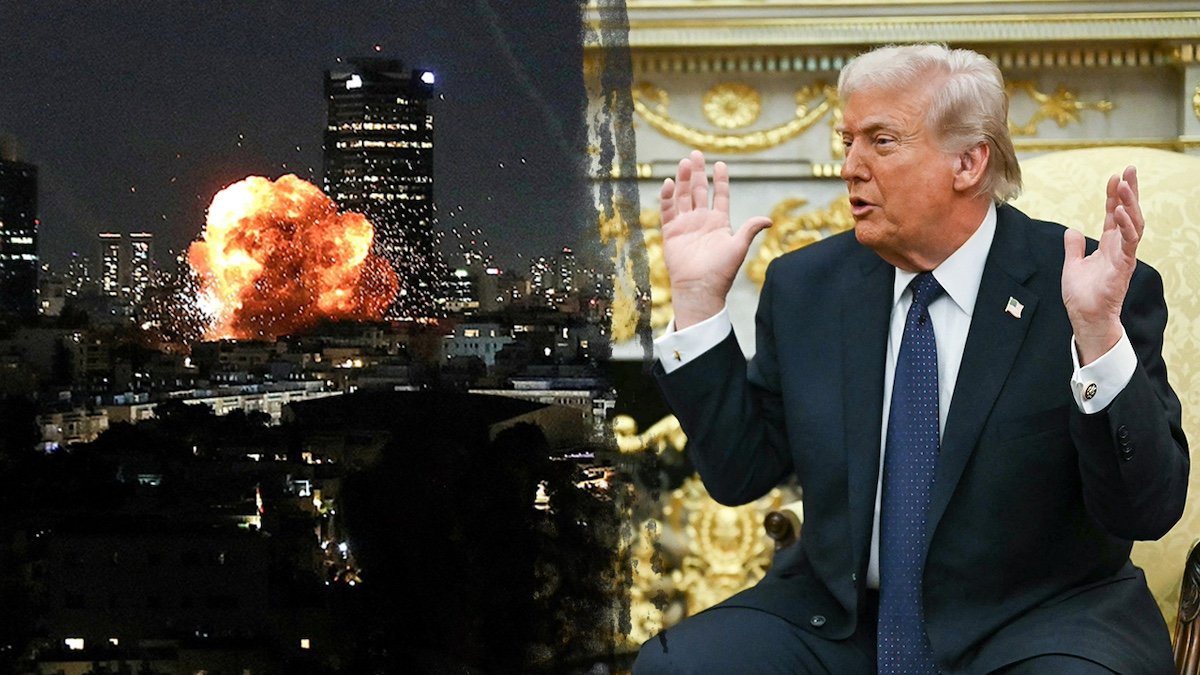

Trump chose to believe Netanyahu. In announcing the US-Israeli attack, Trump told the Iranians that this was their chance to take back their country. To win the war on Trump’s terms, the Iranian theocracy needed only to survive.
The attack killed Iran’s supreme leader and senior members of the government. But immediately, the snake grew another head—the son of the Supreme Leader, Mojtaba Khamenei, who had lost his wife and teenage son in the bombing.
The new leader is known for deep and long ties to the Iranian Revolutionary Guard Corps (IRGC) security outfit. His appointment signaled a transition to a more militarized, hardline and anti-Western regime.
Trump calls this “regime change.” By his own definition, Admiral Karl Donitz succeeds Adolf Hitler as head of the German state near the end of the Second World War, he also constituted regime change.
Iran’s theocracy survived in an even more militant form.
Score: Iran 1, Trump 0
“Contain Iran”
Trump boasted that war would curb Iran’s ability to project power:
“We are systematically dismantling the regime’s ability to threaten America or project power beyond their borders,” he said.
Trump then described the destruction of Iran’s navy, air force, missile facilities and defense industrial base. These were tactical successes, but the war itself has been a strategic failure.
Iran’s response included attacks on neighboring countries. Even more disturbingly, it discovered and deployed a powerful new weapon: the blockade of the Strait of Hormuz. Despite its decimated navy, Iran now has a stranglehold on the global economy.
Netanyahu had insured Trump that the regime would be so weakened by the US-Israeli attack that it would not be able to block the waterway through which a fifth of the world oil it flowed.
Chairman of the Joint Chiefs of Staff, Dan Caine, noted the great difficulty of securing the strait and the dangers of its blockade by Iran. But Trump dismissed that possibility on the assumption that the regime would capitulate before that happened.
With the price of oil skyrocketing, Trump has created a new problem for the entire world and a powerful lever for Iran.
Score: Iran 2, Trump 0
“No nuclear weapons”
In his June 2025 attack on Iran, Trump ALLEGED to have “deleted” its nuclear facilities. Defense Secretary Pete Hegseth went further, saying that not only were the facilities destroyed, but so were Iran’s nuclear ambitions.
Trump then made repeated victory laps over the mission:
- “It knocked out all of their potential nuclear capability.” (July 16)
- “It’s gone.” (July 31)
- “We wiped out… Iran’s future nuclear capability.” (August 18)
- “But I also destroyed Iran’s nuclear hopes by completely destroying its enriched uranium.” (September 20)
- “Well, they don’t have a nuclear program. It disappeared.” (October 13)
- “…completely obliterated Iran’s nuclear capability.” (November 11)
- “It was called Iran and its nuclear capability and we wiped it out very quickly, powerfully and powerfully.” (November 19)
- “We wiped out their nuclear capability.” (December 11)
- “We eliminated Iran’s nuclear threat and it’s gone.” (January 8)
- “…wiped out Iran’s nuclear enrichment capability.” (January 20)
- “…achieving the total elimination of Iran’s potential nuclear capability – completely eliminated.” (February 13)
In defense of starting war on February 28, 2026, Trump RECEIVED that Iran’s nuclear program was not gone after all. Rather, the country was now “on the doorstep” of having a nuclear bomb. Trump doesn’t even have a strategy for solving this problem.
Trump’s tactics – bombing – will not work. Knowledgeable experts BELIEVE that a key Iranian nuclear facility is Mount Kazma, where some of its uranium may be stored. This facility is so far underground that even America’s 30,000 pound bunker-busting bombs cannot reach its inner chamber.
Trump talks about “getting in” and getting out nuclear material. But a ground operation to retrieve the material or destroy the facility would carry immense risk to those attempting it, while ensuring, at best, an uncertain outcome.
The threat of a nuclear Iran remains.
Score: Iran 3, Trump 0
False claims of victory fail
Trump’s mistake is not working with Iranian leaders.
His threats to commit war crimes dominate news cycles, but they merely reveal to Iran Trump’s desperation to extricate himself from the mess he created. As a negotiating strategy, it is counterproductive.
Trump’s constant bragging about tactical victories against Iran’s military ignores the underlying strategic fact that Trump has lost the Iran war. If a deal emerges from discussions between Iran’s seasoned negotiators and Trump’s collection of cronies, America and the world will pay a heavy price for a long time.
Steven J. Harper is an attorney, adjunct professor at Northwestern University School of Law, and author of several books, including The Hoffa Pass – The Story of a Team and The Lawyer Bubble – A Profession in Crisis. He has been a regular columnist for Moyers on Democracy, Dan Rather’s News and Guts, and The American Lawyer. Follow him at https://thelawyerbubble.com.
Originally published by Shared dreamsthis article is republished under a Creative Commons license. Read the original here.



