
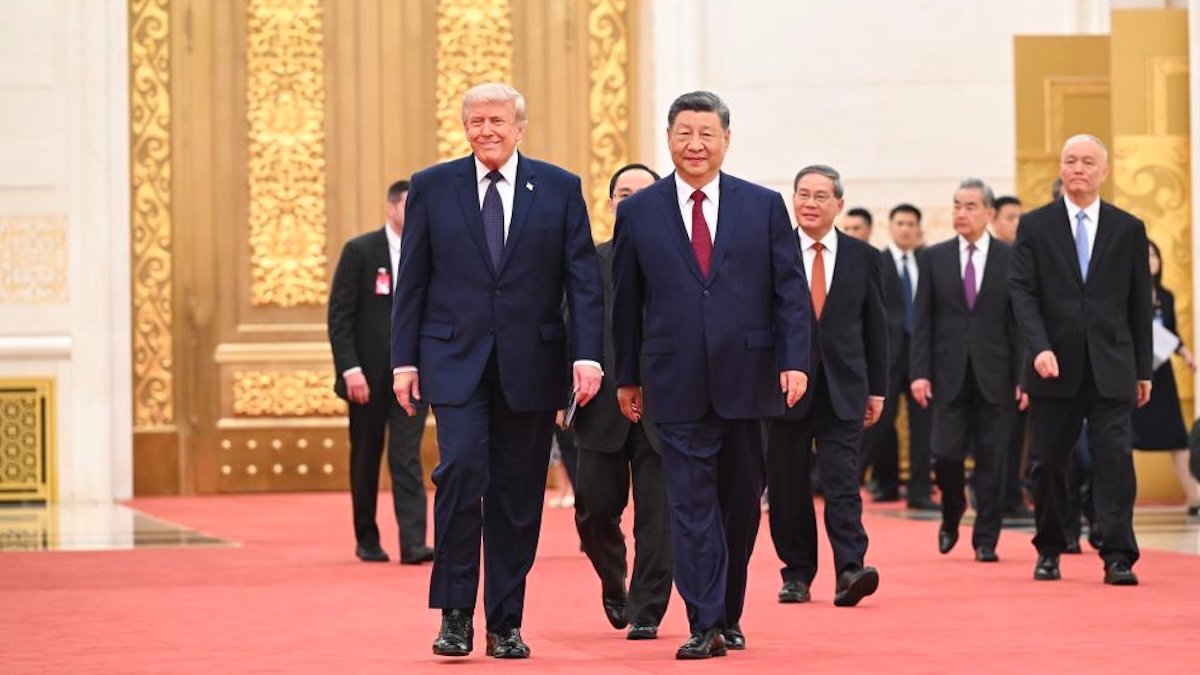

US President Donald Trump’s summit in Beijing with Chinese President Xi Jinping produced a package of Chinese commitments on soybeans, energy and US aircraft, giving the two governments a basis for stable relations after years of trade and security tensions.
The two hour and 15 minute meeting between Trump and Xi also laid the groundwork for Washington and Beijing to rebuild bilateral relations after years of escalating trade conflicts, export controls and geopolitical disputes. Trump invited Xi and his wife, Peng Liyuan, to visit the White House on September 24.
Trump said Fox News on Thursday that Xi has pledged to help the US in Iran and has agreed to buy soybeans, oil, liquefied natural gas (LNG) and other energy products. He said China will buy 200 Boeing 737 aircraft.
A US official said Xi had opposed the militarization of the Strait of Hormuz and any attempt to charge a fee for its use, while showing interest in buying more US oil to reduce China’s dependence on the strait in the future.
“Both countries agreed that Iran can never have a nuclear weapon,” the official said.
US Treasury Secretary Scott Bessent said Washington has already secured a major soybean commitment from China, confirming that one of the key agricultural promises from the previous Trump-Xi summit remained in place.
“And then soybeans, we have a very large purchase commitment from the Busan agreement for the next three years. So beans are really cautious,” he said in an interview with CNBC on Thursday.
At the previous Trump-Xi summit in South Korea last October, China agreed to buy 25 million metric tons of US soybeans annually over the next three years.
Global geopolitical situations have changed since Washington captured Venezuelan leader Nicolas Maduro and his wife in January and began blocking ships from entering or leaving Iranian ports in April. Some Chinese experts said Conflicts in the Middle East and global supply chain tensions have made it easier to accept Trump’s demand to buy energy from Beijing.
Reuters reported On Thursday, Chinese Customs appeared to have renewed the licenses of hundreds of beef exporters to the US on Thursday, a move that would have restored market access to many factories whose permits had expired over the past year. But then Customs changed the registration status of those exporters to “expired” on its website. It was unclear why Beijing made these moves.
Before the trip, observers said Trump’s mission to China was straightforward. He wanted to help American farmers and manufacturers increase sales to China, giving Republican candidates a stronger economic message ahead of midterm elections in November.
Other US goals included pressuring China to stop buying Iranian oil or supplying Tehran with drone parts and missile-related materials, and calling out for the release of Hong Kong pro-democracy businessman Jimmy Lai.
The media reports said the two governments are expected to hold further talks to reduce tariffs on about $30 billion worth of imports unrelated to national security concerns.
Meanwhile, Nvidia CEO Jensen Huang last minute hop on Trump’s plane to Alaska to join the trip to Beijing fueled market hopes that the two countries may have agreed to a deal that allows Chinese firms to import and deploy Nvidia’s H200 graphics processing units (GPUs).
Reuters reported on Thursday that the US Commerce Department has cleared about 10 Chinese firms to buy Nvidia’s H200 chips, including Alibaba, Tencent, TikTok parent ByteDance and JD.com. The US also approved Lenovo and Foxconn as distributors. Nvidia has not delivered any H200 chips to China, as Beijing has asked domestic firms to prioritize domestic chips over foreign processors.
Details about possible deliveries of the H200 to China were not immediately available.
China’s rejuvenation meets MAGA
For Beijing, Xi’s top priority at the meeting was rebuilding China-US relations and preventing the return of heavy US tariffs in early November 2026, after a year-long ceasefire. Beijing also wants the Trump administration to halt arms sales to Taiwan and remove tariffs and export controls to China.
At a banquet held in honor of Trump and his delegation, Xi said China-US relations concern the welfare of more than 1.7 billion people in both countries and affect the interests of more than eight billion people around the world. He said that both sides should rise to this historic responsibility and steer the giant ship of China-US relations steadily in the right direction.
Xi framed his national rejuvenation agenda and Trump’s “Make America Great Again (MAGA)” slogan as compatible rather than conflicting goals.
“The people of China and the US are both great people. Achieving the great rejuvenation of the Chinese nation and making America great again can go hand in hand. We can help each other succeed and advance the welfare of the whole world,” Xi said in a toast.
In the US, MAGA is a Republican slogan closely associated with Trump. In China, Xi’s “great rejuvenation of the Chinese nation” refers to Beijing’s goal to make China rich, powerful and central to global affairs by 2049, reversing what the Communist Party calls a century of national humiliation by Western powers. The concept is also linked to Beijing’s goal of reunification with Taiwan.
“If the Taiwan issue is handled properly, the bilateral relations between China and the US will be generally stable,” Xi said. said Trump at the official meeting on Thursday. “Otherwise, the two countries will have clashes and even conflicts, putting the entire relationship at great risk.”
Maintaining cross-strait peace and stability is the biggest common denominator between China and the US, he added, stressing that “Taiwan independence” and cross-strait peace are as incompatible as fire and water. He asked the American side to be more careful in handling the Taiwan issue.
“I have agreed with President Trump on a new vision of building a constructive China-US strategic stability relationship,” Xi said. “I look forward to working together with you to set the course and steer the giant ship of China-US relations, so that we can make 2026 a historic and landmark year that opens a new chapter in China-US relations.”
The new vision will provide strategic guidance for bilateral relations over the next three years and beyond, and should be welcomed by the people of both countries as well as the international community, he said.
“China-US economic ties are mutually beneficial and beneficial in nature,” he said. “Where disputes and friction exist, consultation on equal footing is the only proper solution.”
He said that both governments should implement the consensus reached by the leaders and make better use of communication channels in the political, diplomatic and military-military fields. He added that the two sides should also expand exchanges and cooperation in trade, health, agriculture, tourism, people-to-people ties and law enforcement.
Thucydides’ trap
During the official meeting with Trump, Xi expressed his wishes in three questions.
“Can China and the US overcome Thucydides’ trap and create a new paradigm of relations with major countries? Can we face global challenges together and ensure greater stability for the world? Can we jointly build a bright future for our bilateral relations in the interests of the welfare of the two peoples and the future of mankind?” it said. “These are vital questions for history, for the world and for people.”
of Thucydides’ trap is a term popularized by American political scientist Graham Allison to describe the risk of war when a rising power challenges an established power. In China-US relations, it refers to whether Beijing’s rise and Washington’s strategic dominance can be managed without military conflict.
“Some American commentators and policymakers had in recent years treated the China-US rivalry as inevitable, saying that the two countries had already fallen into Thucydides’ trap and were forced to compete for supremacy.” said Cui Hongjian, professor at the Academy of Regional and Global Governance at Beijing Foreign Studies University. “This pessimistic and negative sentiment not only affected China-US relations, but also affected the international community, increasing the sense of insecurity and uncertainty.”
He said the latest Trump-Xi meeting, which came after their summit in Busan, showed both sides wanted to move the relationship away from pessimism and back toward controlled engagement.
“This has resolved a major psychological concern in the international community,” he said. “This interaction is expected to change the sense of loss of control and return both countries to the path of reasonable and effective management of their relations.”
Read: Trump-Xi summit to weigh on US energy sales amid Hormuz crisis
Follow Jeff Pao at X at @jeffpao3



