

When Britain sent its first official diplomatic mission to China in 1793, one of the participants from London, Peter Auber, noted that the group had been “received with the greatest civility, treated with the greatest hospitality, watched with the greatest vigilance, and dismissed with the greatest civility.”
The mission, which aimed to open trade and establish a permanent British embassy in Peking, involved great pomp – but led to no tangible return. Auber’s quote came back to me as I watched Donald Trumptwo-day state visit to China unfolds.
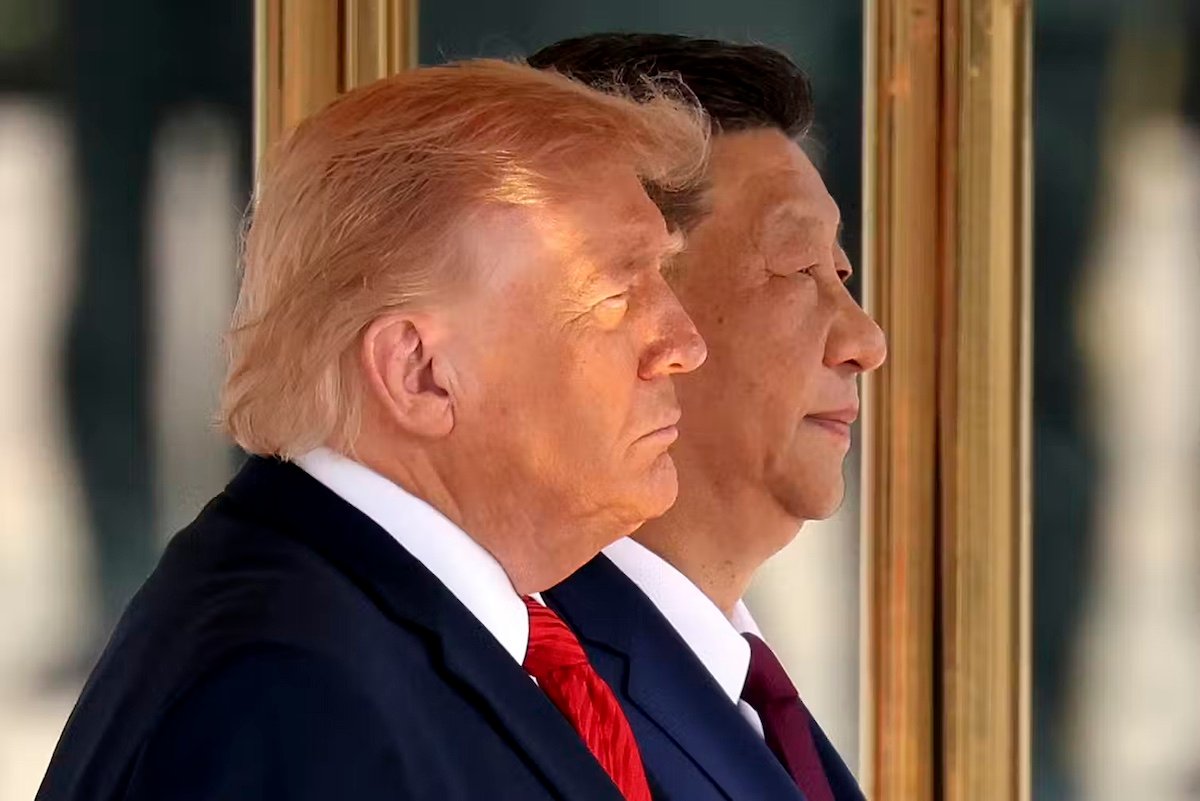
Chinese President Xi Jinping opened the summit by greeting his American counterpart with warm words. The relations between their two countries, he said, were his “The most important in the world.” Xi added that by making America great again, referring to Trump’s political slogan, was consistent with Chinese progress.
Trump was equally unequivocal in his praise for Xi. Writing on social media during his flight to Beijing, he stated that the Chinese president was “respected by all”. And when the two delegations sat down for direct talks, Trump told Xi: “You are a great leader.”
But what did this visit really achieve, beyond diplomatic words and mutual flattery?
One of Trump’s abiding goals in his first and second terms in the White House has been to correct the trade imbalance between the two powers. 2025 figures show that while The US sold $106 billion in goods to China, bought $308 billion worth of products from Chinese exporters – a trade deficit of about $200 billion.
In Trump’s previous visit to China in 2017, soybeans were the thing Beijing agreed to buy more from the US. This time, the only big ticket item was the plane.
On May 14, Trump announced that China had agreed to order 200 Boeing jets. However Boeing Shares fell 4% shortly after the announcement because the order was lower than many analysts expected. Trump also said that China had, in principle, agreed to buy crude oil from the US.
However, in terms of anything important to the CEOs of the big tech companies accompanying Trump to Beijing, including Tesla’s Elon Musk, Nvidia’s Jensen Huang and Apple’s Tim Cook, there doesn’t seem to have been much progress.
China’s strategy to develop its technology and capacity in this area is well known, with the government’s recent 15th five-year plan. starting out its commitment to innovation and to its own local companies.
The cooperation of the great powers
A more significant result from the visit came in the less tangible space of geopolitical management and great power cooperation. At the summit, Xi made it clear that the world relies on the ability of China and the US to engage with each other pragmatically, even if they don’t see eye to eye.
Comments made about Taiwan, in particular, were seen as underscoring red lines for each side. Xi reiterated his demand for US non-interference, a coded warning against US arms sales to the island, which Beijing considers a breakaway province. Trump later told reporters that he had has not yet been decided whether a major US arms sale to Taiwan can go ahead.
But in their talks with Chinese officials, the US delegation appears to have largely stuck to policy lines established since the 1970s — that the issue should be resolved peacefully, with agreement from both Taiwan and China.
Given the other turbulence in the world at the moment, sticking as much as possible to the status quo on this matter, but not exciting, can be described as positive.

Of that turbulence, Trump said Xi had offered to help US in the Iran conflict – but how this might work in practice is another matter. China is unlikely to want to play a heavy mediating role, given the potential to get bogged down in the perennial problems the region seems to present to anyone who gets more involved there.
What China wants is a long-term ceasefire that means Tehran and Washington can claim to have emerged from the Iran war as winners – despite there being no decisive end result. China definitely does not want the conflict to continue indefinitely, given its devastating economic impact – hence the offer of some sort of aid.
History will probably judge Trump’s visit as one more landmark along the path to a world in which China is more important, but still accords the US respect and acknowledgment of its current economic and military superiority. Trump may have walked away empty-handed — but in diplomacy, nothing happens sometimes is a good thing.
The fact that the two leaders faced off, did not clash and agreed to continue talking may not seem like a great outcome. But in this troubled world, it still counts as a plus.
Kerry Brown is a professor of Chinese politics; director of the Lau China Institute, King’s College London
This article was reprinted from Conversation under a Creative Commons license. Read on original article.



