
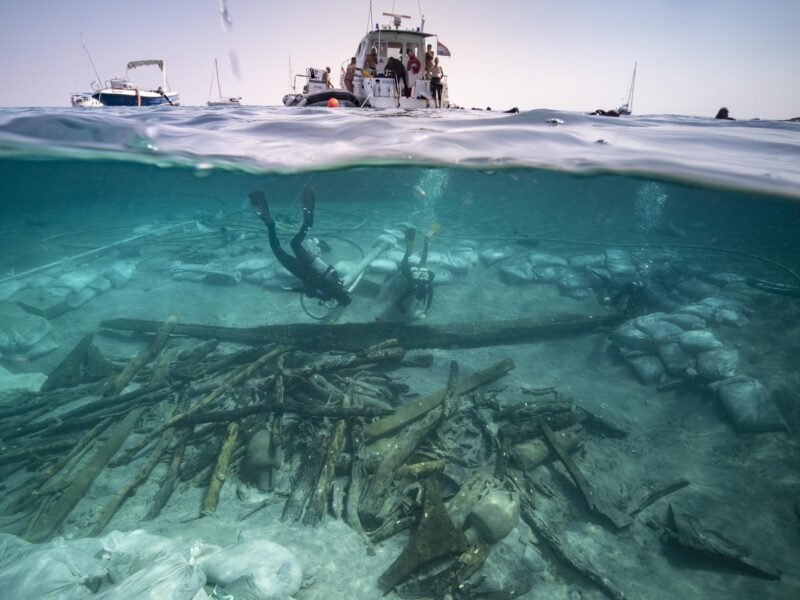

Researchers examined a 2,200-year-old Roman shipwreck and found tar and beeswax to coat and waterproof wood.
(CN) – Repairs for life’s essentials are often a pain, requiring time, attention and extra detail to ensure a lasting fix. This may be even more true if the repairs involve sea vessels from approximately 2,200 years ago.
Or that’s what scientists have managed to find when analyzing the components of ancient waterproofing on sunken Roman ships. In one study published in Frontiers in Materials on Thursday, researchers with the Interactions and Systems Mass Spectrometry Laboratory at the Université de Strasbourg in France examined materials used to keep out seawater, microorganisms and wood-eating nuisances like shipworms from destroying skinned ships.
The researchers looked specifically at the protective coating of a Roman Republic ship called Ilovik–Paržine 1 that was wrecked off the coast of what is now Croatia.
“In archaeology, little attention is paid to organic waterproofing materials. Yet they are essential for navigation at sea or in rivers and are true witnesses of past maritime technologies,” Armelle Charrié, an archaeometrist — or a scientist who applies the scientific method to archeology — and first author of the study said in a statement.
Charrié and a team of archaeologists found two different types of materials on the ship: one made of pine pitch, also called tar, and another that was a mixture of pine tar and beeswax.
By analyzing the pollen in the beeswax coating, the researchers were able to identify the plant the pollen was from and the region where the plant grew – indicating where the sailors made their repairs.
The identified materials came from diverse landscapes such as inland oak and pine forests, from the Mediterranean and Adriatic coasts, to matorrals, a type of scrub with olive and hazelnut trees, to alder and ash, fir and beech cases, suggesting environments near the rivers or mountains of Iraatia.
The study highlights common patterns within the same sea basin while also revealing regional specifics, Charrié said in an email to Courthouse News.
“It also allows us to track the evolution of practices over time, in relation to technological advances,” she said of the study. “Furthermore, the analysis of materials highlights the variability of techniques across sea basins, particularly in relation to resource availability.”
However, as for hypothesizing how the wax was obtained – was there an industry of beekeepers collecting wax for ship repairs or were sailors venturing far inland to collect wax from wild beehives – scientists offer no theories.
“We don’t have answers to these questions,” Charrié said. “For this shipwreck, we know of no archaeological evidence or sources that address the subject.”
Questions persist about what the proportions of the mixture were – how much tar and wax was needed to get it right?
Charrié noted that the wax was added to modify the physical and chemical characteristics of the tar, and the resulting adhesive mixture was “more pliable and less brittle in the long term, while maintaining its hydrophobic properties.”
She said the use of wax at the time was not limited to marine use – it was used as a plaster for a Roman wall covering, or protective sloping infrastructure used around banks and embankments to stop erosion.
But how much wax was used requires further study.
“Perhaps not much is needed?” notes Charrié. “The question remains open.”
Subscribe to our free newsletters
Our weekly newsletter Closing arguments provides the latest on ongoing trials, major litigation and decisions in courts around the US and the world, while monthly Under the lights feeds legal dirt from Hollywood, sports, Big Tech and the arts.



