
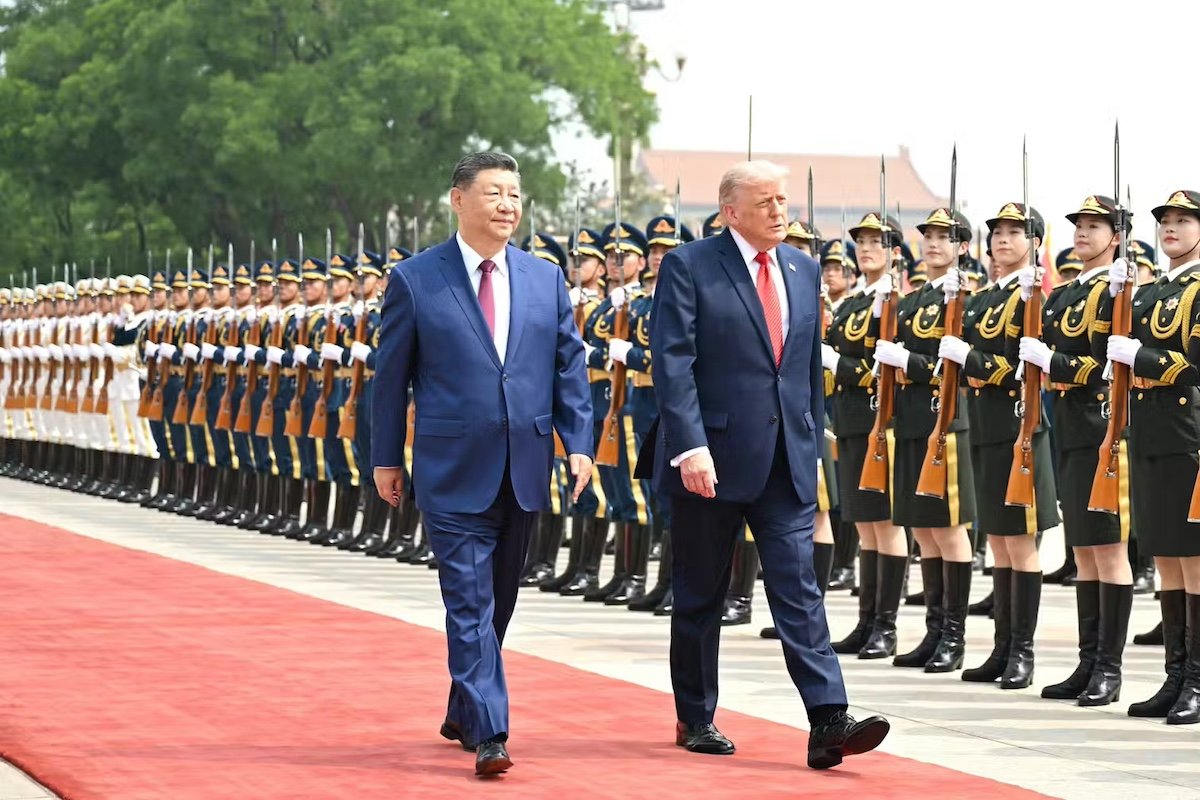

President Donald Trump left China on May 15, 2026, after a two-day summit with Chinese leader Xi Jinping, who was scrutinized from every angle for clues about where the relationship is headed.
Trump hailed the trip as “unbelievable”, while Xi noted that marked a “new bilateral relationship. Other observers were a little less enthusiastic, noting that there are no major breakthroughs were evident in the long-awaited meeting of the two most powerful political leaders in the world.
Yan Bennett, one expert on US-China relations and author of “American Policy Discourses on China,” gives her top three takeaways from the summit here.
Taiwan: tough talks, but status quo in place
No one really expected there to be movement in Taiwan – which Mainland China lays claim to – although it is clear that Beijing would like the United States to take a stronger stance against the island moving towards a declaration of independence, or for the US to explicitly seek reunification.
So what we got was Beijing reiterating that Taiwan remained a priority and a core interest. Xi did this on the first day of the summitnoting that the Taiwan “issue” remained “the most important issue in China-US relations” and that any mishandling of it could lead to “clashes and even conflicts”.
But this meant two things. First, Xi has a domestic audience to appeal to, and Taiwan has long been important to Chinese rhetoric. Chinese Communist Party has about 100 million membersmany of whom would have expected Xi to talk tough on Taiwan – and those were the people he was mainly talking to.
But he was also signaling to the US that it should not support Taiwan independence. And it won’t ruffle any feathers in Washington. Indeed, 2025 National Security Strategy emphasized that the US opposed unilateral action on Taiwan by “either side” – a signal to Beijing that it opposed Taiwan’s declaration of independence.

Trump mentioned arms deals with Taiwan. But the declaratory policy of the US since the Reagan administration is that it does not allow Beijing to enter into discussions about what weapons Washington sells to Taiwan.
And that hasn’t changed at all, neither has the US treaty commitment to Taiwan since 1979 which requires the US to provide Taiwan with defensive weapons to maintain a sufficient self-defense capability.
Rhetoric aside, everyone is happy with the status quo in Taiwan – it is in no one’s interest to change it.
But talk of Taiwan has been somewhat clouded by Xi’s determination on it modernization of the People’s Liberation Army. The Chinese president has put forward a number of benchmarks, including that the PLA must be able to occupy Taiwan by 2027.
This has been misinterpreted in the US under the so-called “Davidson’s window” – a concept that says China intends to conquer by that time.
In reality, China is not able to do this at all. She doesn’t have a “blue water navyAble to operate without the aid of the port, and the island is incredibly difficult to conquer – it has only two places where you can land, and only at certain times of the year.
It is also very mountainous. Taiwan is also slowly building up its defenses – and learning a lot from Ukraine’s war with Russia – with the aim of becoming “untouchable” for China.
Xi’s modernization timeline also says that The PLA must be a “world-class military” – considered the counterpart of the USA – that is, until 2049. But the fact that it spends more on internal security than on defense, shows where the real interests of the PKK lie – in internal security and not in external capabilities.
Trade: Expectations are shortened
The big picture is that the US and China have tried to restabilize what was until recently a very good relationship in terms of economic ties.
Both sides have clear priorities to that extent. China wants to regain the US market it had in the 1990s and early 2000s – and certainly reverse the trend since the 2018 trade war.
Trump has made it clear since his first administration that he views Chinese control over supply chains and trade imbalances as a matter of national security. Washington also wants to address unfair trade practices, such as the demand that American companies deliver plans, trade secrets, customer lists, marketing plans and more to act on.
So what was achieved at the summit? On the surface, very little. There was some movement US beef sales in China. And Trump announced that Beijing would buy 200 planes from Boeing – lower than the 500 that had been mentioned earlier in media reports. And some Chinese companies agreed to buy Nvidia microchips – continuation of a process that started at the end of 2025.
That doesn’t seem like much, and it showed that Trump himself wasn’t being too “Trumpian” about what could be achieved during the summit. He wasn’t promising the moon.
But more importantly, Xi and Trump agreed the creation of a Board of Trade and Board of Investments – aims to create a path forward for more trade in the coming months.

A big focus will be on technology. China is about 18 months behind the US in microchip development. some have questioned whether US companies must sell chips to China, amid fears that China could steal intellectual property and be able to use higher-tech chips for defense reasons.
The US position is that it cannot allow Huawei – China’s telecommunications giant – to take over the entire Chinese market, so it will only allow the sale of entry-level Nvidia chips.
Military issues: Washington wants to talk
During the Cold War, the Soviet Union and the US always kept the military lines of communication open to avoid a catastrophic incident. This has not happened with Beijing and Washington. We saw it in 2001 when a American planes crashed with a Chinese plane; and again on “Chinese spy balloon incident” in 2023.
Washington is looking to open a line of communication on military matters, and perhaps that is why US Defense Secretary Pete Hegseth was there in Beijing. Indeed, it is highly unusual for a defense secretary to be at such a summit.

Not that Trump believes he needs China’s help on military matters. He made that clear when asked about Beijing’s possible help earlier to the top.
In fact, little news came out of the summit about Iran. China criticized The US on the war, but also quietly told Tehran to stop bombing the Gulf countries.
regardless of some comments suggest that Beijing benefits from US stalling in the Middle East, what Xi will want is a solution before the economic fallout hits China.
China’s stockpile of Iranian oil will only last a few more weeks and then the oil price hike will hit China like a brick.
Yan Bennett is a professor pedagogue, American University. She has a contract position at the US State Department’s Foreign Service Institute, working to educate US diplomats about international affairs. Her views are her own and do not represent those of the US government.
This article was reprinted from Conversation under a Creative Commons license. Read on original article.



