
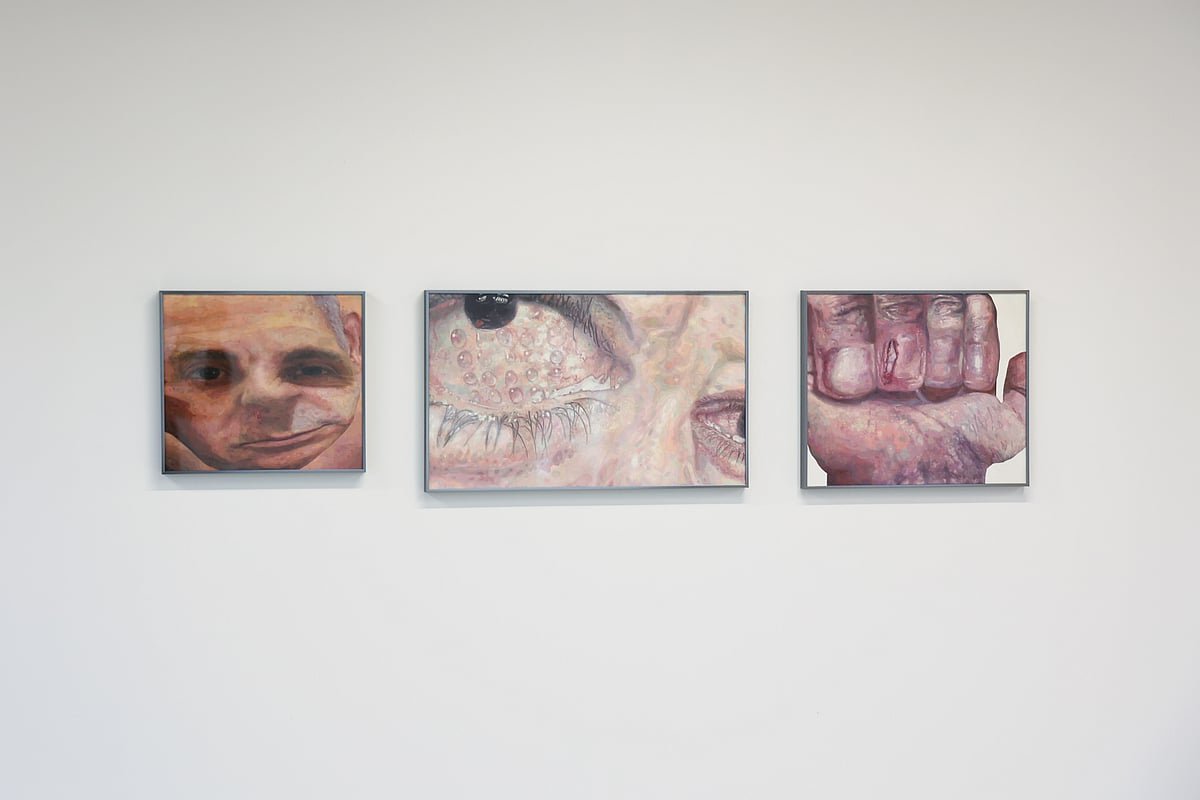

An ongoing group exhibition at Thapar Contemporary brings many together to reflect on the difficult overlaps between individual experiences and broader political realities. Titled “Wild, Ordinary, Fascinating, Excruciating Beauty”, it is curated by Vaibhav Raj Shah in collaboration with Jasone Miranda-Bilbao. Open until June 21, the show features works by 11 contemporary artists and includes artworks in paintings, sculptures and installations focused on the ways conflict, media and ideology affect everyday life.
Shah discussed the curatorial approach, stating that the exhibition draws inspiration from what we often perceive as “small” and “big” problems in our environment. He emphasized that, regardless of size, no one remains unaffected by what is happening around them, be it what happens on the other road or distant world events. According to him, artists have reflected on the current moment, being shaped by various global uncertainties, ongoing conflicts and the continuous flow of information.
Crisis amelioration
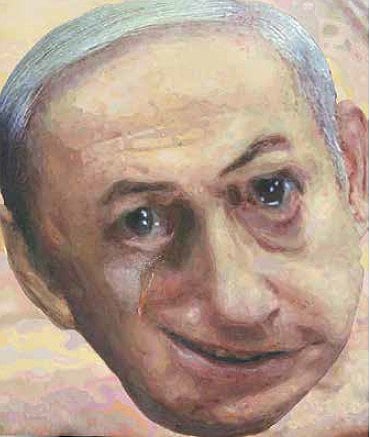
Among the participating artists, Vanshika Babbar’s paintings focus on our engagement with internet culture and how global conflict is consumed online. Her gouache-on-paper works combine references to the Israel-Gaza conflict with “the aesthetic of memes, using humor.” One of the works features a distorted, caricature-like portrait of Israeli Prime Minister Benjamin Netanyahu. The teary-eyed face, accompanied by a sideways, stretched smile, evokes a sense of unease despite its seemingly playful appearance.
Babbar explained that her work highlights the uneasy contrast between humor and tragedy in the digital age. “There’s an ease to laughing things off online,” she said, adding that this response often goes hand in hand with the constant stream of disturbing images as one scrolls through social media. Her paintings hold this contradiction, where laughter and discomfort appear together, while also exploring how repeated exposure to images can lead to desensitization.
In another piece, a clipped nail makes a reference to the map of the Gaza Strip, drawing a connection between bodily discomfort and distant geopolitical realities.
Power requisites
Sculptor Yogesh Ramkrishna approaches similar concerns through his sculptures made with chalk paint and 3D printing techniques.
One of Ramkrishna’s works, titled, “Props of the Post-Truth Society-II” turns a pair of Kolhapuri caps into a symbolic representation of ideological divisions. The “left” and “right” slippers show how society has opposite ideological sides. The work suggests that balance – like walking – relies on the coexistence of the two, rather than the dominance of one.
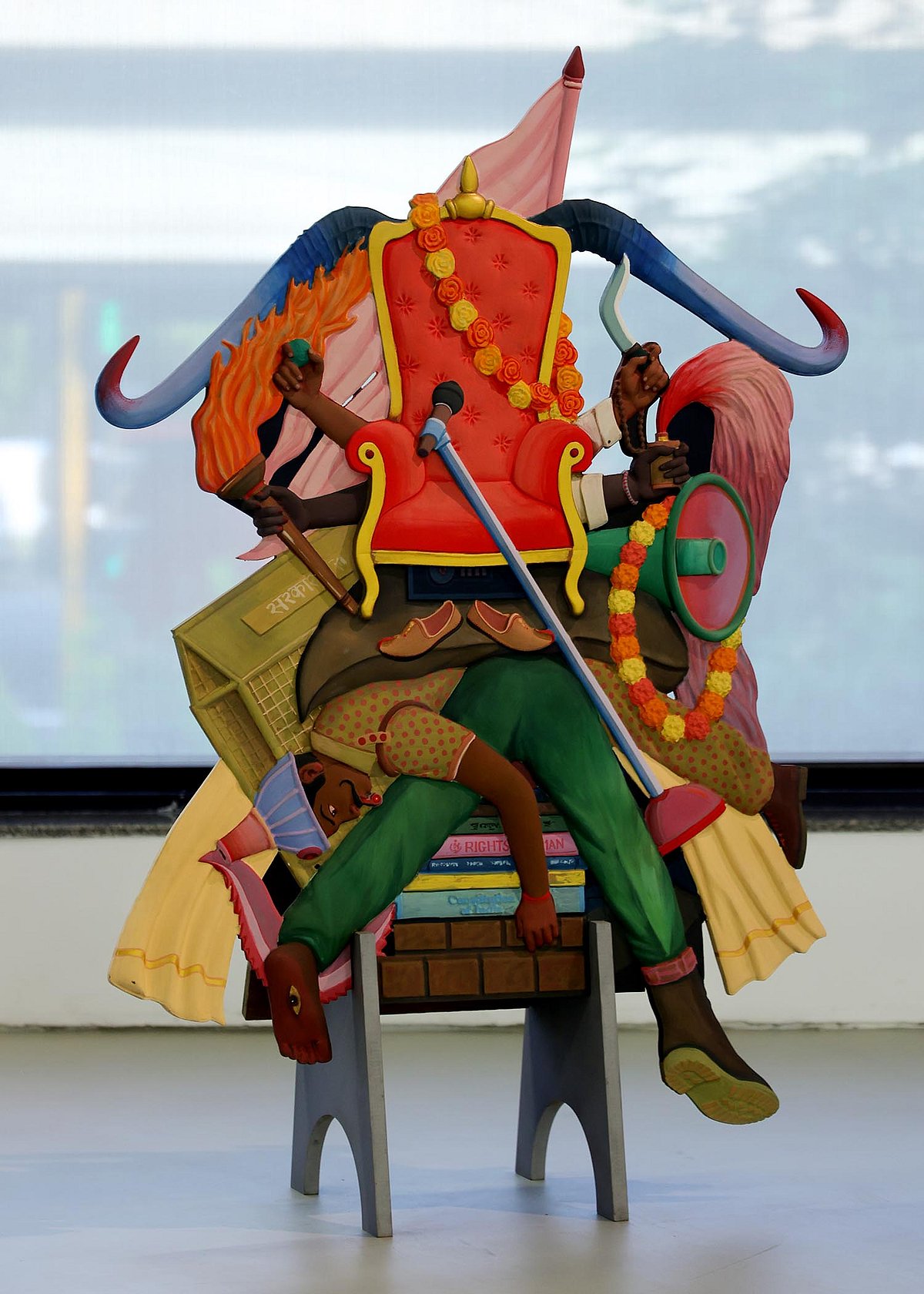
Another work is a sculpture, designed as a headrest; its components include a large structure like a throne with a crown, equipped with a microphone, police guard bands, a hand holding fire, the horns of a buffalo, exploring the nature of power. Drawing inspiration from the cultural practice of carrying deities on one’s head during religious ceremonies, the piece reflects how political beliefs are often supported with similar devotion. When raised in front of the head, the heavy object obstructs the wearer’s vision, showing how blind faith can limit critical thinking.
Gender social structures
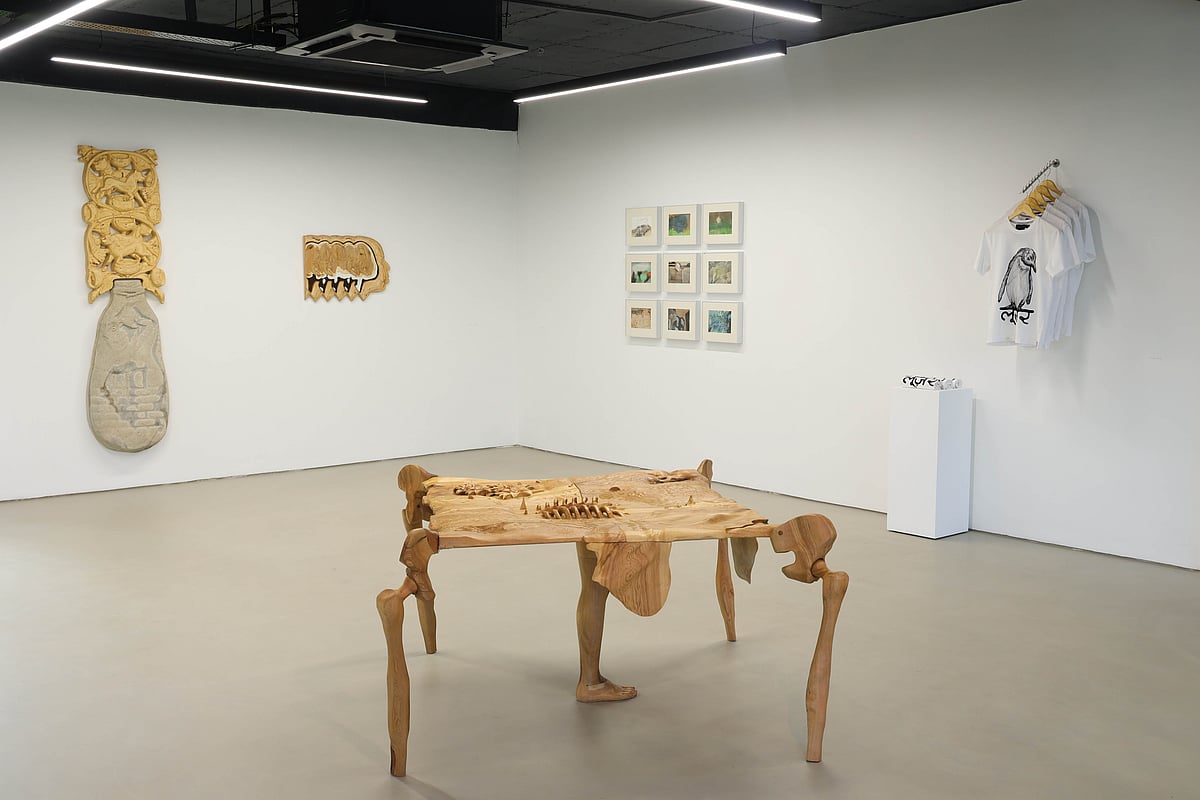
Artist Harmeet Singh Ratan’s contribution is inspired by the writings of Saadat Hasan Manto, known for his sharp critique of social hypocrisy. Manto’s stories such asThanda August,Toba Tak Singh,Khol DoANDHorse Shalwarform the basis of the narrative of his sculpture. His table-like sculptural work incorporates elements such as flowers and Punjabi calligraphy.
The four legs of the table are designed as pelvic bones, hinting at the male presence within social institutions. A female leg positioned in the middle of the table, on the other hand, speaks to the vital but often overlooked role women play in maintaining these systems.
Additionally, Ratan’s work addresses issues of migration and cultural transformation, particularly as they relate to Punjab. His art explores how people explore identification and belonging in unfamiliar environments as they physically and emotionally drift away from their roots.
Taken together, the exhibition explores how distant conflicts seep into everyday life, how belief systems shape behavior and how personal anxieties are inseparable from larger power structures. It encourages viewers to take a closer look at the world they inhabit and their role in it.



