


There is a special kind of courage that doesn’t make the evening news. It doesn’t come with a victory speech or a wreath of marigolds. It is the courage to show up, day after day, to a fight you will almost certainly lose and refusing to stop anyway. This is the argument at its heart Hands On No (Unstoppable), Prateek Shekhar’s documentary was screened at the Press Club of India recently.
Part of the larger Election Diaries series, the film follows CPI (ML) candidate Sandeep Saurabh during his 2024 Lok Sabha campaign in Nalanda, Bihar, the home turf of Nitish Kumar, where the sitting MP had won by a margin of three to four lakh votes. Saurabh challenged that stronghold with volunteers, citizen donations of 20 rupees and a will to fight against a powerful government with corporate influence and support.
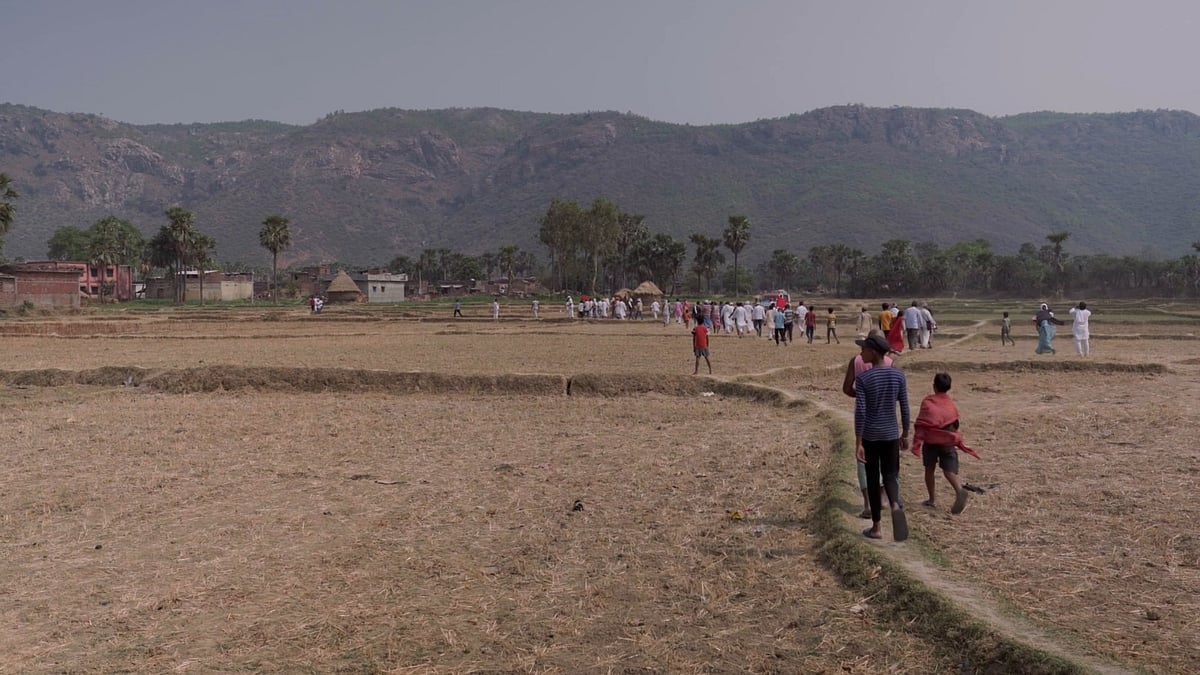
The film opens with Saurabh on his way to a rally in a moving car, recounting his political journey, the flat agrarian expanse of Bihar passing by — a man on the move, a landscape indifferent to his ambitions.
Fields don’t care about his manifesto. Bihari just goes on big, unhurried, ancient in his indifference, while this man talks in the middle distance about why he’s doing this and why he won’t stop.
Political contributions, commitments
It is an image that can be read as vanity. Shekhar frames it as something closer to faith. When the film closes with the identical shot, the effect is quietly devastating. He is still on the move. The landscape hasn’t changed and yet everything has changed.
Consider what twenty rupees means as a political act. Less than the cost of a tea. Cannot buy airtime, fund a cabin agent or move a single WhatsApp stream. And yet the CPI(ML) built its Nalanda campaign precisely on these contributions not as a romantic gesture but because there was no alternative. “Elections have become a very expensive exercise for parties,” Shekhar said. So if you don’t have the means, how can you fight the election? For a party without corporate support, democratic participation is effectively funded by people who themselves have next to nothing.
Shekhar’s interest in Saurabh stretches back four years. “The conviction with which he was speaking, the clarity, that was very inspiring to me.” The choice of topic was also ideologically deliberate – it drew on the CPIML’s remarkable performance in 2020, winning 12 of Bihar’s 19 assembly seats at a time when left parties were losing ground nationally. “There was a definite resurgence that was something I wanted to see.” And then there was the issue of electoral bonds. CPIML’s opposition to the scheme was not merely moral, it was a practical action.
Parties that accepted bond money gained sophisticated data infrastructure: voter profiling, targeted micro-messaging, algorithmically optimized WhatsApp campaigns. Instead, the CPIML knocked on doors. “In the last ten years, politics is less on the ground and more in newsrooms, social media and WhatsApp,” Shekhar noted. In 2024, giving up this economy means fighting a digital air war with an infantry running on tea and persuasion.
A hassle-free campaign
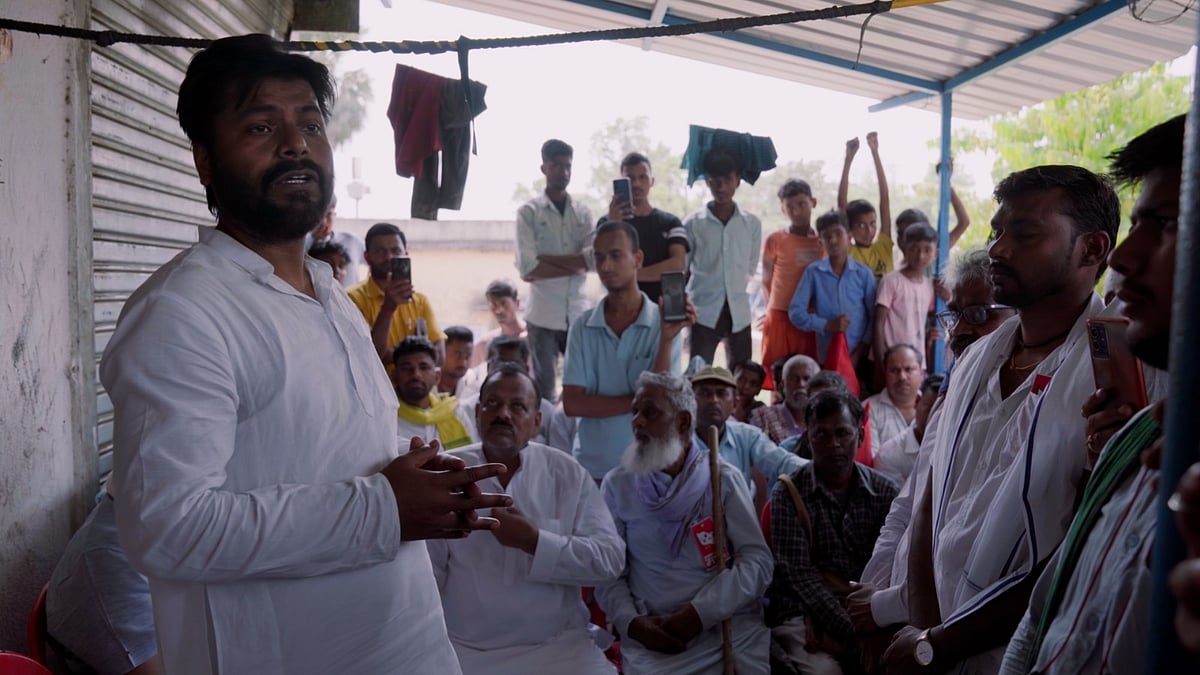
Shot with a team of two over 17 to 18 days, the camera is close, observant and unhurried, documenting not only Saurabh’s campaign but also the concerns, frustrations and aspirations of the communities he seeks to represent. Long covers the fight – Saurabh on the road ten to eleven hours a day, sixty to seventy days straight. No reconstruction, no confession. Just the campaign as it really was.
A standout sequence puts CPIML’s Deepankar Bhattacharya and RJD’s Manoj Jha in direct conversation about direct benefit schemes, Bhattacharya dismissing them as distractions from structural justice, Jha framing them as an inalienable right. The film lets that tension breathe. “Two different parties, five parties sitting together and voting among themselves, this is a very unique scenario,” Shekhar noted.
Saurabh lost by 1.7 lakh votes but reduced the opposition’s margin of victory by over two lakh from the previous election. “Even when he lost, there was grace in his loss. He was ready to come back the next second,” Shekhar said. “Stories of victory are short-lived. Stories of struggle are what daily existence is all about.”
What the film indicts is not any single opponent, but the infrastructure of modern Indian elections; an ecosystem where money buys not just advertising, but organizational capacity, data and reach. A twenty-rupee donation campaign can’t buy that. She can only refuse to need it and build something slower and more fragile in its place.
Last image, Saurabh back in that car, Bihar driving behind him, refuses closure. The road continues. So does he.



