
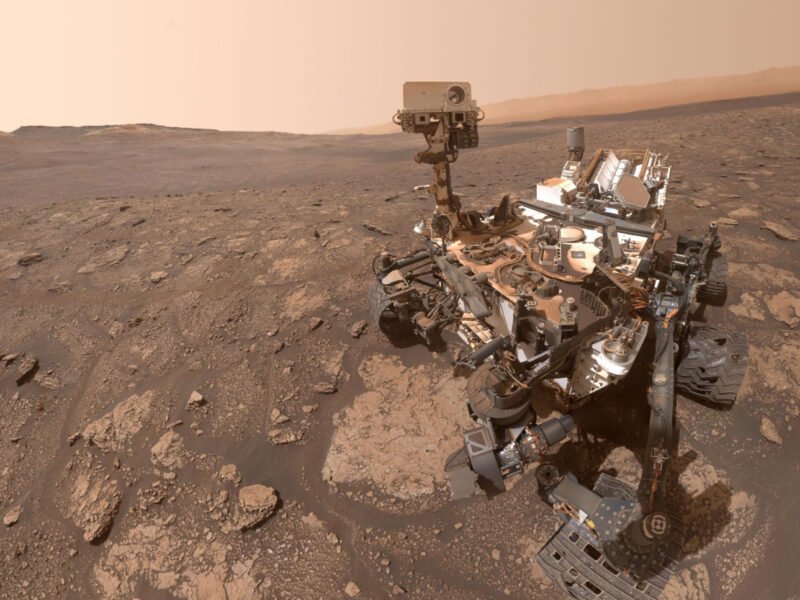

The findings suggest that Mars may harbor the kind of molecules that could show evidence that life once existed on the planet.
NASA’s Curiosity rover has found a new set of organic molecules on Mars, including compounds that scientists say are linked to the building blocks of life.
The discovery comes from a chemical experiment carried out for the first time on another planet and suggests that Mars could store complex organic materials for billions of years.
Scientists say the rover identified more than 20 organic compounds in rock samples collected from Gale Crater, a former lake bed where water once existed.
Among them was a nitrogen-containing molecule with a structure similar to the chemicals that help form DNA, something never before detected on Mars.
findings, published Tuesday in the journal Nature Communications, shows that Mars may retain organic material, supporting the idea that the planet may once have had conditions suitable for life.
However, compounds alone are not proof that life ever existed there.
“We think we’re looking at organic matter that has been preserved on Mars for 3.5 billion years,” said Amy Williams, a professor of geological sciences at the University of Florida who led the study, in a press release. “It’s really useful to have evidence that ancient organic matter is preserved, because that’s one way to assess the habitability of an environment. And if we want to look for evidence of life in the form of preserved organic carbon, this shows that it’s possible.”
Organic molecules are considered key ingredients for life, but they can also form through non-biological processes or arrive on the planet via meteorites.
One of the compounds identified, benzothiophene, is commonly associated with material sent from space.
“The same things that rained down on Mars from meteorites are what rained down on Earth and probably provided the building blocks for life as we know it on our planet,” Williams said.
Curiosity landed on Mars in 2012 to investigate whether the planet once had environments capable of supporting life.
The rover conducted this latest experiment in 2020 in the Glen Torridon region of Gale Crater, an area rich in clay minerals that can preserve organic material.
To analyze the samples, scientists used an instrument on board the rover called the Sample Analysis on Mars, or SAM. The experiment relied on a chemical known as TMAH, which breaks apart larger organic molecules so they can be studied more easily.
Since the rover only carries a limited amount of the chemical, the researchers had to choose carefully where to use it. The results suggest that the technique can reveal complex organic chemistry that might otherwise remain hidden.
The findings could also shape future missions, including efforts to search for organic compounds on Mars and Saturn’s moon Titan.
While the new results don’t confirm that life once existed on Mars, scientists say they show that the planet may retain the kinds of molecules that could point to it.
“We now know that there are large complex organics preserved in the shallow subsurface of Mars, and this holds great promise for the preservation of large complex organics that could be diagnostic of life,” Williams said.
Subscribe to our free newsletters
Our weekly newsletter Closing arguments provides the latest on ongoing trials, major litigation and decisions in courts around the US and the world, while monthly Under the lights feeds legal dirt from Hollywood, sports, Big Tech and the arts.



