
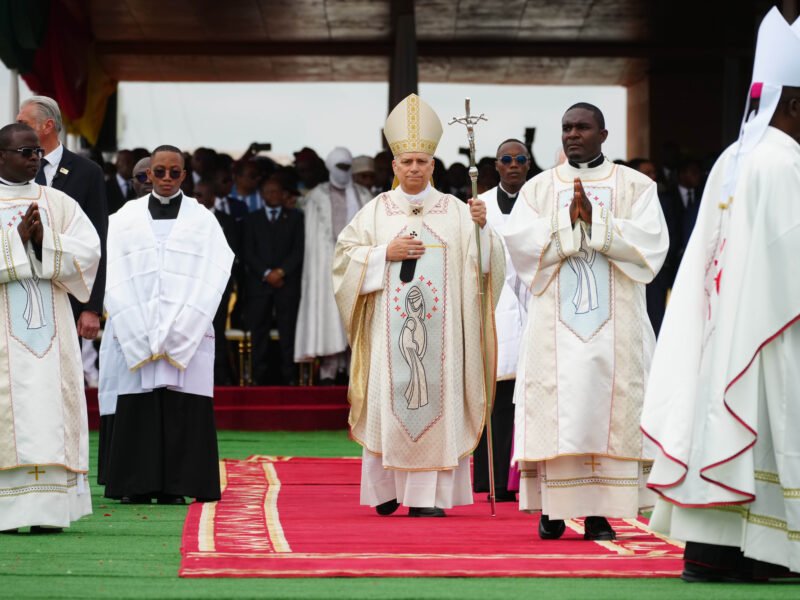

YAOUNDE, Cameroon (AP) – Pope Leo XIV called on Saturday for “structures of solidarity” to help those on the margins as he ended his visit to Cameroon and left for Angola on his third leg. Four Nations African Odyssey.
Leo celebrated mass at Yaounde airport in front of about 200,000 people, including President Paul Biya, 93, the world’s oldest leader. The poignant and joyous atmosphere underscored the joy that the third pope to visit Cameroon has brought to the former French colony, where about a third of the population is Catholic.
Some people who struggled to walk were brought to mass in wheelchairs pushed by family members.
On his visit to Cameroon, Leo tried to encourage the young people to have hope despite feelings of disappointment. He also demanded that elites stop exploiting the land and its people for profit.
In his sermon on Saturday, delivered in French, Leo said respect for human dignity was a cornerstone of any society.
“For this reason, every community has the obligation to create and maintain structures of solidarity and mutual aid, in which, when faced with crises – be they social, political, medical or economic – everyone can give and receive help according to their capacity and needs”, he said.
A remote Angola welcomes the Pope
After the Mass, Leo will fly to Luanda, the capital of the southwest African nation, where he will meet with President Joao Lourenco and deliver his first speech to Angolan government authorities.
Angola, a southern African country of about 38 million people, gained independence from Portugal in 1975. But it still bears the scars of a devastating civil war that began soon after independence and raged for 27 years before finally ending in 2002. More than half a million people are believed to have been killed.
The civil war was for years a proxy conflict of the Cold War, with the United States and apartheid South Africa supporting one side and the Soviet Union and Cuba supporting the other.
“I would like to hear a message of peace, a message of reconciliation,” said Luanda resident Sergio Jose. “I would also like to hear good political messages and I would also like to hear that the Pope would also speak about the upcoming elections in Angola.”
Angola today is the fourth largest oil producer in Africa and among the top 20 producers in the world, according to the International Energy Agency. It is also the third largest producer of diamonds in the world and has significant deposits of gold and highly sought after minerals.
But despite diverse natural resources, the World Bank estimated in 2023 that more than 30% of the population lived on less than $2.15 a day.
In Cameroon, Leo had railed against the “chains of corruption” that were hampering development, as well “a handful of tyrants” who were destroying the Earth with war and exploitation. He is expected to raise similar points in Angola.
The late former president Jose Eduardo dos Santos, who led Angola for 38 years from 1979 to 2017, was accused of diverting billions of dollars of public money to his family, mostly from the country’s oil revenue, while millions of people struggled in poverty.
After Lourenco took office as president, his administration estimated that at least $24 billion was stolen or embezzled by dos Santos. Lourenco’s administration has vowed to crack down on corruption and has worked to recover funds allegedly stolen during the dos Santos era.
But critics note that Angola still has deep problems with corruption and have questioned whether Lourenco’s actions were more aimed at political rivals in order to consolidate his power.
A legacy of slavery awaits the American pope in Angola
Angola, on the southwest coast of Africa, was considered to be the epicenter of the transatlantic slave trade as a Portuguese colony. More than 5 million of the approximately 12.5 million enslaved Africans were shipped across the ocean on ships departing from Angola, more than any other country, although not all were Angolans.
The highlight of Leo’s visit to Angola is expected to be his visit on Sunday to Muxima, south of Luanda. It is a popular Catholic shrine in a country where about 58% of the population is Catholic.
of Church of Our Lady of Muxima it was built by Portuguese colonizers in the late 16th century as part of a castle complex and became a center in the slave trade. It remains a reminder of the indissoluble connection hundreds of years ago between Catholicism AND exploitation of the African continent.
Leo, the first U.S.-born pope in history, has black and white ancestors that included both enslaved people and slave owners, according to genealogical research. He will go to Muxima to pray the Rosary, in recognition that the place became a popular pilgrimage destination after believers reported an apparition of the Virgin Mary around 1833.
Imray contributed from Cape Town, South Africa.
The Associated Press’ religious coverage receives support through the AP COOPERATION with The Conversation US, with funding from the Lilly Endowment Inc. AP is solely responsible for this content.
By NICOLE WINFIELD and GERALD IMRAY Associated Press
Subscribe to our free newsletters
Our weekly newsletter Closing arguments provides the latest on ongoing trials, major litigation and decisions in courts around the US and the world, while monthly Under the lights feeds legal dirt from Hollywood, sports, Big Tech and the arts.



