
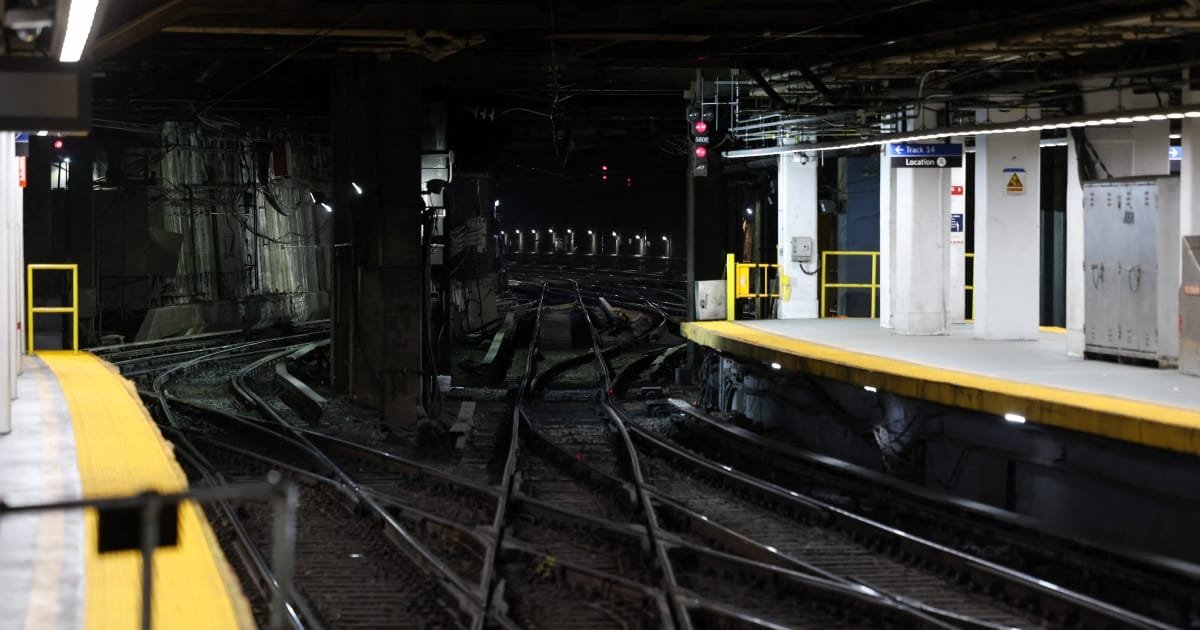

New York: A marathon day of negotiations that ended early Monday failed to end a strike that shut down the Long Island Rail Road, North America’s largest commuter rail system, setting the stage for a rough start to the work week for some 250,000 commuters.
Unions representing rail workers and the Metropolitan Transportation Agency, which runs the railroad, negotiated through much of Sunday and early Monday after some prodding from the National Mediation Board and New York Gov. Kathy Hochul.
Both sides came up short, but talks went so well that negotiators agreed to return to work early Monday morning, according to a spokesman for union workers. Negotiations dragged on for so long that even an agreement could not have saved the Monday morning journey because of the time needed to deploy crews and trains.
The National Mediation Board, the federal labor agency that regulates labor relations for railroads and airlines, called representatives of both sides to a meeting Sunday afternoon that kicked off the talks. They continued until almost 1:30 a.m. on Monday. The parties agreed to return to the negotiating table six hours later.
Earlier Sunday, Hochul appeared with the MTA’s chief executive and said they were willing to do whatever was necessary to help negotiations during a strike that continued into its second day.
“We all know that the railroad is the lifeblood of Long Island. Without it, life as we know it simply isn’t possible. At the end of the day, nobody wins in a strike. Everybody gets hurt,” she said. Hochul offered to provide refreshments.
The nation’s busiest passenger railroad
The LIRR serves hundreds of thousands of commuters who live along a 120-mile-long land mass that spans Brooklyn and Queens in New York City and the Hamptons, a summertime playground for the rich and famous near its eastern tip. The railway has long offered commuters relief from its congested highways during rush hour.
Most of his riders live outside New York City in two counties populated by nearly three million people.
After the press conference, the International Association of Machinists and Aerospace Workers and the Transportation Communications Union said in a statement that union workers “are not asking for special treatment — they are simply struggling to keep up with the sky-high cost of living in the New York region after years without a raise.”
The railroad shut down and workers went on strike at 12:01 a.m. Saturday after five unions representing about half of its workforce walked off the job for the first time in three decades.
Workers have spent years without a new contract
Unions and the MTA have been negotiating a new contract through 2023, with talks stalled over workers’ wages and health care premiums. President Donald Trump’s administration got involved in September after unions demanded a panel of experts be appointed, but they were unable to reach an agreement. Unions were legally allowed to strike starting at 12:01 a.m. Saturday.
At her press conference, Hochul said workers would lose every dollar they would earn in a new contract by going on strike for three days.
MTA Chairman Janno Lieber said during the press conference that the union proposals would “blow up the MTA budget” but he joined the governor’s demand that the unions resume talks.
“They chose to leave. We are more than willing to meet them halfway on wages,” he said.
Sports fans feel the pain first
The walkout, the first for the LIRR since a two-day strike in 1994, hit many sports fans who wanted to see the Yankees and Mets battle or the Knicks’ playoff game at Madison Square Garden, which sits directly above Manhattan’s Penn Railroad station.
Federal law makes it extremely difficult for railroad workers to walk away and even allows Congress to block a strike, but lawmakers didn’t step in here like they did with the nation’s freight railroads in 2022.
Would-be travelers were greeted all weekend by train timetable departure boards listing ghost trains marked “No Passengers” instead of upcoming trains listed by destination.
Hochul said essential workers among the roughly 250,000 weekday LIRR riders can take city buses from six locations on Long Island starting at 4 a.m. Monday and during an evening rush hour commute from 3 p.m. to 7 p.m.
Hochul and Trump blame each other for the attack
Hochul, a Democrat, has blamed the Trump administration for ending mediation in September and pushing negotiations toward a strike. Trump, a Republican, said on his Social Truth platform that he had nothing to do with the strike.
“No, Kathy, it’s your fault, and now looking at the facts, you shouldn’t have allowed this to happen,” Trump said.
Hochul urged companies and agencies that hire workers from Long Island to let them work from home whenever possible.
“It’s impossible to completely replace LIRR service. So, effective Monday, I’m asking that regular commuters who can work from home do so. Please do so,” she said.
The MTA has said the unions’ initial demands to raise wages would result in large fare increases and would be disproportionate to what other unionized workers are paid.
The unions, which represent locomotive engineers, machinists, signalmen and other train workers, have said larger increases are warranted to help workers keep up with inflation and rising living costs.



