
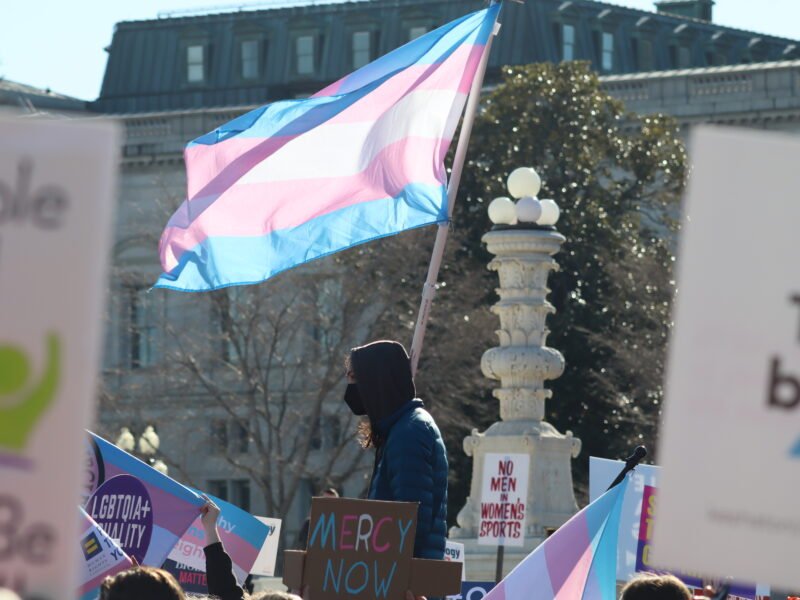

The Montana Supreme Court found that the state Constitution prohibits the state from allowing only cisgender residents to change their gender identity on their documents.
(CN) — Montana cannot block transgender residents from changing their government-issued identification documents to match their gender identity, according to State Supreme Court.
“Transgender discrimination is, by its very nature, gender discrimination,” Montana Supreme Court Justice Laurie McKinnon wrote for the majority. “Discrimination based on sex is expressly prohibited under Montana’s unique nondiscrimination clause.”
Enacted in 2023 by the Montana Legislature, Senate Bill 458 defined “sex” as binary and based on biological and genetic indications present at birth. Shortly after it went into effect, the Department of Health and Human Services announced it would ban changing birth certificates based on “gender transition, gender identity or gender reassignment.”
In 2024, two transgender Montanans sued the state, arguing the policies violated the state Constitution. Specifically, the plaintiffs requested that they be able to change the sex designation on their birth certificate and driver’s license as allowed by previous state policy.
At the end of the year, a lower court issued a preliminary injunction blocking the state from implementing the policies. The court found that cisgender and transgender residents are equal in all relevant respects except for their status as transgender or cisgender, but only cisgender Montanans can change their birth certificates or driver’s licenses to accurately reflect their gender identity, which violates the constitutional right to be free from discrimination on the basis of sex.
The state appealed, arguing that the plaintiffs lacked standing to sue and that the lower court abused its discretion by blocking the policies.
The Montana Supreme Court on Tuesday rejected the state’s arguments.
The state’s highest court found that the two plaintiffs have a “definite and deeply personal stake in the ultimate outcome” of the lawsuit, since they must disclose that they are transgender each time they present their identification documents and those documents do not reflect who they believe they are.
In the 5-2 decision, the majority also concluded that the lower court properly found the challenged policies discriminated against transgender residents.
“Our Montana Constitution requires the state to treat individuals with dignity even when exercising its broad police powers,” McKinnon wrote. “This bold constitutional proposal protects all individuals and does so equally.”
While state policies apply to all Montanans, the plaintiffs showed the policies result in unequal treatment, McKinnon said.
Supreme Court Justices Jim Rice and Cory Swanson both dissented. Rice described the ruling as forcing the state to issue falsified legal documents, and Swanson objected to the court’s “unnecessary involvement in lawmaking.”
The plaintiffs’ lawyer welcomed the court’s decision.
“Today’s opinion reflects what we all know to be true: that the Montana Constitution protects the human dignity of everyone, including transgender Montanans,” Alex Rate, deputy director of the ACLU-Montana, said in a statement. “Everyone deserves the equal protection of the law, and policies that single out individuals or groups for discrimination and harassment will not withstand constitutional scrutiny.
The state was less thrilled about the decision. Chase Scheuer, deputy director of communications for the Montana Attorney General’s Office, said the decision would be expected in a blue state, but not in Montana.
“Requiring the state to issue false documents simply does not change the reality that men cannot become women and women cannot become men,” Scheuer said in a statement. “It is disappointing, but not surprising, that once again a majority of the Montana Supreme Court chose to advance the agendas of their shrewd political allies rather than evaluate the case on its facts.”
Subscribe to our free newsletters
Our weekly newsletter Closing arguments provides the latest on ongoing trials, major litigation and decisions in courts around the US and the world, while monthly Under the lights feeds legal dirt from Hollywood, sports, Big Tech and the arts.



