
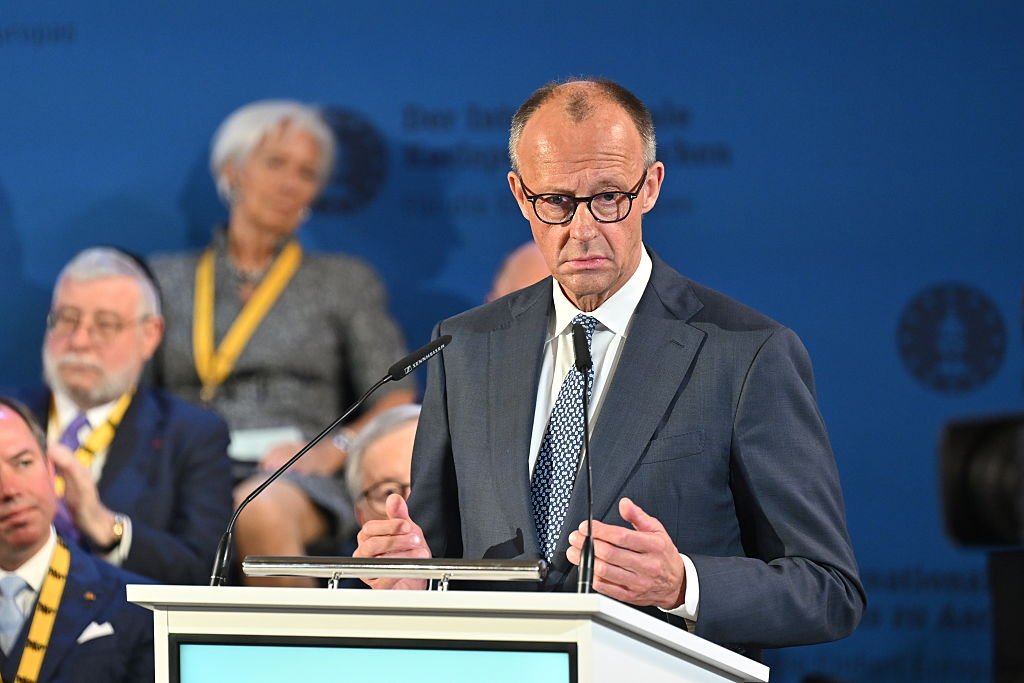

EU spending should be modernized to focus on defense investment and competitiveness with cuts to traditional agriculture or regional subsidies, according to Friedrich Merz, the German chancellor.
Germany – Europe’s biggest economy and biggest contributor to Brussels’ budget – has drawn red lines as debate over the EU’s future long-term spending plans begins.
“The content and structure of the EU budget have remained virtually unchanged over the past decades,” he said on Thursday, adding that “more than two-thirds of European funds still go towards redistribution and subsidies”.
As negotiations over the European Commission’s proposed €1.8 trillion 2028-2034 spending plan, pressure is mounting on capitals to decide how to fund the bloc’s new priorities while paying off Covid-era debt dating back to the last budget resolution.
Merz argued that the EU should focus its spending for the cycle on strategic priorities and investments to raise the budget in a new geopolitical era.
“Reduced structure, investment in competition and defence, focus on European resources for European policy. All this is necessary because resources are limited,” the German conservative said, adding that Germany is “strongly supporting” the Commission’s efforts to reform the next budget.
Why Next GenerationEU could become the problem of the next generation
The debt is usually intended to be repaid. But a growing number of EU leaders…
4 minutes

The EU executive’s proposal includes a major overhaul of the budget structure, including merging 52 programs into 16 and folding social, agricultural and cohesion funds into 27 national plans.
Traditionally, agriculture and cohesion accounted for roughly a third of the bloc’s budget each, although the new proposal sets a combined share of around 44%.
Merz’s remarks reinforced Germany’s long-standing opposition to further joint debt at the EU level and the need for new budget priorities to be financed through reallocation rather than expansion of the general budget.
In contrast, Emmanuel Macron and Kyriakos Mitsotakis, the French and Greek leaders, have in recent weeks supported the idea of new joint borrowing and a rollback of pandemic debt to finance the bloc’s shared priorities.
EU leaders will meet on June 18-19 in Brussels for a summit expected to mark a key step in the MFF negotiations, with the Cypriot Council presidency aiming to present indicative figures on the size of the budget for the first time.
Meanwhile, MEPs have asked for a bigger budget, VOTING in April to increase the overall size of the MFF by 10% compared to the Commission’s proposal.
EU budget reform battle will be like ‘Hunger Games’
The battle over a Brussels plan to reform the EU’s next seven-year budget is taking place…
4 minutes

(w)



