
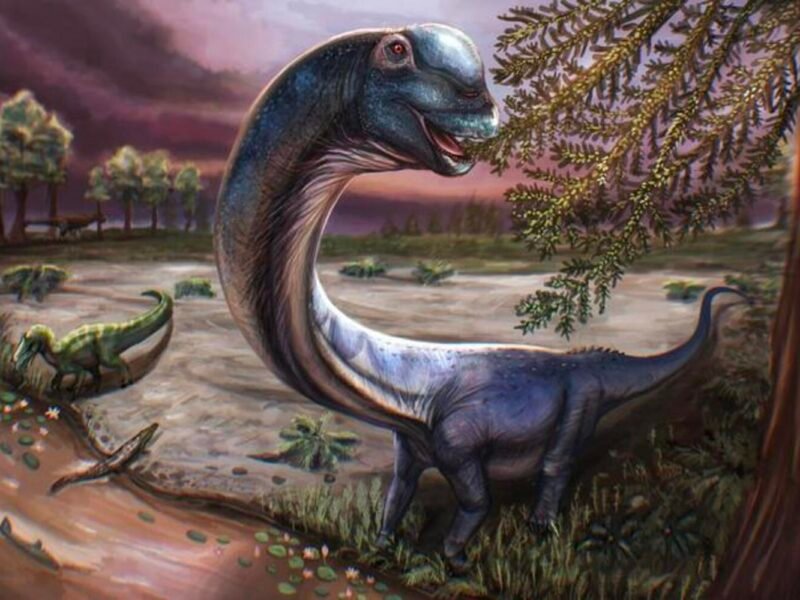

Scientists say the giant, long-necked dinosaur weighed as much as nine elephants and stretched almost the length of three city buses.
(CN) – Ten years ago, workers on the edge of a pond in northeastern Thailand discovered bones belonging to the largest dinosaur ever found in Southeast Asia.
Now, a team of researchers led by University College London has identified the ancient giant, naming it Nagatitan chaiyaphumensis. The name is based on the Naga, a mythological snake from Thai and Southeast Asian folklore, and from Chaiyaphum, the Thai province where the fossils were found.
Scientists believe that the dinosaur lived between 100 and 120 million years ago during the Early Cretaceous period. It was a sauropod, the family of long-necked, long-tailed herbivores that includes Diplodocus and Brontosaurus.
Researchers estimate its weight at 27 tons, roughly equivalent to nine full-grown Asian elephants, and its length at about 89 feet. Among the bones analyzed was a forefoot bone measuring 5.8 feet, roughly as tall as an average human.
It is the 14th dinosaur named in Thailand.
Lead author Thitiwoot Sethapanichsakul, a Thai PhD student at UCL Earth Sciences, put the discovery into context.
“Our dinosaur is huge by most people’s standards. It probably weighed at least 10 tons more than Dippy Diplodocus,” Sethapanichsakul said. “However, it is still dwarfed by sauropods like Patagotitan (60 tons) or Ruyangosaurus (50 tons).
Despite its impressive size, Nagatitan belongs to a sub-group of sauropods called somphospondylans, which spread widely across the globe around 120 million years ago. Within this group, it fits into a smaller group called Euhelopodidae, found only in Asia. Researchers say the species is distinguished from others based on a unique combination of features on its back, pelvis and legs.
Sethapanichsakul called him the last titan of Thailand. The fossils came from the country’s youngest dinosaur rock formation. The rock layers laid down after this, as the region gradually became a shallow sea, are unlikely to contain any further sauropod remains.
“This may be the last or the last large sauropod we’ll find in Southeast Asia,” he said.
During Nagatitan times, the landscape would have been dry and sparse, conditions that seemed to favor sauropods. Scientists think the animals used the large surface area of their necks and long tails to dissipate heat and keep body temperatures under control. The area where the remains were found appears to have been part of a winding river system, home to fish, freshwater sharks and crocodiles.
The creature would also have shared the region with smaller plant-eating dinosaurs, large predators and flying reptiles called pterosaurs that hunted fish from the river.
Co-author Professor Paul Upchurch of UCL Earth Sciences said the research grew out of a new partnership with Thai researchers. The team used 3D scanning to study the specimens without having to travel, which he said also helped reduce the project’s carbon footprint.
“We’ve had a long-standing interest in the evolution of these giant plant-eaters and have good collaborative relationships with researchers around the world,” Upchurch said. “It’s great to work with Thai colleagues and start to gain insight into what was happening in Southeast Asia during the Jurassic and Cretaceous.”
Project leader Sita Manitkoon, a researcher at the Paleontology Research and Education Center at Mahasarakham University and a National Geographic Explorer, said Thailand’s fossil record is richer than many people realize.
“Although Thailand is a small country within Asia, we have a very high diversity of dinosaur fossils, probably the third most abundant country in Asia in terms of dinosaur remains,” Manitkoon said. “We’ve really been studying dinosaurs in Thailand for about 40 years, since the first dinosaur was named in 1986, and we already have a surge of new generation paleontologists who are actively undertaking research.”
For Sethapanichsakul, publishing is also personal. The research team has a large collection of not yet formally described sauropod fossils, which may include additional new species.
“I’ve always been a dinosaur kid. This study not only creates a new species, but also fulfills a childhood promise to name a dinosaur,” he said.
A life-size reconstruction of Nagatitan chaiyaphumensis is on display at the Thainosaur Museum in Asiatique in Bangkok.
Findings titled “‘The Last Titan’: Southeast Asia’s Biggest Dinosaur Discovered”, were published on Thursday in the journal Scientific Reports.

Subscribe to our free newsletters
Our weekly newsletter Closing arguments provides the latest on ongoing trials, major litigation and decisions in courts around the US and the world, while monthly Under the lights feeds legal dirt from Hollywood, sports, Big Tech and the arts.



