
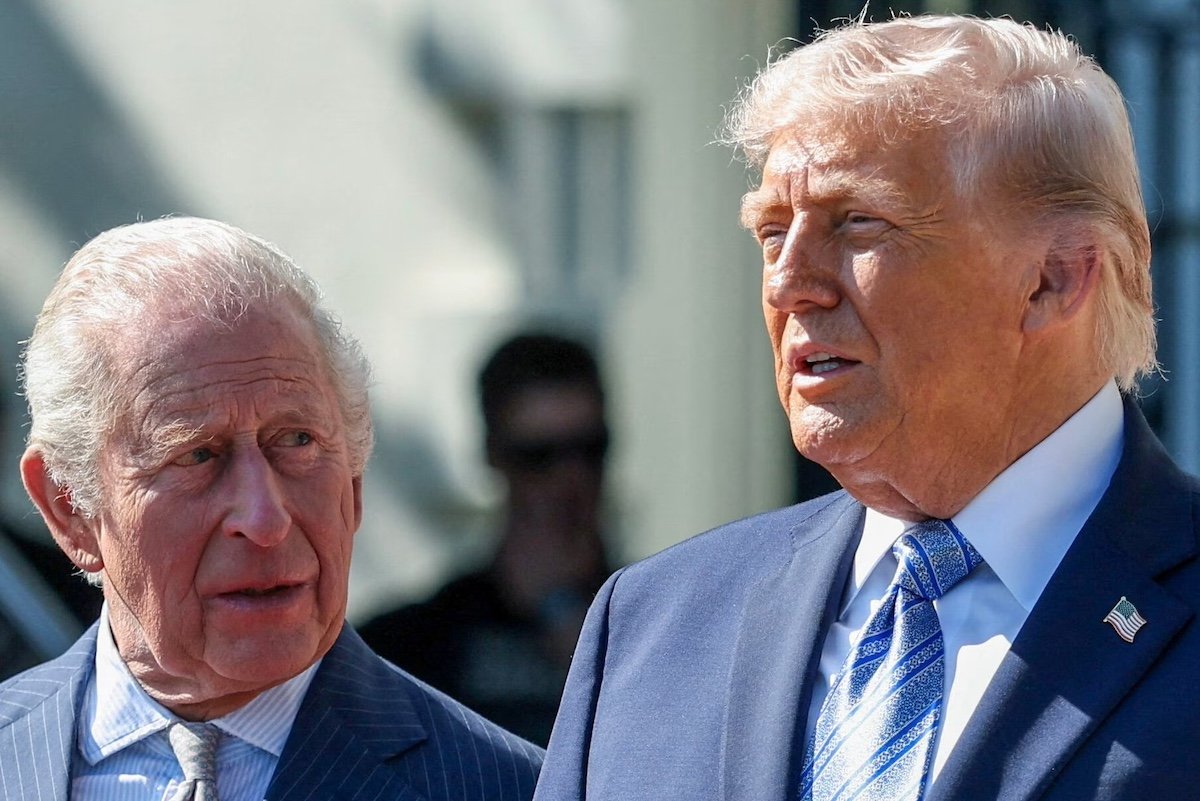

When King Charles III addresses a joint session of Congress on Tuesday (April 28), he will become only the second British monarch to do so. His mother gave the first such speech in May 1991, at a Washington meeting with the victory of the Cold War and the triumph of the Gulf War, with Anglo-American leadership at something close to its post-1945 zenith.
Washington Charles entering this week is a different country, and change is the whole story. Donald Trump accepts the king with 36% in Gallup, mired in an unpopular war against Iran, which Britain refused to join, in open opposition to Prime Minister Keir Starmer for precisely that non-participation and presiding over a tariff regime that has hit British exporters along with most of America’s other partners.
A YouGov poll at the end of March found that 49% of Britons wanted the visit to be scrapped altogether. Buckingham Palace and Downing Street are said to be clearing every line of choreography in advance, the better to avoid an “unscripted moment” – diplomatic shorthand for a moment of truth.
The polite framing is that Charles’ visit will “reaffirm” the special relationship. The honest framing is that the ceremony is the last functional instrument of the relationship.
A bargain dressed in Magna Carta language
The stripping away of sentimentality and the special relationship was always more contingent than its mythologists let on. Churchill coined the phrase at Fulton in 1946 to address an America that had once again withdrawn from Europe and needed to be coaxed back into an Atlantic role.
The architecture that followed—NATO, the nuclear sharing agreements, the Five Eyes intelligence partnership—did real strategic work, but it worked because Washington had a use for a permanent forward position in Europe, and London had a use for displaying continued global importance. It was an agreement, clothed in the language of Magna Carta.
This arrangement made sense in a bipolar world and again in the unipolar interlude that Britain enthusiastically helped usher in. It makes much less sense in the world that Trump’s second term is building.
The thing about Trump is that he takes the suit off. Where his predecessors in both parties paid sentimental tribute to the Atlantic alliance while running it transactionally, Trump runs it transactionally and says so. He has no patience for institutional liturgy – NATO, the G7, the WTO – and has made no effort to disguise his view that the Allies are debtors.
The fallout for Britain is embarrassing in a way that the British political class has not fully metabolized. Half the value of the special relationship was always the prestige of being treated on elevated terms by Washington. Trump does not address anyone in elevated terms.
What he answers is monarchy. Hence September’s unprecedented second state visit to Windsor, and now this week’s extraordinary reversal: a reigning British monarch crossing the Atlantic to address the legislature of a republic founded by rejecting his predecessor, on the 250th anniversary of that rejection, while his government quietly hopes the spectacle of war will buy it off.
There is something weak the old regime about the choreography. Britain offers the one thing Trump really covets – royal validation – and in return asks not for substantive concessions but the favor of being heard.
Planning analysts expect the address itself to remain, in the words of CSIS’s Max Bergmann, “high-profile” and “somewhat historic.” Translation: no one on either side wants to test what’s left of the relationship by asking her to lift anything heavy.
Iran’s test has already failed
The Iran war is the test that relations have already failed. Starmer refused to commit British forces. Trump continued regardless. The asymmetry is the crux of the matter – it confirms that British participation is no longer a prerequisite for US military action, and that British non-participation imposes no measurable cost on Washington’s freedom of manoeuvre.
For seven decades, the implicit bargain was that Britain would side with the United States in its wars and the United States would treat London as an indispensable European partner. The first half of that bargain Britain has now fallen; the second half, Washington had already quietly abandoned.
What replaces shopping is harder to name. Starmer officials describe a patient management strategy — keeping the channels open, absorbing the insults, hoping the post-1945 scaffolding will survive until another administration. Simon Tisdall of The Guardian has called this appeasement approach a failure.
The truest description is neither: it’s a holding stock from a country that hasn’t yet decided what it wants to be when the Atlantic frame is gone.
Canary for Asian allies
The implications travel far beyond London, and here the issue becomes unique to Tokyo, Seoul, Manila, Canberra and Delhi. The British case is the canary on the axis of the alliance.
If the most institutionally embedded, culturally closest, and reflexively loyal of America’s partners cannot move the second Trump administration into a war in the Persian Gulf, the assumption that AUKUS, the US-Japan alliance, the US-ROK extended deterrence framework, or the Indo-Pacific posture will be dangerous during inertial review.
The transactionalism that has hollowed out the special relationship will not stop in the Atlantic. In some respects, it has already arrived in Asia, in the form of the tariff regime, in the unresolved question of what extended deterrence now means in practice for Seoul and Tokyo, and in the apparent distance between American and allied positions on the Taiwan contingencies.
Japanese and South Korean planners who saw Britain kneel in Windsor in September and again on Capitol Hill this week – and still fail to extract concessions worth the trouble – are learning a lesson that no amount of AUKUS messages will mark: ceremonial proximity is not strategic insurance.
The realistic reading is not that alliances are doomed. It is that they have always been more contingent than their guardians admitted, and that the claim to the contrary is itself a strategic vulnerability.
Feeling is no substitute for common interest. Where interests align, the alliance gets the job done; where they differ, no amount of state banquet pageantry will replace the missing lining.
The morning after
Charles’ address will be gracious and historic and carefully curated. He will speak, as his mother did in 1991, about language, law and common sacrifice. He will be applauded. Cameras will catch the president shaking his head. Vice President JD Vance will take center stage.
And then the king will fly to New York and Virginia and home, and the questions about whether Britain will get an exemption from tariffs, whether Washington will care what London thinks about Iran or Ukraine, whether the next administration in either capital will bother to maintain the pretense — they will remain exactly where they were on Monday.
The honest duty – for Britain, for America’s Asian allies, for anyone who still points to the post-1945 order – is to stop confusing spectacle with politics. The special relationship isn’t what will be on the Capitol stage Tuesday afternoon. It is, or it is not, what is offered the next morning.
it ITEM was originally published in Leon Hadar’s Global Zeitgeist and is reprinted with kind permission. Become a subscriber here.



