
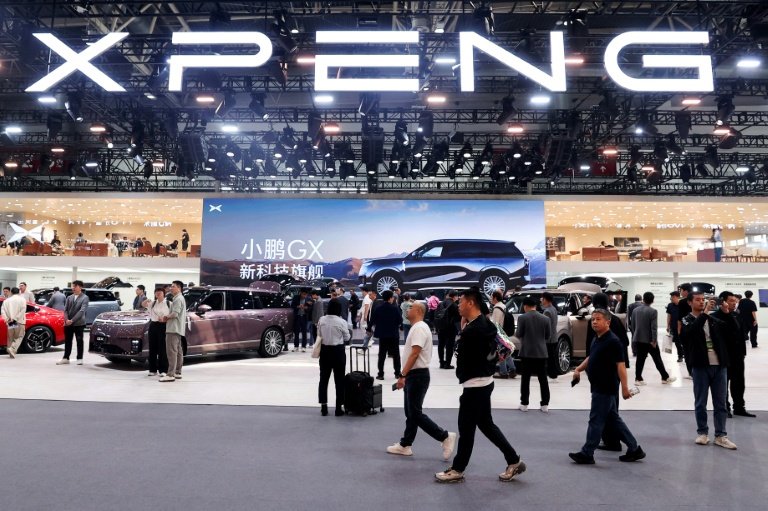

Visitors walk past the booth of Chinese automaker XPeng at the Beijing Auto Show – Copyright CN-STR/AFP –
Jing Xuan Teng with Rebecca Bailey in Shanghai, Luna Lin in Beijing and Julien Girault in Tokyo
In a sprawling office in Hefei, China’s eastern electric vehicle hub, hundreds of employees and several robotic arms sat down to refine software jointly developed by German giant Volkswagen and Chinese electric vehicle maker XPeng.
The days when foreign firms saw such partnerships primarily as a necessary entry fee into the world’s largest auto market are long gone.
Legacy overseas brands are now looking for cooperation, hoping that the rapid pace of domestic market and technological innovation will undo and increase their competitiveness in China and increasingly, abroad.
VW-XPeng’s China Electronic Architecture (CEA) – the software that controls a car’s electronics – was delivered within 18 months, said Frank Han, CEO of Cariad China, VW’s software company.
Without XPeng’s cooperation, it would have taken much more, he told reporters on a trip this week ahead of a major auto show in Beijing.
“In Germany, (it would take) at least three to four years,” he said.
From China’s opening up until recently, carmakers seeking market access had to enter into a joint venture with a local, often state-owned, company.
In addition to profit sharing, domestic firms benefited from the shared technology and best practices of their overseas partners.
“You can basically call the current situation a ‘reverse joint venture,'” said Zhang Yu, managing director of Shanghai-based consultancy Automotive Foresight.
“Foreign partners are starting to use local Chinese partners’ technology or EV platforms to modify – or actually directly build a new car – based on their Chinese partners’ car.”
– ‘Shocking moment’ –
For decades, China was a cash cow for many legacy brands, requiring minimal investment and offering huge profits.
But as the EV era began, aided by top-down policies such as generous subsidies, Chinese firms hit the throttle.
After the Covid lockdown and against a backdrop of sliding sales, the 2023 Shanghai auto show was “a shock moment” for foreign visitors, UBS analyst Paul Gong told AFP.
He described the relative speeds of pandemic-era development as “interstellar travel – internally, China had leapfrogged ahead while externally, global carmakers lagged behind”.
China is now considered by many to be a leader in areas such as smart cabs, battery technology and driving assistance systems.
Ford CEO Jim Farley called the progress “the most humbling thing I’ve ever seen.”
By 2025, foreign brands were increasingly adopting Chinese technology.
Autonomous driving collaborations included VW with Horizon Robotics, Audi with Huawei and a range of firms including Toyota and GM with Momenta.
Models such as the Nissan N7, Mazda EZ60 and SAIC Audi E5 were developed using the platforms of joint venture partners and investment was poured into research and development teams in China.
– “China for the world” –
Companies are increasingly clear that they hope that investment in China will increase their competitiveness overseas, especially as Chinese firms begin their overseas expansions.
“The knowledge we gained (in China) is driving us towards our goal of becoming a major technology player in the automotive industry worldwide,” VW Group CEO Oliver Blume said Monday, calling the country “the fitness center of the automotive industry.”
He told AFP that VW was looking at other Asian countries and South America as places that might be open to its Chinese-developed offerings.
His counterpart at rival BMW told the state-run Xinhua news agency last year that “the supply chain here is not just about China for China, it’s also China for the world.”
For Japan’s Nissan, exports will become “a strategic pillar”, the company said in April, as its sales in China have slowed.
The Chinese-developed N7 and Frontier Pro will be shipped to South America and Southeast Asia, with the latter additionally shipped to the Middle East.
“Our brand is still important, even in a very difficult market like China,” CEO Ivan Espinosa told reporters.
“And if you can compete in China, you can compete outside of China.”
France’s Renault, meanwhile, has stopped selling cars in China but uses its partnership there to develop technology.
One example is the Dacia Spring, made by state-owned Dongfeng, a small EV that significantly undercuts competitors when it goes on sale in Europe in 2021.
– Ecosystem Advantage –
The scoreboard for the foreign automakers’ pivot is “mixed,” UBS’s Gong said.
While they haven’t regained market share in China, “their products and technologies have improved,” which could help them in other markets like Europe, he said.
“Their challenges would be greater without” that strategy, he concluded.
To some extent, foreign firms have little choice.
“The advantage that Chinese firms have is not related to a single technology or model, but to an integrated ecosystem,” Chris Liu of research group Omdia told AFP.
The combination of software engineering talent, proximity to suppliers and access to real-world data “is difficult for foreign automakers to replicate outside of China.”
And foreign brands must make “drastic decisions” that go beyond just the product, said Sino Auto Insights founder Tu Le.
“It’s the culture, the speed, the closure of brands, the elimination of management that doesn’t have the right skills to lead them,” he said.
“‘Learning’ (from Chinese firms) is only part of the answer.”



