
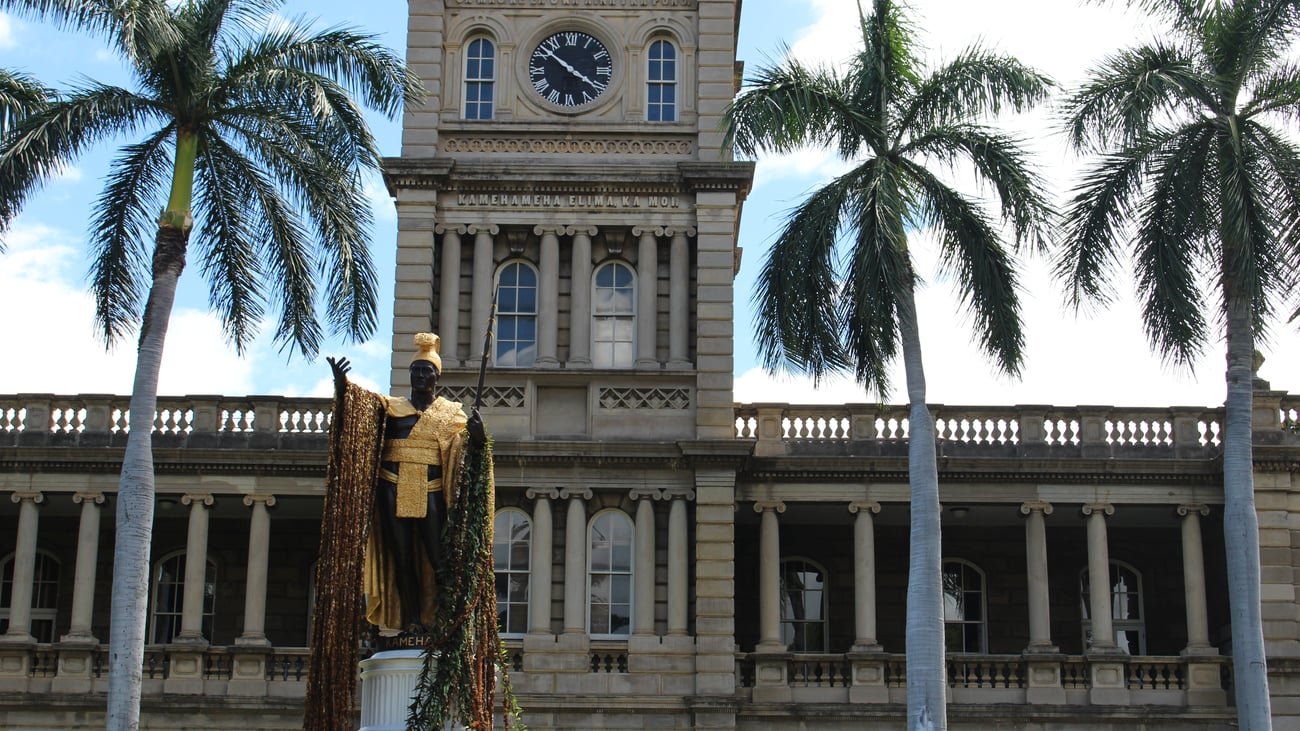

HONOLULU (CN) – Martin Kao could not speak for himself.
That, in essence, was the argument his attorney made Tuesday before the Hawaii Supreme Court, as justices considered whether a civil arbitration process should have been stayed years ago while Kao faced federal criminal charges that would eventually send him to prison.
Kao, the former president and chief executive of a Honolulu defense contractor formerly known as Navatek and now called PacMar Technologies, is serving a 87 months federal sentence on covid relief wire fraud, money laundering and bank fraud. He received an additional 33 months in October 2025 for orchestrating more than $200,000 in illegal campaign contributions to U.S. Sen. Susan Collins’ 2020 re-election campaign.
While those criminal cases were still pending in federal court, investor Navatek Capital pursued separate arbitration claims against Kao, accusing him of breach of fiduciary duty, fraud and gross negligence.
Kao asked the arbitrator to stay the proceedings until his criminal case was resolved, arguing that he could not fully defend himself without jeopardizing his constitutional right to remain silent. The arbitrator denied the request, continued the hearing, and ultimately awarded damages and punitive damages against Kaos.
Kao has been fighting that award ever since. Both the Oahu First District Court and the Intermediate Court of Appeals were against him.
Now the Hawaii Supreme Court is considering and addressing an issue that no Hawaii appellate court has resolved before: What standard should be applied when someone faces civil and criminal proceedings at the same time, and when does that situation justify a stay?
“It really depends on what the Fifth Amendment invocation prevented,” Kaos’ attorney, Keith Kiuchi, told the court. “In this case, he prevented him from testifying. It prevented him from getting a fundamentally fair hearing because he was the key witness in his own defense.”
Kiuchi argued that the arbitrator applied the wrong legal framework in denying the stay. The lower courts relied on a test derived from the Ninth Circuit’s decision in Keating v. Office of Thrift Supervisionwhich weighs factors including the plaintiff’s interest in moving forward, the defendant’s burden, and the public interest.
Kiuchi said the test is biased against defendants, with three of its five factors favoring the plaintiff’s side, and that it ignores stronger protections provided by Hawaii’s own constitution.
Unlike federal law, Hawaii prohibits courts from drawing any adverse inference when someone invokes their right against self-incrimination. This defense is written into the Hawaii Rules of Evidence.
“I would not advocate adoption Keating” Kiuchi said. “I think this court was correct in never approving it Keatingand I think there are reasons why it shouldn’t.”
Navatek Capital’s lawyers had a different view. David Louie, arguing for the investor group, said the company was fighting for its life when the arbitration took place in September and October 2021.
Louie said the company had already lost a quarter of its employees. The clearance of his federal facility, required to work on sensitive defense contracts, was under review. And as long as Kao remained a 99% owner, Louie said the company would have to disclose that fact in every new contract application submitted to the government.
“Justice delayed would have been justice denied to Navatek,” Louie said. “Honestly, they really would die if they couldn’t get some relief.”
Louie argued that the arbitrator properly weighed all these factors and made a reasonable decision, and that the court should uphold it regardless of the legal standard it ultimately adopts.
“I believe, under the circumstances, if this court would not disregard the existential threat or the arbitrator’s discretion, we win,” he said.
Leaders withdrew from both sides.
Acting Chief Justice Sabrina McKenna noted that Kao’s previous attorney had floated the idea of splitting the proceedings into separate phases, a process known as bifurcation, which could have allowed some cases to move forward without requiring Kao to testify. That idea was never pursued, and Kiuchi disputed it when it came up during Tuesday’s hearing.
Kiuchi said bifurcation would not have solved the problem because Kao still could not have testified on any part of the case, while his federal criminal exposure remained unresolved.
Chair Lisa Ginoza asked whether the claims at the heart of the case, specifically those related to removing Kao from his ownership role in the company, could have been separated from the damages claims so that Kao would have had an opportunity to participate.
Louie said the cases were too tangled to sever because proof of the severity of Kao’s behavior was necessary to justify his dismissal and support claims for damages.
“It’s not an easy thing for a 1% owner to cut off a 99% owner,” Louie said.
Judge Todd Eddins questioned whether it mattered that Kaos’ request to stop the arbitration was filed before he had been formally charged, even though he had already been arrested. He suggested that the court may want to draw a line between someone who is under investigation and someone who has actually been charged.
Throughout the hearing, the justices returned to the question of whether the Hawaii Constitution requires more than the federal standard. McKenna noted that Hawaii law is clear that no adverse inference can be drawn from silence, a defense that goes further than Keating framework provides.
Louie noted that the arbitrator had explicitly stated, on multiple occasions, that he was not drawing such a finding against Kao.
The judges took the case under advisement. Their decision could set the standard for how Hawaii courts and arbitrators handle future cases where civil and criminal proceedings overlap.

Subscribe to our free newsletters
Our weekly newsletter Closing arguments provides the latest on ongoing trials, major litigation and decisions in courts around the US and the world, while monthly Under the lights feeds legal dirt from Hollywood, sports, Big Tech and the arts.



