

Earlier this month, Indonesia and Japan signed a defense cooperation agreement deal which may eventually allow Jakarta to obtain lethal weapons from Tokyo. The move was the latest in a series of strategic engagements that signal Indonesia is beginning to take sides amid growing geopolitical rivalry in the Indo-Pacific.
When I arguing last July that the US-Indonesia trade compromise would test President Prabowo Subianto’s noncommittal strategic discipline, the assumption was that Jakarta would have time to calibrate. There isn’t, and there isn’t.
This has been evident in new political and defense deals with the US and its regional partners, including discussions that have raised China’s voice over expanded US military access over the air, and in simultaneous energy deals with Russia under sanctions pressure.
All this has unfolded against the backdrop of Iran’s war and its oil shock, caused by the blockade of the Strait of Hormuz.
From Jakarta’s perspective, this may look like strategic diversification. From Beijing’s perspective, it is likely to be seen as a strategic shift towards the US. The danger is not Jakarta’s formal outreach, but that Indonesia is being thrust into the eye of the storm of US-China rivalry at a time when the maritime order and the global economy are under severe strain.
The geography of Indonesia is increasingly important. The archipelago straddles the Straits of Malacca – the main artery for China’s energy imports and westward trade – and runs a network of sea lanes connecting the Indian and Pacific oceans.
The Hormuz conflict has shown how quickly chokepoints can be weaponized and how weak legal guarantees become during armed conflict. This, in turn, has focused renewed attention on the strategic Malacca Strait corridor and its potential role in any US-China conflict in the Indo-Pacific, including Taiwan.
Jakarta can rightly point out that it has engaged Beijing at the highest level. Prabowo met with Chinese President Xi Jinping in September 2025 and attended China’s military parade – an unmistakable signal of diplomatic goodwill.
Economically, the relationship is deep and growing. China is Indonesia’s largest trading partner and is deeply integrated into Indonesia’s minerals, manufacturing and infrastructure sectors. Indonesia officially joined BRICS+ in January 2025, a bloc in which China is the main force building systems and channels outside US-led institutions.
However, these commitments do not resolve Beijing’s core concern: the prospect that Indonesia’s airspace and sea lanes could be used by US forces in a kinetic conflict. This concern has crystallized around recent reports of a US request for broad access over military flight.
The Ministry of Foreign Affairs of Indonesia has warned that such access could enable US surveillance, create the perception of an alliance and possibly make Indonesia a target in a regional conflict pitting the US against China.
Beijing’s diplomatic response, delivered through its Foreign Ministry, was characteristically measured but emphatic, saying defense cooperation must not “target any third party” or undermine regional stability. The “third party” did not need to be named.
Herein lies the crux of the matter. In contemporary conflict, overflight rights, intelligence, surveillance and reconnaissance (ISR) integration, and shared logistics corridors shape military outcomes more than treaties or formal partnerships.
Indonesia may not choose geopolitical sides – but its airspace may be used by the US before it does. This is the threshold that Beijing’s statement suggests it is wary of Indonesia crossing.
China’s reaction to the Indonesia-Japan deal was also notable. When the Tokyo leadership signaled that a Taiwan emergency could pose a direct security threat to Japan, Beijing he answered harshly, warning of consequences, saying a red line had been crossed.
The Tokyo announcement marked a decisive shift from strategic ambiguity to a clear commitment to contingency planning. Once a state is seen as part of a Taiwan scenario, it is no longer neutral – it is pre-positioned in China’s strategic calculus.
Indonesia has made no such statement about Taiwan. But its deepening defense engagement with Japan creates what analysts call the risk of second-order alignment. Beijing’s concern is not what Jakarta says; it is to which Indonesia is functionally converging.
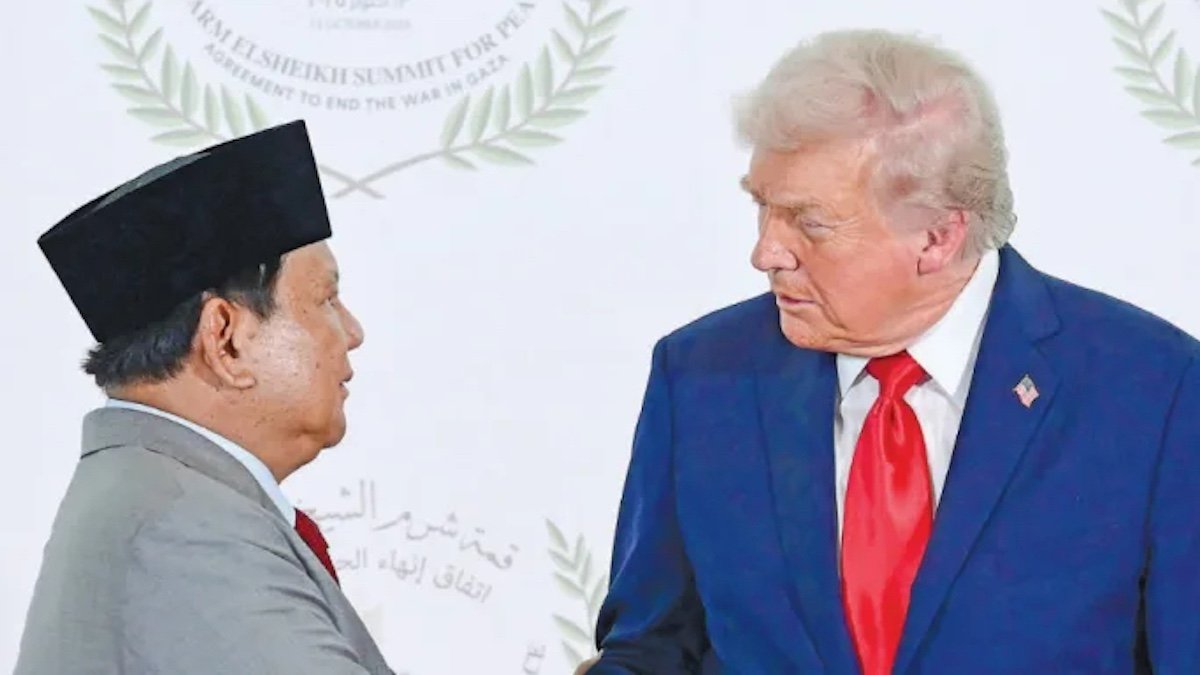
The events of February deepened this perception. Indonesia’s participation in a US-led “peace” initiative framed around Palestine was quickly overtaken by the subsequent US-Israeli attacks on Iran, leading to the rift in Hormuz, a spike in energy prices, and an overt US shift from diplomacy to coercion.
A diplomatic initiative turned, without warning, into an instrument of force, leaving Indonesia exposed – it seemed to have taken sides in the process.
Individually, none of Indonesia’s recent moves – defense cooperation with the US, Australia and Japan, a trade deal involving critical minerals cooperation with Washington and industrial discussions with Europe – amount to overt alignment. But together, they form a clear pattern.
This is not political incoherence. It is a strategy of movement through sustainable accumulation. Each step is protected, but together they reduce ambiguity and create a directional signal.
At the same time, geopolitical competition is intensifying with European sanctions regimes expanding to include third-country hubs, turning energy and other transactions into geopolitical positioning.
The global economy, already strained by the shock of Hormuz, is becoming more fragmented, pressuring nonaligned states like Indonesia to take sides. Moreover, despite the recently concluded summit between Xi Jinping and Donald Trump, the US-China rivalry is not going away. As maritime chokepoints become central to strategic competition, Southeast Asia is no longer a buffer—it’s a theater.
This, in turn, is making neutrality policies increasingly difficult to sustain. If Indonesia moves too quickly or too far toward Washington without calibrating Beijing’s concerns, it risks moving from stabilizer to battleground.
Such a change, or even the perception of one, would be costly for the region. Indonesia has long anchored Southeast Asia as an area of relative stability, acting as a convention within ASEAN and a bridge between competing powers. This diplomatic role depends on its credibility as a non-aligned nation.
A country perceived as positioned, on the other hand, may see its influence erode quickly as its neutrality is questioned. This may not yet be the case for Indonesia, but China’s concerns have been clearly expressed.
In a fractured geopolitical order, sovereignty is defined not only by what a state controls, but also by its ability to avoid involvement in systems it does not command. For Indonesia, the task is no longer to expand partnerships indiscriminately, but to restore balance—deliberately and visibly—before displacement hardens in scope.
Adi Abidin is a public policy specialist based in Jakarta at Kiroyan Partners and a researcher at the Populi Center. The look is his.



