
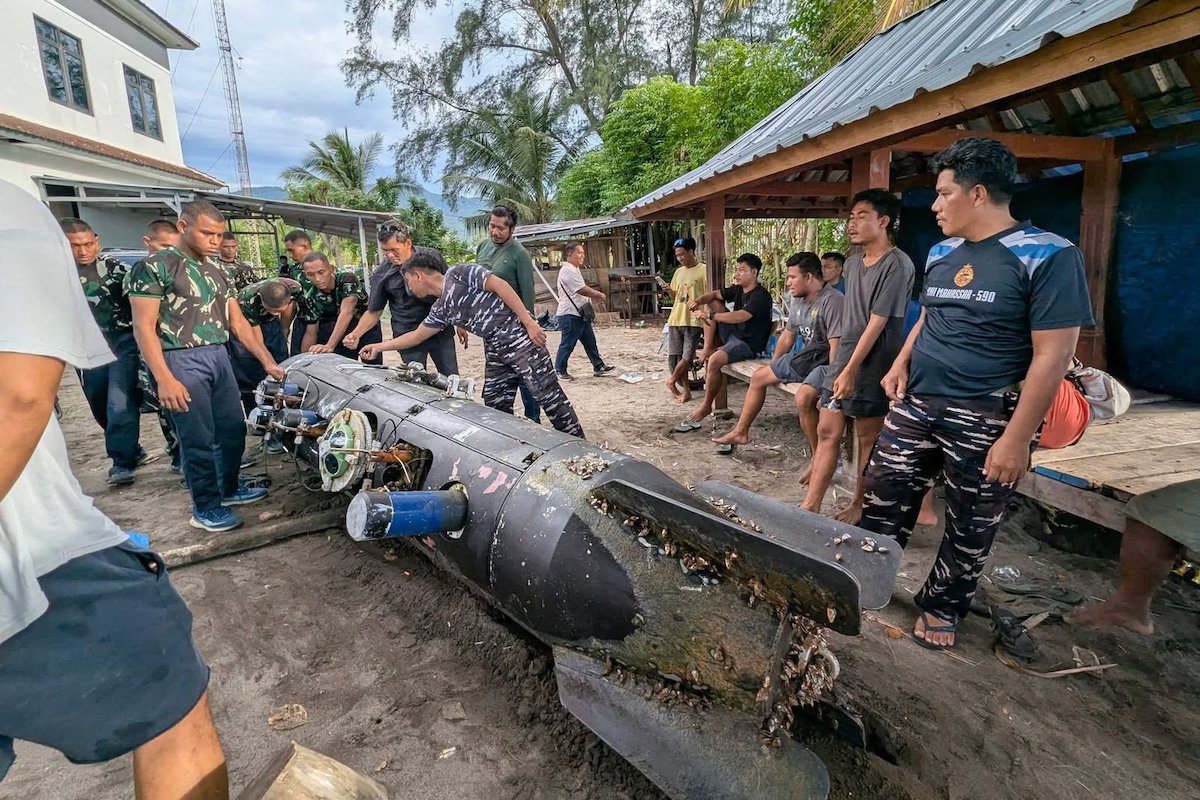

of INTELLIGENCE of a suspected Chinese unmanned underwater vehicle (UUV) in the Lombok Strait is not a routine maritime incident. It is a violation of Indonesia’s strategic space.
Found by a local fisherman inside Archipelagic Sea Lane II (ALKI II), the device – marked “CSIC”, linking it to the China Shipbuilding Industry Corporation – points to unauthorized underwater activity in one of the country’s most critical maritime corridors.
This requires more than caution. Requests a response from Indonesia. Lombok Strait is not a peripheral water. It is a strategic choke point connecting the Pacific Ocean with the Indian Ocean, used for global trade and, more importantly, for underwater transit due to its depth.
Control over this corridor is essential to Indonesia’s maritime sovereignty. Allowing foreign systems to operate there without consequence weakens that control in practice, regardless of what the legal boundaries say on paper.
UUVs are built to be invisible and durable – qualities that make them ideal for surveillance and deeply problematic when found in someone else’s waters without permission.
While they can collect scientific data, they are equally capable of mapping the seabed, recording acoustic signatures and supporting submarine operations. In modern naval strategy, this constitutes intelligence gathering – not passive research.
Treating this ambiguity as acceptable is a strategic mistake. It creates room for undeniable interference. Over time, it normalizes foreign presence under Indonesian waters without consent or oversight.
Indonesia’s current stance – investigate, avoid escalation, wait for clarity – is inadequate given the stakes. The actor who sets up the system benefits from the strategic ambiguity, not the state whose waters are being penetrated.
Jakarta must respond clearly and decisively. First, it must publicly state that any unauthorized deployment of unmanned underwater systems within its archipelagic sea lanes constitutes a violation of its sovereign rights. Transit does not include covert surveillance. This must be said without qualification.
Second, Jakarta should call Chinese officials for an official explanation. Silence should not be tolerated. If no credible answer is given, Indonesia should say so publicly. Diplomatic discomfort is justified when national security is at stake.
Third, Indonesia should immediately prioritize awareness of the underwater field. Currently, the country is effectively blind below the surface – a strategic vulnerability that can no longer be ignored. Investment in seabed sensors, acoustic monitoring and anti-submarine capabilities are no longer optional. It is urgent.
The fact that a fisherman, not a detection system, found the device is no accident. It is evidence of a critical gap in national skills.
Fourth, Indonesia should deepen operational cooperation with capable partners such as Australia, Japan and India. This is not alignment – it is capacity building. Without outside expertise and technology, closing the underwater surveillance gap will take much longer than the strategic environment allows.
Fifth, Indonesia should lead efforts to establish regional regulations governing unmanned underwater systems. The lack of clear norms enables exactly this type of activity. If Indonesia does not push for new standards, it will be forced to play by the rules set by others.
The strategic competition in the Indo-Pacific is moving underwater – quieter, harder to detect and easier to deny than anything happening on the surface. This makes it more dangerous for states that fail to adapt.
Indonesia cannot afford to treat this incident as an isolated case or a technical curiosity. It is a direct challenge to control its maritime domain.
The last time a foreign UUV appeared in these waters and was left unanswered, it returned. Consequence-free content isn’t patience—it’s permission.
Indonesia does not need confrontation. But it must impose costs – diplomatic, political and strategic – for unauthorized activity in its waters. Sovereignty is not declared. It applies – or it doesn’t.
If Jakarta fails to act decisively now, it will not only lose visibility beneath the surface. It will lose control over it.
Muhammad Zulfikar Rakhmat is director of the China-Indonesia Desk at the Jakarta-based Center for Economic and Legal Studies (CELIOS) independent research institute.



