
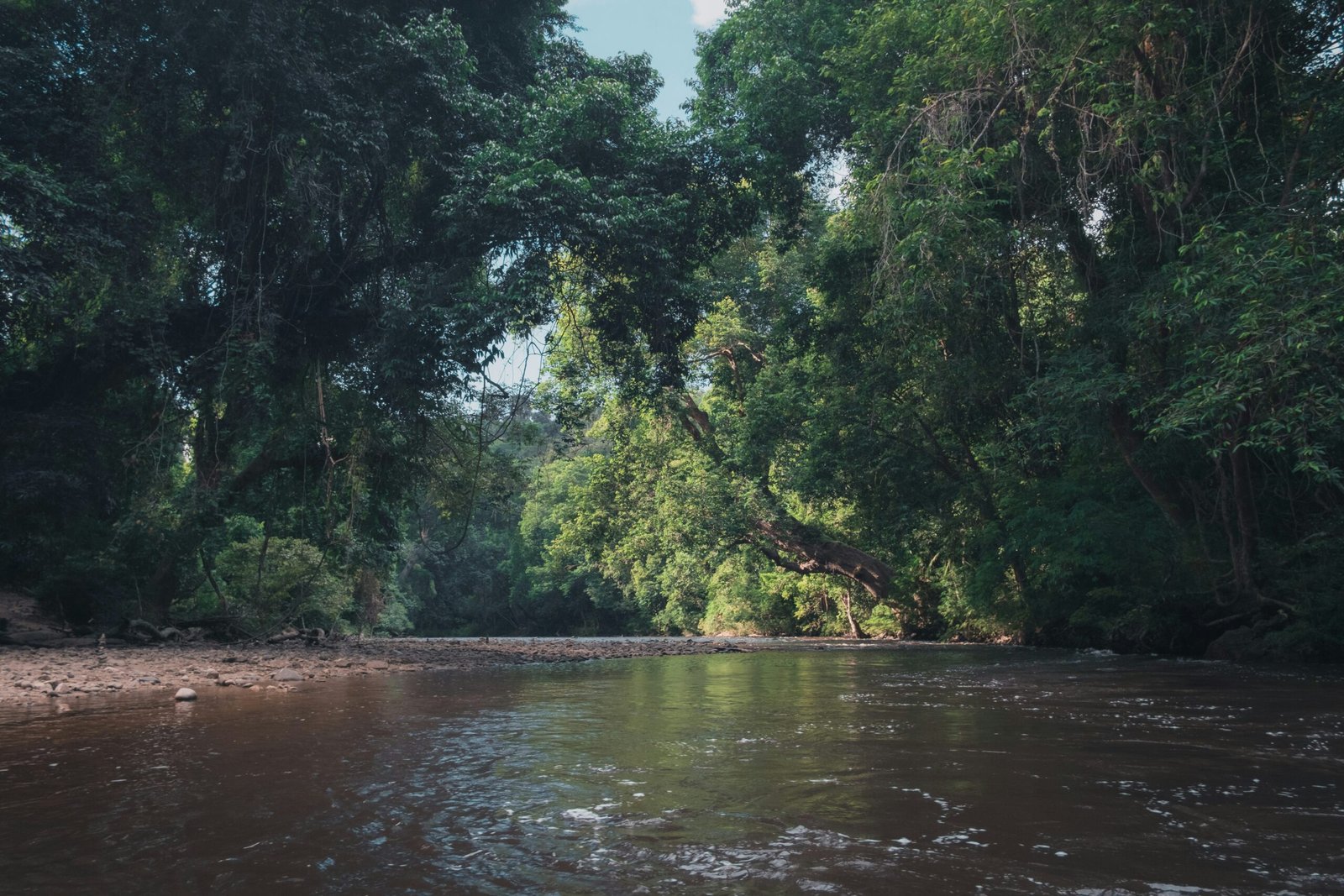


The boat trip begins with a warning from the guide: you’re going to get wet.
IN AsiaCamp Resorton the edge of Malaysia’s Taman Negara National Park, travelers bundle up in rubber sandals and quick-dry clothes before boarding narrow wooden boats that cross the muddy Tembeling River. The excursion is called “rapid shooting,” a tourist-friendly name for jumping through small river rapids at speed.
The trip costs 119 Malaysian ringgit (about $30) and comes as part of a package including return transport from Kuala Lumpur, a speedboat ride through the shallows and a canopy walk over the rainforest. Tucked into the itinerary is something more unusual than rapids and tent trekking: a stop at a Batek village, deep within one of the world’s oldest rainforests.

Taman Negara, a large protected area spanning three Malaysian states, is estimated to be around 130 million years old, pre-Himalaya. The park is home to Malayan tigers, Asiatic elephants and sun bears and dense jungle ecosystems of extraordinary age. But it is also home to people who have lived within these forests for thousands of years. Among them are the Batek, part of the Orang Asli, a Malay term meaning “original people”, which includes 18 distinct indigenous groups of peninsular Malaysia.
I had come to Taman Negara specifically to meet them. A guide on a food tour in Kuala Lumpur had mentioned an indigenous population living deep within the national park. I booked the excursion right after.
As a black British woman of Nigerian descent, I had long been curious about certain indigenous populations throughout Southeast Asia and parts of Oceania. These are communities whose tightly curled hair, darker skin tones and facial features have prompted comparisons with sub-Saharan African populations for centuries. However, these comparisons are misleading. Genetic research confirms that similar physical traits emerged through convergent evolution—parallel adaptation to rainforest-like environments rather than common ancestry. of A language belongs to the Asian branch of the Austroasiatic family, a linguistic lineage completely separate from the major language families of Africa. However, the visual resemblance had fascinated me and I had wondered what it might be like to stand inside it.
When the boat slowed and the engine cut off, the jungle suddenly felt vast and peaceful. Our driver was Bateku, a young man from the village we were about to enter. He cut the engine and waited in silence as we waded into the muddy bank, then followed our guide along a narrow path in the trees.
The meeting lasted maybe 30 minutes. What stuck with me was not what happened, but what didn’t happen.
Before traveling, I had imagined that the meeting might have an emotional charge. I’m not sure exactly what I was expecting – a flicker of curiosity, perhaps, a mutual recognition from a distance. Instead, the moment felt remarkably ordinary. The villagers observed us politely, but without particular interest. Demonstrations ensued: pipe hunting, rattan bonfires, handicrafts passed between hands. With no common language and no translator, we communicated through gestures, nods and partial translations of the guide.

Whatever curiosity I felt was not reflected. I had half expected that our shared sight might register even a fraction of my intrigue, and that I might be perceived as something other than another tourist, that one of them might linger on my face a moment longer than the others. None of this happened. The villagers watched us all with the same polite detachment.
The women and children had gathered away from the group, going about their business near their thatched shelters at the edge of the clearing. I walked towards them. A woman stood with a young girl by her side. I wanted so badly to ask her something, not about technique or tradition, but about how this daily stream of visitors felt from where she stood. Be it intrusive, or just plain boring. If she’s ever tired of being someone else’s revelation. If she had ever seen a visitor and seen something of herself looking back.
I didn’t ask anything.

I gestured for her permission to photograph her and she agreed, without much interest. She held my gaze steadily as I took the picture, neither welcoming nor unwelcoming. Her indifference was not rude. It was just right. I was a stranger who had crossed space to her, and the fact that we might share some traits—however meaningful or meaningless—was entirely my preoccupation, not hers.
As we walked back to the river, I realized that the meeting had quietly dismantled one of my assumptions. The physical resemblance had led me to imagine some sort of instant kinship. Kinship, of course, doesn’t work that way. The vast, distinct distance between two human lives that do not share a language, a history, or even a reason to reach each other cannot be resolved through similarity alone.

The contrast was sharpened months later when I visited the Aeta people near Angeles in the Philippines, another indigenous community often grouped within the broader category of Negritos. Most of the people in the village I had visited were of mixed heritage, speaking Tagalog with little English. Conversations flowed easily. I even met a young man of half-Nigerian, half-Aeta heritage. That meeting felt warmer, more reciprocal—but it didn’t resolve my earlier curiosity so much as reformulate it. What made that meeting feel like real contact wasn’t the looks. It was the language and the simple possibility of conversation.
Back in Taman Negara, the Batek man steering the boat up, greeted us for our journey back to the mainland, flicking the engine handle with easy recognition. He smiled when I caught his eye. Work like this – boating, selling crafts to visitors, demonstrations for tips – represents the community’s main income from tourism, although how much of the tour fee paid to the operator goes directly to them remains unclear. Like many indigenous trade meetings, the economics are murky.

The exchange had been, in many ways, anticlimactic. I wasn’t met with an instant embrace like I was long-lost family, nor was I singled out as someone remotely worth mentioning. And yet something had changed. The lack of recognition I expected had forced more uncomfortable questions: what had I really been looking for? And what did it say about me that I expected to find it here? I left without an answer, but I left thinking all the same, which turned out to be more than I bargained for.



