
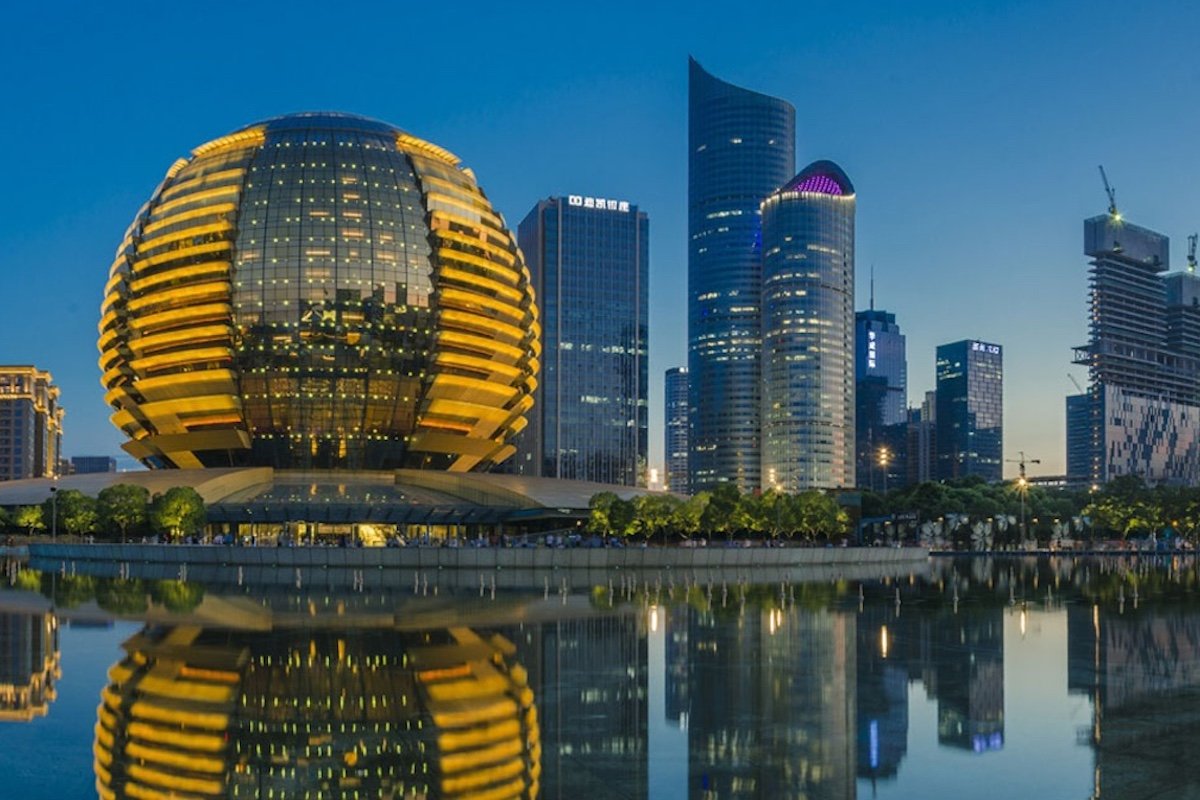

On April 1, China’s National Bureau of Statistics releasing the latest ranking of the GDP for the various provinces and municipalities of the country. The data showed steady growth in major metropolises, but also revealed significant geographic variation in the Chinese economy.
The data ranked Jiangsu and Zhejiang first and third, respectively, among Chinese provinces by GDP per capita, while Guangdong was ranked fourth. However, 20 years ago, Guangdong held an undisputed first placewith Zhejiang and Jiangsu a distant third and fourth.
The change is even more visible at the city level. In 2005, nine cities from Guangdong appeared in the top 25 by GDP per capita, compared to five from Jiangsu and two from Zhejiang.
Twenty years later, only three Guangdong cities remain in that group, while Jiangsu and Zhejiang have grown to seven and four, respectively.
Of course, the three provinces remain among the most developed regions in China. Since the late 1970s, China’s economic reforms have relied heavily on manufacturing and export-led growth, fostering a regional inequality that continues today and favors its eastern coast.
Guangdong pioneered this model, with Shenzhen (ranked No. 1 in 2005, No. 6 in 2025) and Zhuhai (No. 3 in 2005, No. 16 in 2025) leveraging their proximity to Hong Kong and Macau, respectively, to become successful economic zones.
Guangzhou (No. 8 in 2005, No. 22 in 2025) also used its status as the provincial capital and largest city to establish itself as a major manufacturing and commercial center.
This success in manufacturing spurred the formation of innovative local firms, including Huawei in telecommunications, DJI in drones, Tencent in digital services, and BYD in batteries and electric vehicles.
As these firms continue to make their mark in China and abroad, the country’s startup scene has shifted further north. The last of China five year planpublished on March 12, makes clear the new centers of gravity.
In artificial intelligence and robotics, Zhejiang’s capital Hangzhou leads with local champions DeepSeek and Unitree, backed by hometown tech giant Alibaba.
In biomanufacturing, national champion WuXi Biologics has FACILITIES in Hangzhou, Jiangsu’s Suzhou (No. 25 in 2005, No. 7 in 2025) and neighboring Wuxi (No. 11 in 2005, No. 5 in 2025).
The divergence in high-tech entrepreneurship can be partially explained by the presence of higher education institutions.
Last March, The Economist profiled Zhejiang University, concluding that its presence is important in turning Hangzhou into a startup hub – just as Stanford has done for Silicon Valley.
Indeed, various university rankings consistently place both Zhejiang University and Nanjing University – located in Jiangsu’s capital Nanjing (No. 31 in 2005, No. 11 in 2025) – along with several universities in nearby Shanghai and Anhui province in the top 10, while Guangdong is absent.
The educational advantage that Jiangsu and Zhejiang have over Guangdong has centuries-old roots. Since Southern Song DynastyJiangnan – the region spanning the southern bank of the Yangtze River, including parts of Jiangsu and Zhejiang – has been China’s premier CulturAl and economic center, comparing strength in agricultural productivity and trade to artistic and intellectual achievement.
In contrast, Lingnanwhich includes present-day Guangdong, was historically open to sea trade, but remained culturally distant from the rest of the country due to its geographic isolation.
Both regions have strong trade traditions, but Jiangnan’s intellectual heritage may give it an edge in producing the talent needed to push the technological frontier.
As Jiangsu and Zhejiang move forward economically, they may once again become China’s cultural center. In the 1980s and 1990s, Cantonese pop culture spread throughout China, fueled by Hong Kong’s prosperity, giving the province’s native language an unprecedented nuance.
But this prestige has declined significantly as Hong Kong’s economic position has declined. Meanwhile, the rise of Shanghai as an economic powerhouse has raised the profile of Jiangnan’s local language as a countercultural force – the once marginalized language is reasserting itself in the public sphere against the nationwide push for Mandarin.
Of course, it is not a foregone conclusion that the wider economic and cultural shift from Guangdong to Jiangsu and Zhejiang will continue. Much will depend on the success of individual entrepreneurs and their firms, wherever they are located.
And global demand for Chinese goods and services can change quickly, shaped by ongoing restrictions on Chinese imports around the world. But in any case, examining regional differences serves as a reminder that China is far from monolithic in its future economic trajectory.



