
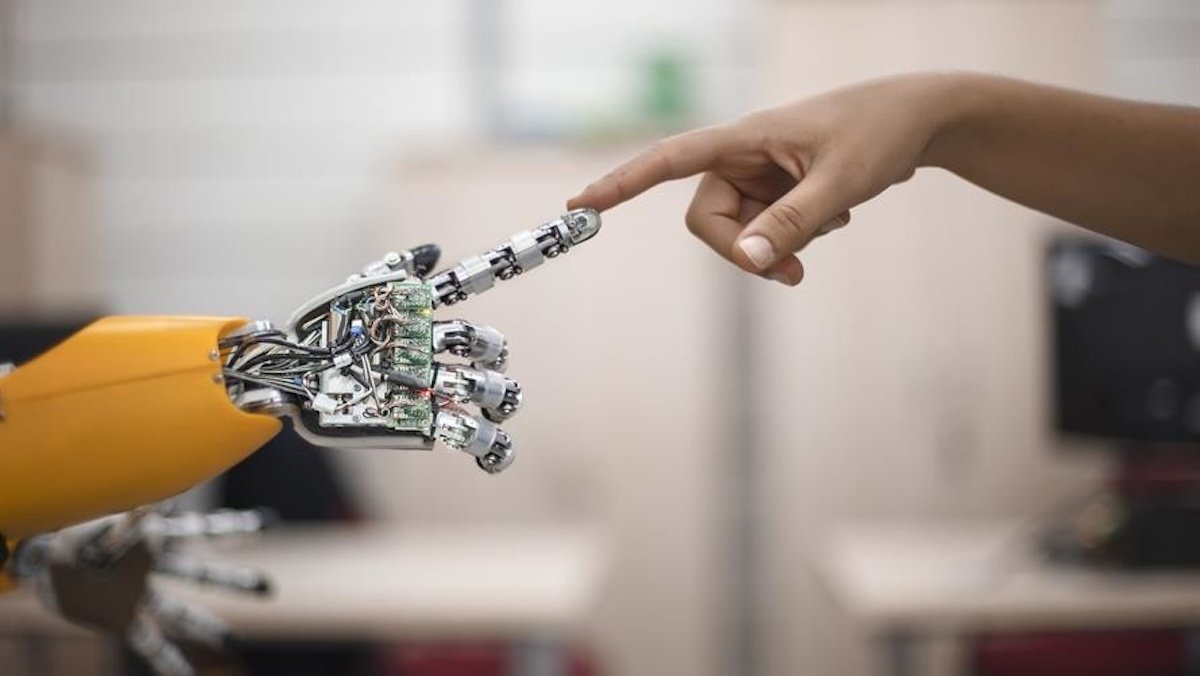

The robot pauses at the edge of the room while an engineer checks its sensors. Then, with a soft mechanical hum, this humanoid machine begins to move. Lift a mannequin from a bed, slowly and carefully. Engineers hold their breath.
I’m in one robotics lab in Tokyo, Japan, as part of my Welcome research scholarship. Engineers have repeated this test hundreds of times over several weeks, with mixed results.
Japan has one of the oldest populations in the worldand a strained health and care workforce. It has also long been a global leader in the development and deployment of care robots.
While other countries are exploring robotics technology, Japan stands out for the size of its investment over several decades, and strong link between innovation and national policy.
Government-led initiatives such as Society 5.0 AND Moon shot promote a “super-intelligent” society in which, by 2050, robots can be integrated into everyday life. An early example is the impending trial of humanoid baggage handlers at Tokyo’s Haneda Airport.
My research evaluates what bot presentation is care tools in Japan. This includes ethical and societal questions about affordability, privacy risks, data management and security – and what The Japanese public thinks about these technologies.
In a care sector that is under pressure globally, different types of robots – from humanoid and pet-like “companions” to more direct mechanical aids – can be useful. Some help lift people, reducing the physical strain on care workers. Others remind patients to take medication, support their rehabilitation exercises and monitor their vitals.
However, my research shows that there is still a large gap between organized robotics demonstrations and everyday reality.
Unique human ability
Many of the robots I observed were tested in carefully controlled environments. The floors were cleaned, the lighting adjusted, the engineers stood by ready to enter. In some cases, the actions of the robots were partially, if not entirely, controlled from a distance.
In contrast, real care settings are busy, unpredictable and crowded. People move suddenly. Their needs change from moment to moment. Technologies that work well in labs still struggle in these environments.
Caregivers can notice changes in the patient’s mood and adjust the way they speak. They can provide comfort without being asked. These are uniquely human abilities. As one family caregiver put it: “The promise of robotic care is practical, but the experience of care is emotional—therein lies the tension.”

Some family caregivers and professional care workers welcomed the idea of robotic assistance, especially for physically demanding tasks such as lifting. Others worried that too much reliance on machines could make care feel impersonal.
“For some adults, these technologies are useful tools,” said one caregiver. “For others, they feel confused, disillusioned—a glimpse of a future they never sought.”
Such perspectives are often missing from media narratives that focus on robot success stories. In Japan, these are shaped by government strategies and economic priorities. Innovation, never neutral, reflects political agendas on how society should respond to an aging and labor shortage.
The care challenges facing societies are not only technical, but social, ethical and cultural. They raise questions about what care should be takenhow it is valued and what future we want. “Between families and caregivers, hope and hesitation sit side by side,” one technology developer told me. “Efficiency is often welcome, but not at the cost of losing the human touch.”
The future of care?
While Japan has been successful in exporting social assistance robots such as Paro (a therapeutic robot that resembles a baby seal) and the humanoid pepperChina is rapidly expanding the market with more affordable, mass-produced technology and humanoid innovation.
However, we are still a long way from the vision of care robots that feed, bathe and support people in various ways, as human caregivers do every day. Participants in my research, including technology developers, all agreed that robots should never fully replace human caregivers.
Technologies that assist with lifting, mobility, and routine monitoring are more likely to be widely used and ethically and socially accepted. In these areas, robots can complement human care rather than trying to replace it.
Caring is, at its core, a deeply human activity, not just a series of programmable tasks. It relies on relationships, trust and mutual understanding. Robots can support these processes, but they cannot replace them.
Furthermore, some technologies are likely to remain expensive, available mainly to well-funded care homes or private users. This raises issues about access to good quality care.
The developments of care robots in Japan show what can be achieved through sustained investment and political support. But they also shed light on the enormous amount of work required for it ensure responsible research and innovative practices in this area.
The real question is not just what robots can do. It’s about what kind of care we want in the future – and how technology can support it without deepening inequalities, limiting access to good quality care and losing the power of the human touch.
Giulia De Togni is a Chancellor’s Fellow, School of Population Health Sciences, University of Edinburgh.
This article was reprinted from Conversation under a Creative Commons license. Read on original article.



