
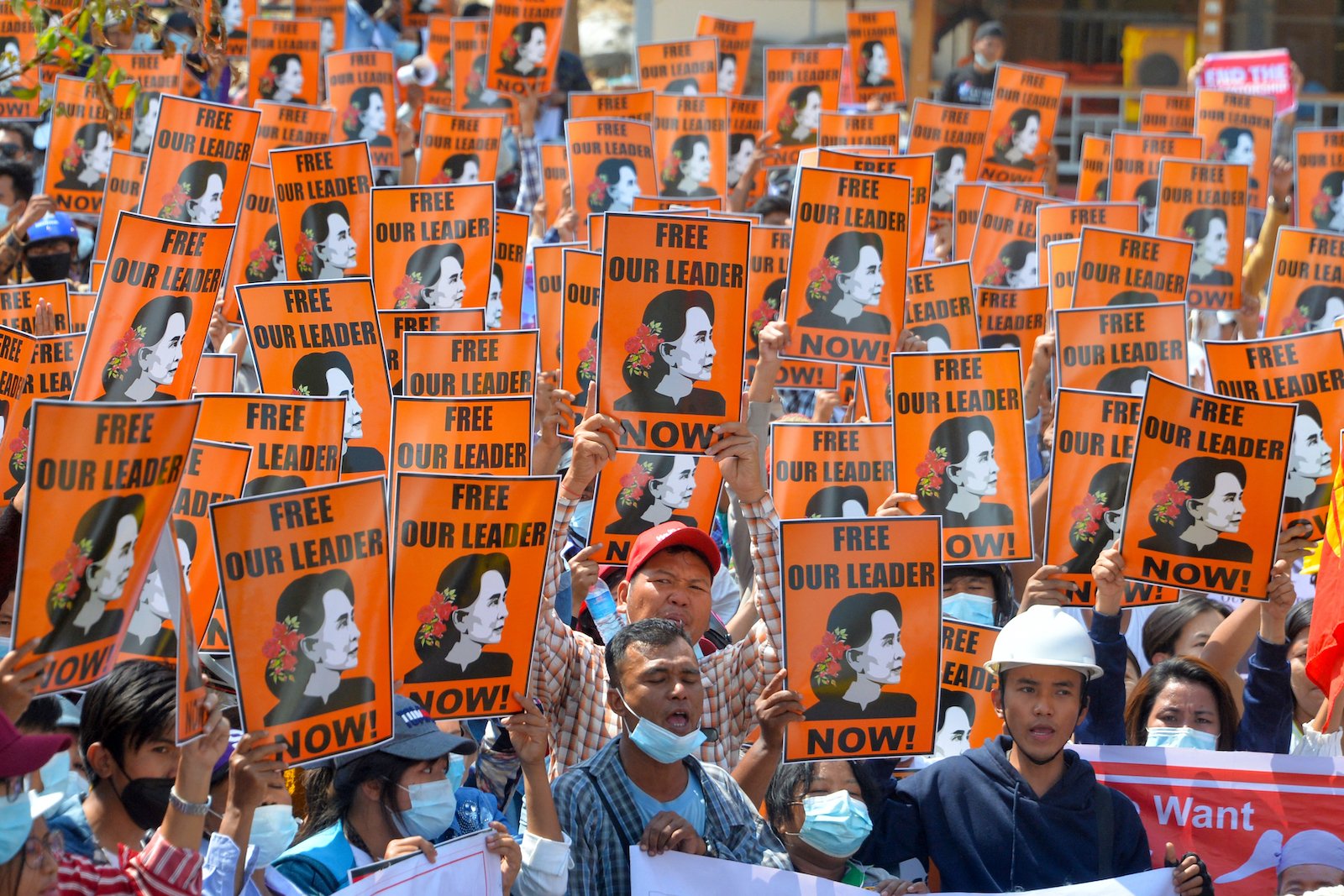

Myanmar’s military is trying to sell the transfer of former state counselor Aung San Suu Kyi from prison to a “designated residence” as a gesture of mercy. But the move has raised fundamental questions: where is she, who has seen her, and can anyone outside the junta verify her health and well-being?
The military’s tactic is already well-worn: imprison perceived opponents, move them through various detention facilities, release some sporadically, reduce sentences, and wait for the foreign praise to come. Some Western governments have responded cautiously, calling for Suu Kyi’s freedom, access to family and lawyers and proof of life. But some have already gone too far.
of The European Union responded cautiouslycalling for her full release and the freedom of all political prisoners. France welcomed the “Proof of Life” campaign. directed by her son, Kim Aris, while United States AND Canada also called for its freedom.
Seema Malhotra, the UK’s minister for the Indo-Pacific, went somewhat further, calling the move “a welcome first step”. although she said it should lead to Suu Kyi’s unconditional release.
The reality is that Suu Kyi is not free – only the place where she is being held has changed. From 1989 to 2010, she spent 15 years under house arrest in her home. But, of course, house arrest is not freedom.
The routine is repeating itself as top general Min Aung Hlaing, the coup d’état, trades his military khakis for civilian clothes without changing the political system. After sham elections held in December and January, the general has assumed the presidency, but the regime remains built and controlled by the military.
The world has seen this act before, and the EU and UK have previously bought tickets to the show.
The Billion Dollar Illusion of Reform
After 2010 elections that started a process of political opening, Myanmar’s military served up a story that Western governments wanted to hear: that long-time abusive generals had changed their ways and supported democracy. The line then was that the country was opening up, that foreign engagement would encourage reforms and the peace process, and that funding would help end decades of civil war.
European donors greeted the narrative with money, consultants and confidence in a “transition” that never removed the military from political power. According to the Asia Foundation’s 2024 review, Myanmar went from the world’s 79th largest aid recipient in 2010 to the seventh largest in 2015, receiving $13.7 billion in aid commitments between 2011 and 2015.
Of course, some of this aid helped real people in need with programs to promote health, education, civil society and ethnic communities. But the policy was all wrong. Mostly Western donors treated a military-engineered opening as a genuine transition away from military rule and toward democratic rule.
They treated Nationwide Ceasefire Agreement 2015 (NCA) as the foundation for national peace, although it excluded many ethnic armed organizations, it failed to address federalism and left the military outside civilian control.
ISP-Myanmar, citing EU figures, later noted that the EU earmarked €103 million for peace-related efforts between 2014 and 2020, including €8.7 million for the Myanmar Peace Center and €58 million for the EU peace and conflict resolution package.
However, the conflict data does not support optimism. Trends based on ACLED show that violence did not abate during the decade of reform, with a particularly sharp increase led by the military in 2017.
Studies from Peace Research Institute Oslo (PRIO) AND Myanmar Institute for Peace and Security (MIPS)meanwhile, it found that Myanmar’s non-comprehensive ceasefires did not reduce overall violence.
Then critics warned about it Support from the government-linked Myanmar Peace Center led many ethnic communities to feel that donors had sided with Naypyitaw in their conflicts. That widespread ethnic sentiment was not against peace. It was a warning to donors against mistaking the Naypyitaw process for a real political solution.
Europe also gave legitimacy and status to the military. Min Aung Hlaing attended the European Union Military Committee in Belgium in 2016. Great Britain committed the army until the Rohingya crisiswidely portrayed as a “genocide perpetuated by the military,” made continued political cooperation impossible.
The EU also trained and equipped Myanmar’s military-controlled police through a program known as MYPOL. later, EU-trained crowd control units were accused of deadly blow to pro-democracy protesters. The EU only suspended the program after the February 2021 coup.
After the initial opening and re-engagement with the West, the military quickly reverted to its abusive form. She attacked Rohingya in 2016 and 2017fueled wars in ethnic areas, blocked constitutional changes and finally staged a coup d’état to suspend democracy in 2021, shortly after voters strongly rejected military rule at the ballot box.
When unarmed protesters filled the streets after the coup, the same coercive structures were put in place in the big cities. Mya Thwe Thwe Khaingan unarmed 20-year-old woman was shot in the head in broad daylight by police in Naypyitaw on February 9, becoming the first widely known casualty of a military crackdown that would eventually claim thousands of civilian lives.
Since then, the junta has burned villages, bombed schools and hospitals, jailed political and civil society leaders, tortured prisoners, blocked aid and turned the country into a battlefield. The point is not that Europe fired the bullets. The point is that Europe helped legitimize institutions that remained under military control and later turned against civilians.
The old playbook is back
The question for Surope today is not whether Min Aung Hlaing and his lieutenants have changed their ways. The question is whether Europe has changed its habits.
The EU still has sanctions in place against Myanmar. In April 2026extended the measures until April 2027, covering 105 individuals and 22 entities, with an arms embargo and ban on military training. But sanctions will be ineffective and meaningless if Europe shifts its diplomacy to accept the new look of the generals.
The UK has a different but related problem. Burma Campaign in the United Kingdom recently warned that the minister’s statement echoes the mistakes Britain made after 2010. By welcoming a move from prison to house arrest for Suu Kyi, London risks giving the generals what they want: a small reward for a staged gesture.
Of course, the generals are not offering reforms. They provide fatigue management. They know that Europe is preoccupied with Ukraine, Gaza, migration, economic pressure and increasingly polarized domestic politics. They are betting that Europe’s jaded diplomats will accept something that looks stable and orderly, even if it is built on mass violence.
This is the old playbook of 2010, adapted for a more confused world. Min Aung Hlaing does not need Europe or the US to fully embrace him, at least not at first. He needs only small openings through softer language, lower pressure, quiet contacts, trade continuity, controlled humanitarian channels and some Western governments willing to see something better than nothing.
The United States is already showing how quickly this can happen. The junta has tried to reach out to the Trump administration through trade, tariffs, natural resources and business deals. Min Aung Hlaing praised Trump, asked for sanctions reliefhired Washington lobbyists, supported a deal to buy American soybean meal and promoted small shipments of Paw San Rice in the USA.
Europe should see this as a warning: the generals are testing whether business contacts can serve as a form of political rehabilitation in a new era of Trump-inspired transactional diplomacy.
This is how false transitions begin – not with a dramatic reversal, but with small concessions couched in the language of pragmatism.
But Europe must not repeat the mistake it made after 2010. It must not fund another state-centric peace show, treat political prisoner transfers as progress or confuse access to generals with influence over generals.
The lesson is not that Europe should abandon Myanmar. The lesson is that Europe should stop focusing on the military. Support must go instead to civil society, independent media, cross-border aid groups, ethnic administrations, labor organizations and other democratic forces that are now building a federal future from the ground up.
Min Aung Hlaing’s new presidential title is not a path to peace. It is a disguise and Europe has seen this masquerade before. The concern is not that Myanmar’s generals are trying again, with the transfer of Suu Kyi to prison as a bald step. Rather, it is that there are already signs that Brussels and London are pretending not to recognize it.
Nyein Chan Aye is a Burmese journalist based in Washington, DC who previously worked for the BBC and VOA and writes on Myanmar, the US, China and regional affairs.



