

By Sophia Xu and Purple Romero
Christine Li is a model and influencer, but not an actress, so when she found herself playing a cruel character in a Chinese micro-drama, she felt confused, then angry and scared.
The 26-year-old is one of two people who told AFP their likenesses were cast without consent in the AI-generated show “The Peach Blossom Hairpin”, which aired on Hongguo, a major microdrama app owned by TikTok parent company ByteDance.

Li plans to sue the drama creators and the platform, highlighting new legal and regulatory gray areas created by artificial intelligence.
“I was really shocked. It was obvious it was me,” said Li, who lives in Hangzhou in eastern China.
“It was so obvious that they used a particular set of photos that I took two years ago” and posted on social media, she said.
Microdramas are ultra-short online soap operas extremely popular in China and elsewhere.
When Li’s fans alerted her to the series, she was horrified to find her digital twin shown hitting women and abusing animals.
“I also felt a deep fear. I kept wondering what kind of person would do something like that,” Li said.
Hongguo hosts thousands of free, bite-sized shows — both live-action and AI-generated — whose episodes are two or three minutes long.
As of October, the platform had about 245 million monthly active users, according to data cited by Wenwen Han, president of the Short Drama Alliance.
A statement by Hongguo in early April said it had removed the series because the producers had violated platform rules and contractual obligations.
Antagonist of “weak”.
AI’s ability to imitate real people has raised global concern over the jobs of actors, and over such fakes being used for hoaxes and propaganda.
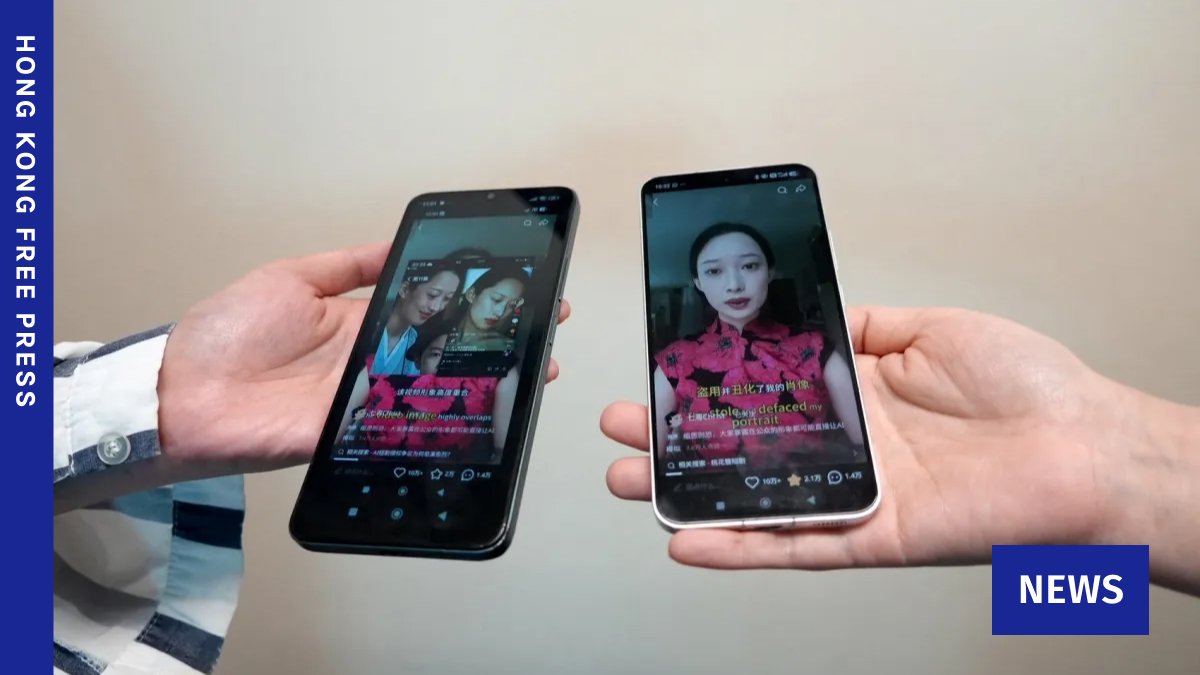
Li and a man who says he was portrayed as her AI husband in the series, which became a hit last month on Hongguo, spoke online about their special unintended discoveries.
But even as their stories sparked a public outcry over the ethics of AI, AFP saw The Peach Blossom Hairpin continue to run for days before it was taken down, with the controversial characters quietly replaced.

Photo: Mahmoud Rizk/AFP.
The man, a designer specializing in traditional Chinese clothing and make-up, had posted photos of himself in costume on the Instagram-like app Xiaohongshu.
Like Li, he was upset by the show’s “ugly” portrayal of his likeness as a “weak” antagonist.
“Will it affect me, my work, my future job opportunities?” said the man, who asked to use the nickname Baicai.
To keep audiences hooked, microdramas are often full of shocking, larger-than-life moments.
Li and Baicai both showed AFP their original photos and the characters in “The Peach Blossom Hairpin,” which bore a strong resemblance.
Legal risk
For low-budget AI microdramas, Chinese regulations say platforms must be the primary checkpoint for potentially questionable content.
If they don’t conduct mandatory content reviews, the videos will be forcibly removed, according to the National Radio and Television Administration.
If the platforms were aware of a violation but failed to act on it, affected parties can alert China’s cyberspace authorities, which can impose administrative penalties, according to Zhao Zhanling, a partner at Beijing Law Firm Javy.
Hongguo said in a second statement this month that it will continue to strengthen the way it reviews content and authorizes creators, among other steps.
It said it had dealt with 670 AI microdramas that breached regulations, with most removed, and warned it would crack down on repeat offenders.
When reached for comment, parent company Bytedance referred two of Hongguo’s statements to AFP.

Li and Baicai say they need more information from Hongguo to confirm the identity of the drama’s creator – with two companies as possible candidates.
One is linked to a verified account on the Chinese version of TikTok that also published the series. Another is listed as a drama producer in an official Chinese filing system.
AFP contacted both firms, but received no response.
Using AI to cut costs could be tempting in the fast-growing, multibillion-dollar microdrama market.
But depicting someone in a derogatory manner without permission “may constitute a violation of portrait rights and reputational rights,” said Li’s lawyer, Yijie Zhao, of the Henan Huailv Law Firm.
‘Involved in controversy’
National regulations require micro-drama creators to register to obtain a license – a mandatory step for AI-generated animations from this month.
But manufacturers can remain in the shadows by registering temporary clothing, Zhao said, while some are suspected of using overseas servers to hide.
In 2024, a Beijing court ordered a company to apologize and pay compensation to a celebrity after its AI software allowed users to produce a virtual persona using their photos and name that could exchange intimate messages.
See also: US tech giant Meta sues Brazil and China advertisers over fake celebrity scams
But lawyers told AFP that the compensation for plaintiffs like Li is likely not to be much because of the limited commercial value of a common likeness.
Li worries that the saga could cost her opportunities in the modeling industry, as she is now “involved in controversy”.
Baicai has not launched legal action, but hopes to see more action from regulators and platforms to protect people like him.
“There are probably many cases with unknown victims,” he said.





