
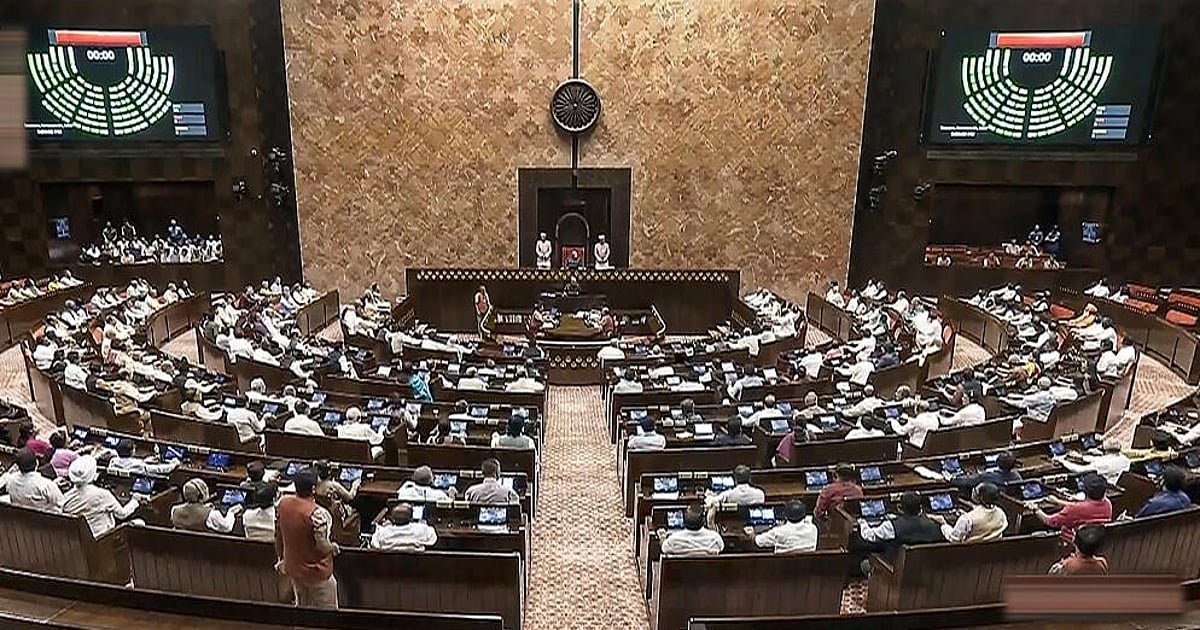

On 17 April, the Constitution (Amendment 131) Bill was defeated in the Lok Sabha. She received 298 of the 352 votes needed, by 54 votes. The Delimitation Bill and the Union Territories (Amendment) Bill, both of which depended on the constitutional amendment, were withdrawn.
The Union government’s response has been to blame the opposition for denying India’s women their political rights. Union Home Minister Amit Shah said the opposition would not be “forgiven” by India’s women. This framing is dishonest. The opposition did not vote against women’s reservation. She voted against a package that combined women’s reservation with an expansion of Lok Sabha seats that lacked consensus.
The political representation of women does not have to remain hostage to this impasse. It may find a way forward through state legislatures.
Congress built women’s reservations at the grassroots. In 1989, Prime Minister Rajiv Gandhi introduced a bill to amend the Constitution to provide one-third reservation for women in rural and urban local bodies. He passed the Lok Sabha but could not clear the Rajya Sabha. In 1992, under Prime Minister PV Narasimha Rao, the 73rd and 74th Constitutional Amendments were passed, mandating 33% reservation for women in panchayats and municipalities.
More than thirty years later, of the approximately 31 million elected representatives in local government across India, nearly 46% are women. Twenty-one states and two Union Territories have increased the reserve to 50%.
Research by Esther Duflo and Raghabendra Chattopadhyay shows that women elected under reservation invest more in public goods directly related to women’s concerns. A UN University study also found that constituencies that elected women exhibited higher economic activity, outperforming constituencies represented by men by approximately 1.8 percentage points per year.
Reform within possibilities
Could Assemblies be the immediate next rung on the ladder? The Vidhan Sabha is where the vast majority of governance that directly affects the lives of citizens is decided and executed. Education, public health, police, land revenue, water supply, PDS, domestic violence enforcement and POCSO enforcement: all businesses on state list or concurrent list.
There is also practical arithmetic here. State assembly seats, like Lok Sabha seats, are frozen at the Census level of 1971. A constituency that had three lakh people in 1971 may have eight or 10 lakh today. Expanding the Assemblies to reflect the current population is overdue on its own terms. And when new seats are created, reserving a third of them for women becomes a matter of design, not displacement.
There is another advantage. The expansion of the seats of the Assembly is an exercise within the state. No Tamil Nadu vs Uttar Pradesh match. It does not cause a north-south dispute over relative representation in a federal legislature. Each Assembly grows proportionally with population growth. No state loses power relative to another. Assembly expansion sits entirely outside the federal balance sheet issue that made Amendment 131 so controversial.
2026-2027 registration is underway. For the first time since 1931, it will include caste enumeration. The expansion of the Assembly should be undertaken after this registration, for two reasons. First, accurate and up-to-date population data is the proper basis for allocating countries. The use of the 15-year-old Census in 2011, when a new census is months away from completion, was one of the legitimate objections to the government’s package. Wait for the data. Secondly, more importantly, caste registration will provide the demographic basis for OBC representation within the framework of women’s reservations.
In panchayats, women’s reservation already works as a horizontal quota across all categories: general, SC, ST and OBC. Some states have extended this to OBC women as well. This is the model that should be repeated at the Assembly level. But you can’t do that properly without knowing the OBC population numbers, and the 2011 Census has no caste data.
Expansion of Lok Sabha seats is a federal matter. The freeze on partition in 1976 was maintained for 50 years as a trust compact between the states of the Indian Union. Building a new consensus on that compact will take time. The women’s reservation should not wait.
The Narendra Modi government had a choice. It could have pursued women’s reservation in its own way, within the existing 543 Lok Sabha seats and Assembly seats, as the Opposition, especially the Congress, has repeatedly demanded. Or he could have followed the expansion of the Assembly as a first step, where the political barriers are lower and the benefit of governance is higher.
The defeat of Amendment 131 should not be the end of the story. It could be a start. Assembly expansion does not involve any interstate conflict, and the 2027 Census will provide the data. The 33 per cent reservation of OBC sub-quota women follows a tried and tested pattern in 31 million elected posts over three decades. Every element required for this is either already in place or will be within two years. Assembly should be the immediate next step. It’s accessible, it’s urgent,
and does not require federal trust burning.
It is within the power of the Union government to initiate. The question is whether you will.
The writer is a member of the Indian National Congress and a former IAS officer.
(Disclaimer: The views expressed above are the author’s own. They do not necessarily reflect the views of DH.)



