
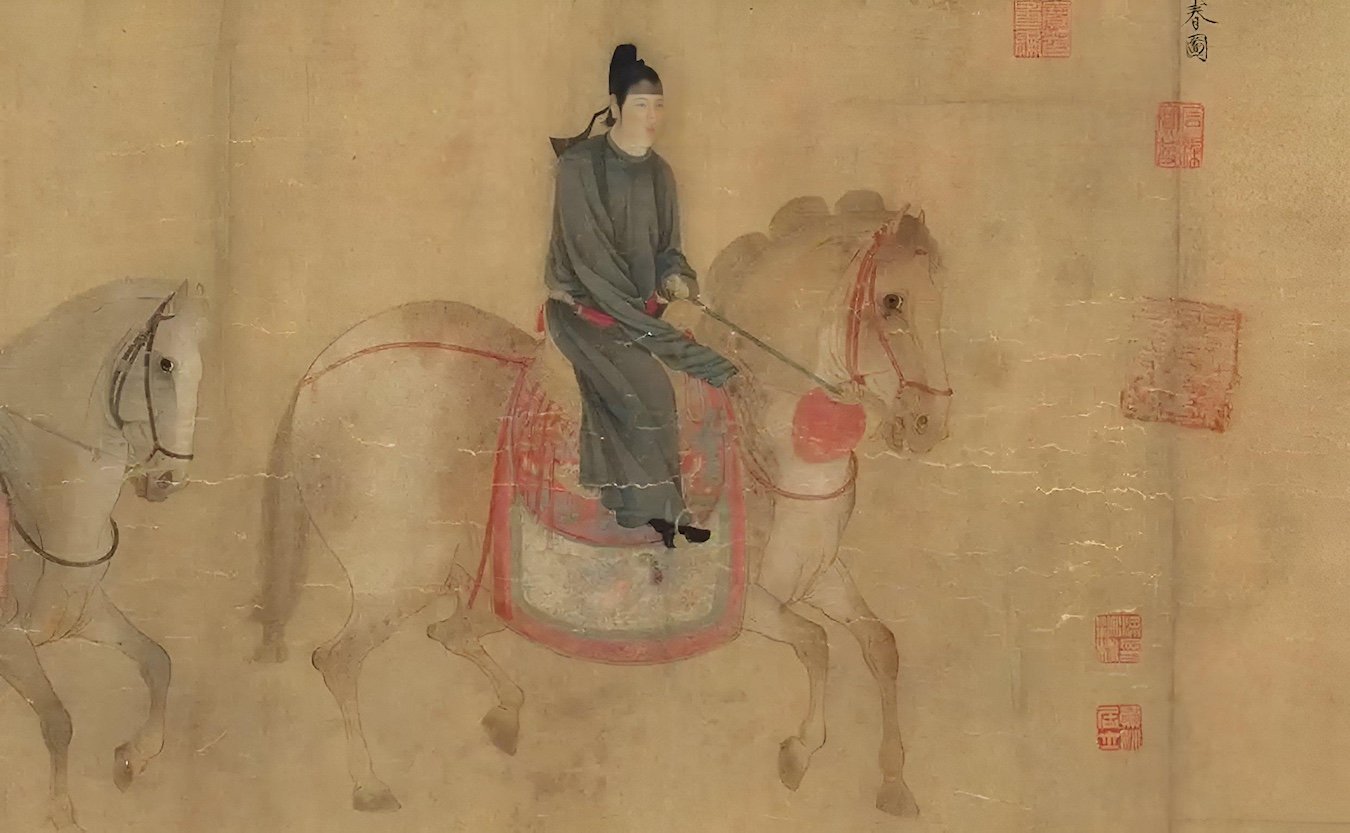

A visitor standing in front of the Courthouse Lady’s Spring Walk doesn’t see the story at first. They see movement. There is no palace. No river banks. No flowering trees. No painted spring landscape to show the eye where to rest.
Along the silk scroll, only a small procession moves through an empty field of space: nine figures, eight horses, robes of pale red, green, and white, and the quiet rhythm of hooves. However, the lack is the point. The painter does not depict spring. He lets her pass through the knights.
The work known in Chinese as Guoguo Furen Youchun Tu(虢國夫人遊春圖), traditionally attributed to the Tang dynasty master Zhang Xuan, survives today not as a Tang original but as a Song dynasty copy.
It is now one of the treasures of the Liaoning Provincial Museum and among the most important surviving images of Tang court life. In the hierarchy of China’s cultural memory, it is not just an old painting. It is a national-level relic, a rare visual testimony to the elegance, power and fragility of the High Tang.
For Western readers, it may help to imagine a work that sits somewhere between Botticelli’s Primavera, Velázquez’s Las Meninas, and the last shimmering images of aristocratic Europe before political collapse.
Like Primavera, it turns spring into a world of bodies, rhythm and grace. Like Las Meninas, it is not only about the figures presented, but about hierarchy, visibility and proximity to power. Like Watteau’s gallant parties, it captures aristocratic leisure with the knowledge that such worlds rarely last.
But this is not Florence, Madrid or Versailles. It is Tang China.
The Tang dynasty, especially under Emperor Xuanzong in the early eighth century, represented one of the most cosmopolitan moments in Chinese history. Chang’an, the imperial capital, was not a provincial city, but one of the great metropolises of the medieval world, comparable in imagination to Constantinople, Abbasid Baghdad, or Renaissance Florence.
Merchants, monks, musicians, messengers and artisans moved through its streets. Her court absorbed Central Asian music, foreign textiles, Buddhist imagery and horse culture. Women of the aristocracy rode horses, appeared in public and sometimes dressed in clothes associated with men. The world of The Court Lady Guoguo’s Spring Outing could only have emerged from such a belief.
At the center of this historical atmosphere was Yang Guifei, Emperor Xuanzong’s beloved consort. She has often been compared, imperfectly, to Helen of Troy or Marie Antoinette: a woman later remembered as the beautiful face associated with disaster.
However, such comparisons are only gateways. Yang Guifei was not a queen like Marie Antoinette, nor a mythical figure like Helen. She was a Tang woman whose beauty, family and fortune became inseparable from the memory of an empire at its brightest and most vulnerable.
Her family rose with her. Her sisters were given noble titles: Ladies of Han, Guo and Qin. Among them, Lady Guoguo became one of the most prominent women in the imperial circle. She was not just a court beauty.
She belonged to a family whose sudden proximity to the throne transformed domestic kinship into public power. To understand it, one can think of the ladies of Versailles, not as rulers, but as women whose dress, movement and presence became part of the political theater.
Hand twirling shows such drama-free theater. The procession is organized in groups. Figures do not call out their status. They keep it. Horses move at different rates; some advance, some turn back, some seem to stop within the rhythm of the journey. Riders’ clothes fall in controlled lines. Their faces are calm, almost unreadable. Nothing is rushed. Nothing is accidental.
One of the most interesting interpretations concerns the rider in the foreground. Some Chinese art historians have argued that the male-clad figure leading the procession may be Lady Guoguo herself.
This is not universally accepted; the painting bears no label identifying each figure. Other scholars place her among the central female knights. However, this essay succeeds the first reading, not because it is the most dramatic, but because it is the most revealing.
Lady Guoguo, as remembered from history, was not a woman who could easily be imagined in retreat. She belonged to the Yang family at the pinnacle of imperial favor, a family whose women didn’t just inhabit privilege, but made it visible. The horse reinforces this reading. Her three-flowered mane, formed in raised tufts along her neck, and the round ornament of red tassels on her breast are signs of rank, ceremony, and aristocratic display.
If this rider is placed first, dressed as a young noble and mounted on such a distinguished animal, she is not simply joining the procession. She is announcing it. It becomes the first figure seen, because it is the figure intended to be seen.
If Lady Guoguo is indeed the figure at the head of the procession, the image becomes quietly radical. A woman of high rank is normally expected to remain sheltered in the middle of a group, surrounded by attendants, protected by order and distance. Rank in court society was expressed not only through luxury, but also through placement. Being placed in the center had to be protected. To ride forward you had to look first.
Therefore, the dress, posture and fit of the front rider matter. Men’s clothing for elite women was not unknown in Tang China, but in such a figure it becomes more than fashionable. It becomes a statement. The horse, too, is not an ornamental animal.
In Tang court culture, the mountain, its coils, and its position in the procession all carried status signals. A noble woman on horseback was not the same as a woman hidden in a carriage. It took up space. She entered the world.

A group of scholars believe that the rider in front, dressed in men’s clothing, is Lady Guoguo. Her horse is shown with a “three flower” mane, in which the hair along the horse’s neck is cut into three raised tufts and with a round red tassel ornament on the chest. Photo: Art Habsburg Visual Archive
The details of the horse deepen the meaning. In Tang equestrian culture, the mane could be cut into decorative shapes known as single-flowered, two-flowered, or three-flowered styles. The most striking was the “three-flower” mane, in which the hair along the horse’s neck was cut into three raised tufts. It was not a pattern on the saddle, but a shape carved into the crest of the horse’s neck.
Such a horse immediately suggested rank, refinement and aristocratic privilege. On the chest, the round ornament with red tassels, known as tixiong, also had ceremonial meaning. In The Court Lady Guoguo’s Spring Outing, these details are not random decoration. The three-flowered mane and red breast tassel turn the horse into a visible sign of identity, hierarchy and courtly appearance.
This is why the painting still feels alive. It is not a portrait of passive beauty. It is a record of female visibility.
Behind the scene there is also a famous poetic echo. Du Fu, the great Tang poet, wrote about the third day of the third lunar month: “The weather is cool; by the waters of Chang’an there are many beautiful women.”
His poem Liren Xing, often read in conjunction with this painting, gives language to the same world of aristocratic spring outings, courtly women, and restless luxury. Du Fu wrote the river bank. Zhang Xuan, or the tradition derived from him, painted the procession. Together, poem and image preserve the atmosphere of a civilization confident enough to make leisure monumental.
However, history was already turning. An Lushan’s rebellion will soon break up the Tang empire. Yang Guifei would die during the imperial flight to Mawei. The Yang family, once so close to the throne, would become part of a moral and political reckoning. The painting itself does not show misfortune. That is exactly its power. It gives us peace before the break.
Her subsequent journey was no less dramatic.
The original Tang disappeared. The copy of the song survived. It entered the imperial collections and was recorded in the Qing court catalog Shiqu Baoji. In the twentieth century, after the fall of the Qing, the last emperor Puyi removed a large number of palace paintings and calligraphy from the Forbidden City under the name of “imperial gifts”.
Arm-twisting eventually followed him from Beijing to Tianjin and then to Manchukuo, the Japanese-backed puppet state in northeastern China. It was kept in the former imperial palace in Changchun.
In August 1945, as Japan collapsed and Manchukuo disintegrated, Puyi fled. From the palace collection, he selected more than a hundred of the most precious works to keep with him. Court Lady Guoguo’s Spring Walk was among them. At Shenyang’s Dongta Airport, Soviet forces intercepted him. The paintings were seized. Later, they were transferred to Chinese custody and eventually entered the collection of the Northeast Museum, today’s Liaoning Provincial Museum.
The irony is almost unbearable. A painting of quiet aristocratic movement survived because a fugitive emperor failed to escape with it.
Modern Painting Life also includes another, quieter figure: Feng Zhonglian (馮忠蓮). My friend Mi Chuan (米川) once introduced me to her story with a personal intimacy unavailable in museum labels. Feng was his maternal grandmother.
A major Chinese artist of the 20th century and one of the pioneers of modern master copying in China, she was commissioned in 1954 to copy the Song version of The Court Lady Guoguo’s Spring Walk. Her task was not to reinterpret, but to disappear. She had to understand the silk, the line, the mineral colors, the aging of the surface and the breathing rhythm of the original.

Feng Zhonglian was not a mechanical copyist. She was an artist who possessed enough skills to print her own style. This is the highest discipline in copying ancient Chinese painting.
In the West, restoration often emphasizes conservation; in China, copying also became a form of transmission. Feng’s work belongs to that tradition. She did not add herself to the painting. It helped the painting remain visible.
That is why the spring release of The Court Lady Guoguo is more than an image of Tang beauty. It’s a chain of survival: Zhang Xuan’s lost Tang original; the copy of the Song that preserved the form; Qing imperial collection; Puyi’s departure from the palace; confiscation during the war in Shenyang; museum stewardship; and Feng Zhonglian’s modern act of disciplined transmission.
The rotation of the hand indicates spring. Her story shows resilience.
In the painting, Lady Guoguo and her companions continue to pass through a landscape that has not been painted. Around them is empty silk. In all that emptiness, dynasties have fallen, emperors have fled, wars have ended, museums have been erected, and artists have quietly worked so that an ancient spring can still be seen.
This may be the true meaning of work. It’s not just a Tang source. It is a Chinese spring that has survived time.
Jeffrey Sze is Reichenau’s ambassador for art, culture and tourism and chairman of Art Habsburg. He is also the general partner of Archduke United LPF, focused on fine art research, collection and digitization of cultural assets.



