
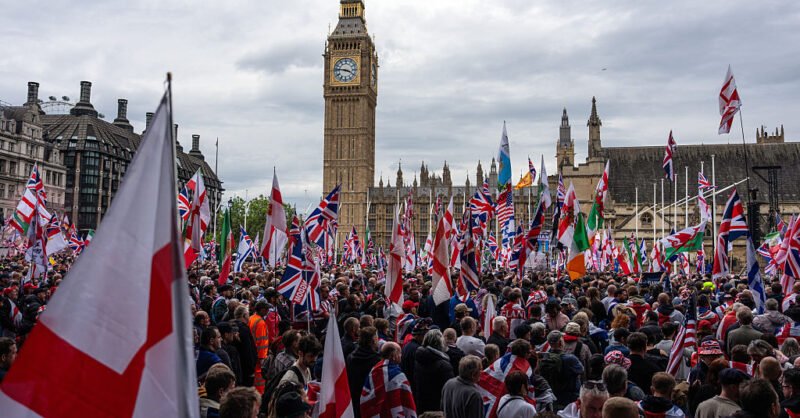

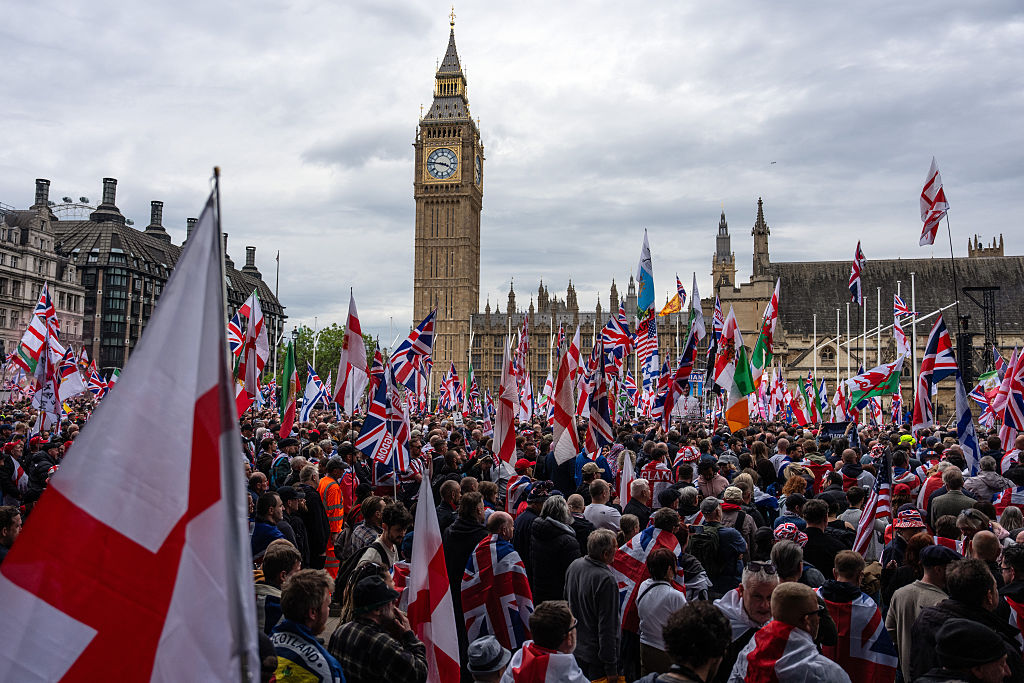
On the way to Parliament Square, men would stop Kate to tell her she was beautiful. She was a devout Christian and aesthete from Kent and wore a skirt made of Union Jacks. It took months to prepare her outfit for Tommy Robinson’s “Unite the Kingdom” march. “I wanted to wear something that was ladylike but covered up,” she told me. “I saw a girl last year, she had all her bits hanging out. I think that’s a little uncomfortable. It’s not part of the message we’re trying to put out there.” An old man asked her for a photo. “You look wonderful,” he said. She held up a wooden cross as she posed. “Christ is King,” she said. The man shouted, “I think he might be.”
The government had banned 11 “far-right agitators” from entering the UK ahead of the May 16 march. The previous “Unite the Kingdom” rally, in September 2025, was mired in fighting: this time Robinson had asked his supporters to be peaceful. The route was planned to avoid the rally to mark Nakba Day, which commemorates the mass displacement of people during the Palestine War in 1948. The marches took place in parallel. More than 4,000 police officers were deployed to keep the peace and separate the groups. Robinson was well away from the crowd, behind a metal fence with other A-listers: former Tory MP Andrew Bridgen, former Ukip YouTuber Carl Benjamin, former actor Laurence Fox and several priests. Everyone was filming everything.
Three white women were getting ready to go on stage. They wore black niqabs, covering everything but their eyes. They removed their covers, revealing short dresses, heels and bright lipstick. The women kept taking off their niqabs and then putting them back on, laughing hysterically each time. They were from the French anti-Islam group Collectif Némésis and were there to “stop the Islamic occupation that oppresses women”. The men were looking at them in confusion. “They are not real Muslims, are they?” one asked his friend. His friend shook his head. “They’re strippers.”
I was standing by the fence with Matt and Paddy, two bald men who both had “SKINHEAD” tattooed on the back of their heads; Matt also had a St George’s Cross and cherry red Dr Martens ink boots near his neck. He had done them years ago. “As you get older, the paint starts to fade,” he noted sadly. He lived on the southeast coast, so he had seen a lot of small boats coming in. “We’re all Tommy Robinson,” he told me.

Subscribe to the New Statesman for £1 a week
A British-Iranian YouTuber in a linen suit called Mahyar Tousi, from the Tousi TV channel, came to take selfies through the fence. He was feeling pretty tired, he said, but pleased with how orderly the crowd had been so far. “I think people are basically self-policing and self-cleaning.” Some people would call this part of the extreme right, he said. “Just come and talk to these guys – they’re not bad people. I can show you the far right. I can show you ethnonationalists. I don’t like them.” He left. “I watch it every night,” said one star-struck woman. “He has 1.6 million subscribers.”
Laurence Fox approached the fence, holding a cigar. “There is a version of England that we are told, and a version of England that is true,” he told me. “It’s hard to see the mainstream media saying this is about hate… This is the real Britain.” It would be nice, he thought, if the rest of Britain would stop being ashamed of themselves. Fox is from a great British acting dynasty and has been in films like Gosford Park. In 2020 he continued Question time and accused an audience member of being “racist” for calling him a “privileged white male”; during covid he was protesting the lockdowns. His agency dropped him. Now he leads the Return Party. I asked him if he was happier before his fall from grace. “I don’t know what that means,” he said. “I was a good actor. I miss it. And I wish I lived in a world where I could act. But I don’t go along with different belief systems that say that men can be women, or, you know, because I’m white, that there’s something wrong with me. I just see that as racism.” He looked upset. “By God’s grace, we are happy today,” he said. “And it’s not for anyone else’s sake.”
Not everyone on the march was Christian, but most were happy to mutter the Lord’s Prayer and join in the “Christ is King” chants when instructed. A pastor got on stage and started shouting to everyone about Christ. “Shout for Jesus!” he shouted. “King of kings, lord of lords, your savior, my savior, Tommy’s savior!” Behind him, Robinson smiled.
Some of the old people were getting tired and were sitting on the plinths. The men continued to drop smoke bombs, filling the sky with pink and blue dust. Through the fog, I could just make out Robinson, telling his audience to prepare for a “Battle of Britain”. He told the parliament. “In that building,” he said, “are 650 traitors to this country.” Two men in the crowd introduced themselves to each other and discovered that they had both just tried and failed to become reform counselors. “I stayed at Tottenham,” said one. “It was difficult.”
I left the stage. The assistant at Tesco in Westminster was standing at the door, apologizing to customers. “If you’re coming in, there’s no alcohol,” he said. “The police have forbidden us to sell it.” Cans and bottles were piled up in the square.
A middle-aged man wore a black shirt covered in Gothic writing: Fate whispers to the warrior: He cannot withstand the storm. And the warrior whispers back: I am the storm. Storm’s name was Graham and he was a builder from Milton Keynes. I asked him why he had come and he started to cry. “I’m sorry,” he said. “This is my home, this is my place.” He was scared. “What can happen to you? Any female in this country? Any male in this country?” he said. “Rape. Murder. The people we let in don’t respect women.”
The protesters were ordered to leave by 6:00 p.m. Robinson was riding in a van as the women watched, waving. “We love you, Tommy!” they called. “Remind us!” A Scouse woman inhaled a pink heat. “I feel like a proper girl,” she told her daughter. “I’m in love.” People were starting to disperse through the park, passing a few pro-Palestinian marchers heading in the other direction. A group of students had come down from Glasgow for the Nakba rally. They’d seen some Unite the Kingdom marchers: “A bunch of filthy room-temperature IQ goons,” said a boy named Finn, and they all laughed.
It was not a fair characterization. “Unite the Kingdom” is a great operation now, with its own world of micro-celebrities, politicians and “new media” journalists. It has telegenic alien speakers and money from American billionaires, with Elon Musk posting support. There’s an anthem — “Kingdom of God” by Unite the Kingdom Collective — that Robinson was pushing his fans to get to number one (it currently has less than 1,300 streams on Spotify). It has middle-aged women, children and dogs wearing British hats and flags.
However, you can still find the thugs – those who have been with Robinson since his days in the English Defense League. In the park I met Jack, from Newham, who told me he was a football hooligan. “I think the march is weak,” he told me. Most of the people involved were “fat as hell”. Spots of white dust had congealed in his nostrils. “Want some cocaine on your face?” he asked. “I’ll give you a dirty coke line.” A few meters away, 20 police officers had swarmed around a man in an England football shirt, who was lying on his stomach, handcuffed, legs bound. His red face was covered with sweat, dirt and stones. A crowd of men surrounded the police, filming from every angle, hoping for one last viral hit. “Relax, bro!” someone shouted. The man spat on the ground. “Suck you mommy,” he said.
(Further reading: Anthony Barnett: England, ethno-nationalism and what I said to Andy Burnham)
Content from our partners



