
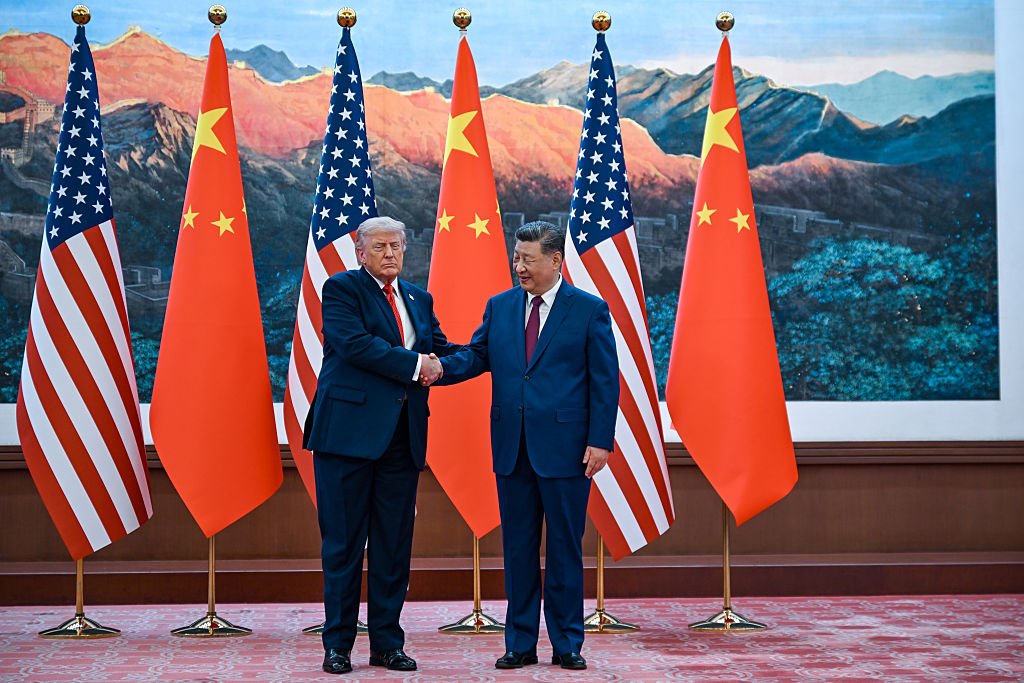

There is a temptation in Brussels to greet the Trump-Xi summit with a sigh of relief. No dramatic escalation. No new rounds of retaliatory export controls on rare earths. No Chinese belligerence that threatens to use arms supply chains against both Washington and – as a collateral victim – Europe.
This, in itself, was not guaranteed. An alternative scenario could have seen Trump redouble pressure on China, prompting Beijing to retaliate by the closure of rare earth exports and strengthening its position across the board. That would have been truly disastrous.
But relief is not a strategy. And when you look closely at what the two superpowers agreed to, the picture for Europe is troubling.
The creation of a bilateral trade board is effectively a managed trade framework — a direct successor to the Phase One agreement of Trump’s first term, now dressed in more ambitious clothes. If China commits to buying more American goods, whether agricultural products, energy, or manufactured goods, the spillover effects for European exporters are real.
China is already a major market for German machinery, French luxury goods and a wide range of European industrial exports. Any framework that systematically redirects Chinese import demand to the United States comes at the expense of Europe. Trade diversion of this kind does not make headlines, but it quietly erodes European competitiveness in one of the world’s largest markets.
The second blow comes from the side of investments. The agreed investment board is likely to include provisions that give US firms preferential access to sectors of the Chinese market that remain largely closed to foreign competition. Financial services are almost certainly on the table – Wall Street has long coveted deeper access to Chinese capital markets – and biopharmaceuticals, given their importance to both economies, are likely to follow.
European banks and asset managers, already struggling to gain significant ground in China, will find themselves at a structural disadvantage if Goldman Sachs and JP Morgan get preferential treatment that BNP Paribas and Deutsche Bank do not. This is not hypothetical. Once granted, managed investment access is very difficult to reverse or extend to third parties.
Trump arrives in Beijing with no cards to play
Few presidential visits to China have been as fraught with political vulnerability as Donald Trump’s…
5 minutes

In the opposite direction, Trump seems ready to open the American market to Chinese investments in what he calls “non-strategic” sectors. The definition of this term will be hotly contested, but one outcome seems very likely: Chinese investment in renewable energy infrastructure in the United States.
The reason is straightforward. The hyperscalers – Microsoft, Google, Amazon, Meta – are desperate to lower the cost of AI computing power. Green energy is their fastest route, and Chinese firms have the production scale and cost structure to deliver it. If Washington intervenes through Chinese solar and battery investments in the name of AI competition, it will be trading one dependency for another. For Europe, this means another sector in which the US will move more quickly and at lower cost.
Then there is the geopolitical dimension, and here the picture is more complex, but ultimately no less disturbing. Trump appears to have secured a commitment from Xi not to supply weapons to Iran, in exchange for the US curbing arms transfers to Taiwan.
At first glance, this may seem like a modest victory for European interests. A weakening of Chinese support for Tehran could, in theory, ease pressure on the Strait of Hormuz and ease European anxieties over energy transport. But this logic does not hold up to scrutiny. China is one of the main beneficiaries of control of the strait by Iran. Discounted Iranian oil flows to Beijing, and a compliant Tehran keeps the pressure on Washington and its allies. The idea that Beijing would meaningfully abandon that leverage for a vague promise of arms strains credibility.
More importantly, the implied softening of the US commitment to Taiwan’s defense should alarm European capitals. The semiconductor architecture that underpins European industrial ambition – from electric vehicles to defense electronics – is largely built on Taiwanese chips, above all those made by TSMC. The United States has spent billions to ensure TSMC manufactures advanced chips on American soil, giving Washington a backstop if the status quo in the Taiwan Strait deteriorates.
Europe does not. A shift in the balance of power between the Straits would alienate European industry grotesquely exposedno domestic advanced chip manufacturing to fall back on and no bilateral deal with TSMC comparable to what Washington has secured.
Overall, the summit reflects the logic of a world where the two superpowers negotiate their rivalry bilaterally, sharing the benefits between them and spreading the costs to everyone else. Europe is neither on the table nor on the menu, but it will feel the consequences of what has been agreed.
Trade diverted from Chinese shelves, investment access circumscribed for American firms, geopolitical deals struck over European heads: this is the evolving architecture of G2 bilateralism, and it was not designed with European interests in mind.
The choice Brussels faces is not between a good outcome and a bad one. It is between managing these consequences strategically or allowing them to accumulate by default. As it stands, Europe is doing the latter.
Strike in action: How Europe can thwart China and the US
Robert Oppenheimer, the father of the atomic bomb, once compared the US and the Soviet Union…
6 minutes

(ow, cm)



