
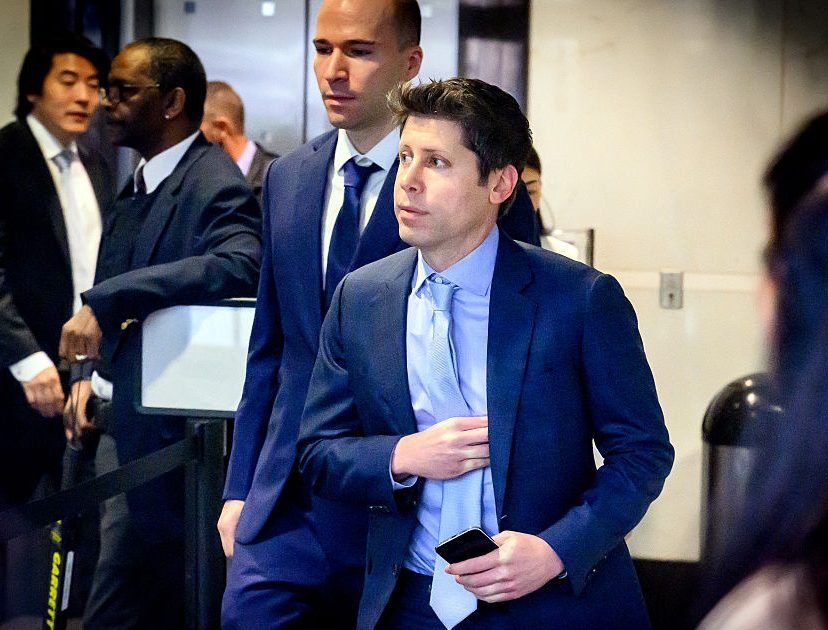


On his heels Sam Altmanended his testimony in the ongoing trial Elon Musklawsuit against OpenAIa clearer picture is emerging of how Musk might have run the company differently. Musk, a co-founder of OpenAI as a nonprofit organization, is suing the company, its CEO Altman and the president Greg Brockman for “stealing a charity.” He is seeking to return the $852 billion artificial intelligence company to its original nonprofit structure and is also seeking up to $180 billion in damages to be transferred from OpenAI’s for-profit arm to its nonprofit parent.
Taking the stand yesterday (May 12), Altman described Musk as a “mercurial” leader, saying he felt like Musk had “abandoned us, failed to deliver on his promises, put the company in a very difficult place, jeopardized the mission, (and) didn’t really care about the things I thought he cared about.”
Musk invested $44 million in OpenAI over five years before stepping down from its board in 2018 after a power struggle. Since then he has not been involved in the company.
Despite Musk’s stated desire to keep OpenAI a nonprofit, Altman testified that Musk repeatedly sought control of the organization. In 2017, Musk allegedly proposed merging OpenAI with Teslaa for-profit company, a move Altman opposed because of their conflicting missions. According to Altman, Musk believed the merger would create a stronger competitor Google.
Altman also claimed that Musk initially asked for 90 percent equity in OpenAI. “Then it softened, but it was always a majority,” he testified.
He further recounted what he described as a “particularly hair-raising moment” when the co-founders asked Musk what would happen to OpenAI if he were in control and then died. Musk allegedly replied that control should pass to his children. Altman’s legal team has used such claims to portray Musk as seeking outsized control.
For his part, Musk last week testified that his concerns about OpenAI intensified after that MicrosoftThe first investment of $10 billion in 2022, which he characterized as a “bait and switch” aimed at profit. He argued that Microsoft would only make such a large investment if it expected financial returns, adding that it would effectively give Microsoft control over AGI—technology that he believes was originally meant to remain under a non-profit structure.
Today, the ownership of OpenAI is spread among several key stakeholders: his nonprofit foundation holds about 26 percent, Microsoft owns roughly 27 percent, and current and former employees collectively own another 26 percent, with smaller stakes owned by venture capital firms.
While Musk has argued that OpenAI should have remained a nonprofit, Altman’s testimony presents a different narrative, in which Musk sought majority control and was unwilling to rule out future dominance of the organization. Musk said “He was unwilling to commit in writing that he would not have long-term control.”
Meanwhile, Musk’s own AI company, xAIfounded in March 2023, operates as a for-profit entity and is valued at $250 billion, or up to $1.25 trillion when considered alongside SpaceX.
Altman’s credibility has also come under scrutiny during the trial. Musk’s lead attorney, Steven Moloasked him directly, “Are you completely trustworthy?”
The previous testimony of other witnesses has added to the complexity of the case. These include OpenAI’s co-founder and former chief scientist Ilya SutskeverCEO of Microsoft Satya Nadellaand Musk himself. Sutskever, who led Altman’s brief ouster in November 2023, previously described him as someone who “exhibited a consistent pattern of lying, undermining his executives and pitting his executives against each other,” He testified this week that he began compiling evidence of what he saw as Altman’s dishonesty in the year leading up to the 2023 ouster, though he later reversed course and supported Altman’s return. Former CTO Mira Murat also testified that Altman was prone to “creating chaos.”



