
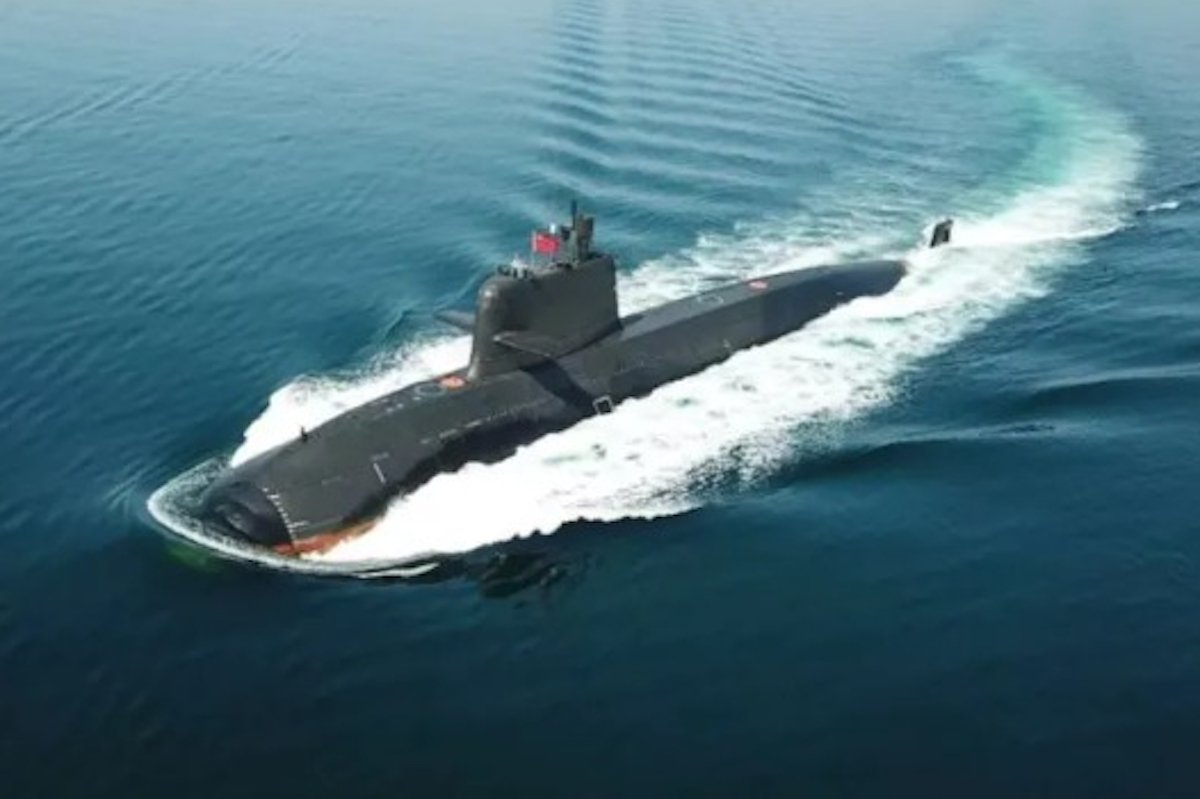

Pakistan is betting on Hangor-class submarines to sharpen its undersea edge as its deterrence increasingly relies on deepening military integration with China rather than any single platform.
Last month, multiple times the media SOuRCES announced the commissioning of the first Pakistan-built Hangor-class submarine in China, the PNS/M Hangor. The ceremony took place in Sanya and was attended by President Asif Ali Zardari and Navy Chief Admiral Naveed Ashraf, signaling a significant advance in Pakistan’s naval modernization efforts.
The induction is part of a wider plan to buy eight submarines – four built in China and four domestically under a technology transfer program – aimed at strengthening maritime security and protecting vital maritime lines of communication amid rising tensions and recent missile tests.
An export variant of China’s Yuan-class design, the Hangor-class submarines are equipped with air-independent propulsion, advanced sensors and modern weapons and are expected to strengthen Pakistan’s deterrence posture while improving its anti-access/area denial capabilities once the program is completed.
Officials described the program as a “milestone” to strengthen the fleet’s capabilities, although timelines have slipped from initial delivery targets, with the first ship launched in 2024 and commissioned in 2026.
The move underscores the expansion of Pakistan-China defense cooperation following the recent escalation of the conflict with India and complements previous transfers of Chinese arms, including J-10C fighter jets.
Tactical employment of Hangor-class submarines may focus on conventional torpedo and anti-ship missile operations, as the risk of escalation limits their practicality for sea-based nuclear deterrence.
Looking at the tactical capabilities of the Hangor-class submarines, the Nuclear Threat Initiative (NTI) endnoteS in September 2024, the class is equipped with 53 millimeter torpedo tubes, which enable the launch of heavy torpedoes such as the Chinese Yu-6, as well as anti-ship cruise missiles.
While Pakistan may choose to arm its new submarines with nuclear-tipped submarine-launched cruise missiles (SLCMs) to create a sea-based nuclear deterrent, notes Betzalel Newman in an April 2025 Stimson Center. ITEM that Pakistan’s Babur-3 SLCM is suboptimal for such a role.
Newman points out that cruise missiles are less often used for nuclear purposes, especially at sea, because they have a lighter payload and shorter maximum range than ballistic missiles.
He also adds that Pakistan arming its submarines with SLCMs could create a problem of nuclear ambiguity, as it would be difficult for India to determine whether an incoming weapon is nuclear or conventionally armed, risking escalation. As such, Newman says Pakistan is likely to deploy its new submarines in more conventional roles.
From an operational perspective, however, their impact remains limited, with Namita Barthwal noting in a January 2026 REPORT to the Manohar Parrikar Institute for Defense Studies and Analyzes (MP-IDSA) that Pakistan’s Hangor-class submarines represent an incremental capability gain rather than a decisive shift in the naval balance.
It suggests that they could progressively increase Pakistan’s capacity to maintain an underwater presence, which would complicate crises, increase the need for anti-submarine warfare efforts, affect commercial shipping advisories, and increase the cost and difficulty for India in providing maritime security and managing escalations during rapid crises.
She notes that replacing older ships and increasing the frequency of patrols could allow Pakistan to more regularly monitor Indian ships during peacetime, keep India safe during crises and threaten sea lanes near Indian ports and naval bases.
This strategy would be particularly effective if supported by Chinese training, spare parts, intelligence, surveillance and reconnaissance (ISR) and life cycle support.
The operational role of the Hangor-class submarines is to enhance Pakistan’s underwater deterrence and support a sea-denial approach to offset India’s larger and more capable naval forces in the Indian Ocean.
Placing Pakistan’s submarines within the country’s broader operational strategy, notes Saad Riaz in a January 2026 ITEM to the Center for Strategic and Contemporary Research (CSCR) that the acquisition of Hangor-class submarines is important for curbing the expansion of India’s maritime footprint and enhancing sub-surface capabilities in the Indian Ocean region.
Taken together, these assessments point to a strategy focused on compensating for structural maritime disadvantages rather than achieving equality.
Looking at the military balance at sea between the two rivals, Rajeswari Rajagopalan and Linus Cohen observe in a June 2025 reportFor the Australian Strategic Policy Institute (ASPI) that India has consistently had greater conventional military strength than Pakistan in key categories of equipment.
They also show that India has two aircraft carriers and two nuclear-powered ballistic missile submarines (SSBNs), which Pakistan does not possess.
In this context, M. Usman Askari and Mudassar Ali Iqbal note on a June 2023 ITEM in the peer-reviewed journal South Asian Studies that, as a navy with limited resources and a smaller fleet, Pakistan cannot match India’s superior conventional capabilities, calling for a focus on alternative approaches.
Askari and Iqbal emphasize an asymmetric approach, using unconventional tactics and weapons—including submarines and coastal defense systems—to offset India’s larger fleet, along with a “sea denial” doctrine aimed at limiting India’s use of surrounding waters and limiting its operational advantage.
The strategic importance of the Hangor-class program lies in its integration within a deepening Pakistan-China defense partnership characterized by extensive arms transfers, interoperability and coordinated military alignment aimed at counterbalancing India.
Khalil Ahmad, in January 2026 ITEM in the peer-reviewed journal Advance Social Science Archive, notes that China has emerged as Pakistan’s leading arms supplier, providing advanced military systems that support its defense capabilities and strengthen bilateral military ties.
Supporting Ahmed’s points, data from the Stockholm International Peace Research Institute (SIPRI) show that from 2021 to 2025, China was the fifth largest arms exporter, accounting for 5.6% of the global arms trade during that period. The data also show that Pakistan was its top customer, accounting for 61% of Chinese arms sales.
Ahmad adds that this military cooperation is complemented by joint exercises, training exchanges and intelligence exchanges, which strengthen interoperability and operational coordination, reflecting Pakistan’s growing reliance on Chinese military support within an increasingly entrenched strategic partnership.
Moreover, Harsh Pant and Rahul Rawat declare on a June 2025 ITEM to The National Interest that China-Pakistan military cooperation poses a strategic threat to India by creating an emerging “two-front” challenge rooted in long-standing territorial disputes, including Kashmir and disputed areas along the China-India border.
Pant and Rawat say the two countries line up to counterbalance India and contest its sovereignty claims, especially after developments in Jammu and Kashmir since 2019. They describe the relationship as a “threshold alliance,” enabling pooling of capabilities, joint planning and interoperability.
They highlight the use of Chinese military technology, ISR support, and efforts to simulate multi-domain warfare, producing a functional military synergy that translates geopolitical reach into a “real-time” threat to India’s national security.
Such territorial disputes may extend to the maritime domain. As the Hangor-class submarines integrate with Chinese systems, their cumulative effect may not tip the naval balance but intensify great power rivalry in the Indian Ocean, sharpening undersea operations as a key arena for deterrence and strategic competition between Pakistan, India and China.



