
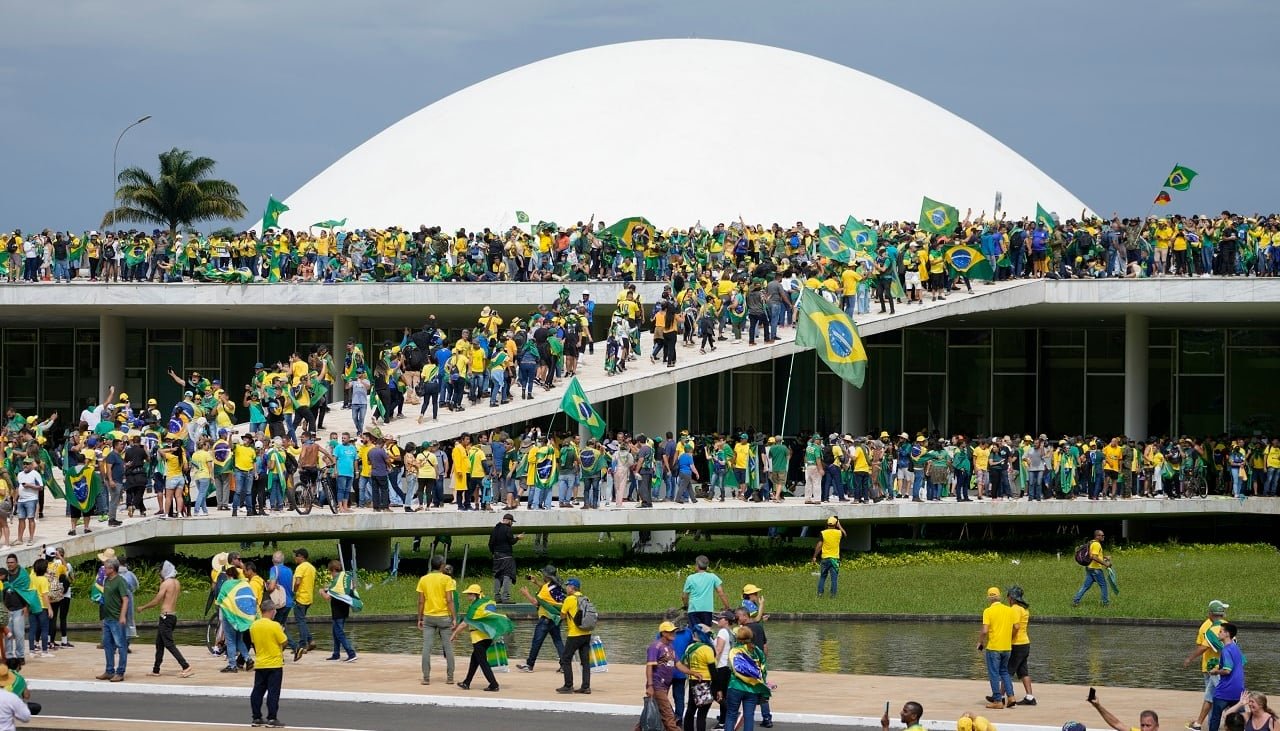

RIO DE JANEIRO (CN) – Brazil’s Congress on Thursday impeached President Luiz Inácio Lula da Silva full veto of a bill that could reduce prison time for people — including former president Jair Bolsonaro — convicted of the January 8, 2023 attacks on Congress, the Supreme Court and the presidential palace.
The veto was overridden by 318 lawmakers in the lower house and 49 senators, exceeding the absolute majority required in both chambers. The bill, passed by Congress in December, is now set to become law.
The bill, known in Brazil as the penalty calculation bill, changes the way criminal penalties are calculated and applied.
According to the draft law, the penalties for coup d’état and the violent removal of the democratic rule of law will not be increased when the crimes are committed in the same context. In those cases, only the harshest penalty would apply, with an increase from one-sixth to one-half.
It also allows the sentence to be reduced from one-third to two-thirds for attempted coup or attempted violent overthrow of the democratic rule of law when the crimes are committed in a mob, provided the defendant does not finance the acts or play a leading role.
Bolsonaro was convicted by Brazil’s Supreme Court in September 2025 to 27 years and three months in prison for five crimes related to his bid to stay in power after losing the 2022 election. The new bill could reduce his sentence and shorten the minimum time he must serve in a maximum security facility, although its implementation will depend on a court decision during the execution phase of the sentence.

Antonio José Teixeira Martins, a professor of criminal law at the State University of Rio de Janeiro, said that, with the veto bypassed, the law goes into effect as originally drafted.
Because it’s a more favorable criminal rule, Martins said, it can be applied retroactively and reach cases that have already been decided. But defense lawyers will have to ask the justice to review the sentences.
During the hearing, Bolsonaro’s allies defended the bill as a remedy to what they considered excessive sentences.
Senator Sergio Moro, the former judge who led Brazil’s Car Wash corruption probe, said he had been strict during his 22 years as a judge and had sent “thieves of the public purse to prison without mercy” but could not agree with what he considered excessive sentences for people involved in the January 8 attacks.
“No one agrees with the occupation of public buildings, but people also cannot be punished without proof for breaking a glass of water and receiving such harsh punishments,” said Moro. “(That’s why) I helped build a text that focused only on those convicted during January 8.”
Government-aligned and left-wing lawmakers accused Congress of trying to water down the judicial response to attacks on the chairs of Brazil’s three branches of government.
Congresswoman Gleisi Hoffmann, a former president of the Workers’ Party and former minister of institutional relations in Lula’s administration, said the hearing was “a disgrace to the country” and “an attack on the Constitution and our democracy”.
“Covering a coup attempt and for the coup plotters is like saying: do it again,” said Hoffmann. “Vandalize Congress again. Vandalize the Supreme Court again. Vandalize the presidential palace again. And try to stage a coup to remove an elected president. This is the message we leave for the future.”

The hearing was chaired by Senate President Davi Alcolumbre, who declared parts of the bill controversial because they could conflict with the anti-faction law passed in March. Without that ruling, the veto override could have reinstated more lenient sentencing progression rules for other serious crimes, including organized crime and femicide.
Left-wing parties contested Alcolumbre’s decision and said they plan to take the case to the Supreme Court.
Senator Randolfe Rodrigues, the leader of the government in Congress, said the veto override could also be challenged on the grounds that crimes against the democratic rule of law are not subject to amnesty, pardons or reduced sentences.
Martins said the main legal challenge may center on the law’s constitutionality.
According to him, the problem is not the facilitation of the sentence process, which is part of the logic of the criminal justice system, but the creation of a rule aimed at a certain group of convicts.
According to Martins, the change breaks the general logic of Brazil’s Penal Code by creating a special rule for crimes against the democratic rule of law and replacing technical criteria with a broader notion of the “context” of the crimes.
He also sees a danger of violating the separation of powers if the legislature is understood to have acted to alter the effects of particular court decisions.
Rodrigo Stumpf González, a political science professor at the Federal University of Rio Grande do Sul, said the veto override was another chapter in a power struggle between Congress and the Supreme Court, with Lula’s government caught in the middle.
González said Congress used criticism that the Supreme Court had imposed excessive sentences on the Jan. 8 protesters to also reduce sentences for Bolsonaro and his aides in the coup plot case.
“It is another example of putting political interests over the protection of institutions,” he said.
on wednesday, The rejection by the Senate of Jorge Messias to the Supreme Court exposed the strength of a coalition ready to face Lula and the court, especially in matters related to the cases against Bolsonaro and his allies.
Messias was questioned for nearly eight hours before being rejected in a 42-34 vote. During the hearing, senators asked him for limits on the Supreme Court’s power, individual decisions by judges and a possible amnesty for those convicted during January 8.
Courthouse News reporter Marília Marasciulo is in Brazil.
Subscribe to our free newsletters
Our weekly newsletter Closing arguments provides the latest on ongoing trials, major litigation and decisions in courts around the US and the world, while monthly Under the lights feeds legal dirt from Hollywood, sports, Big Tech and the arts.



