
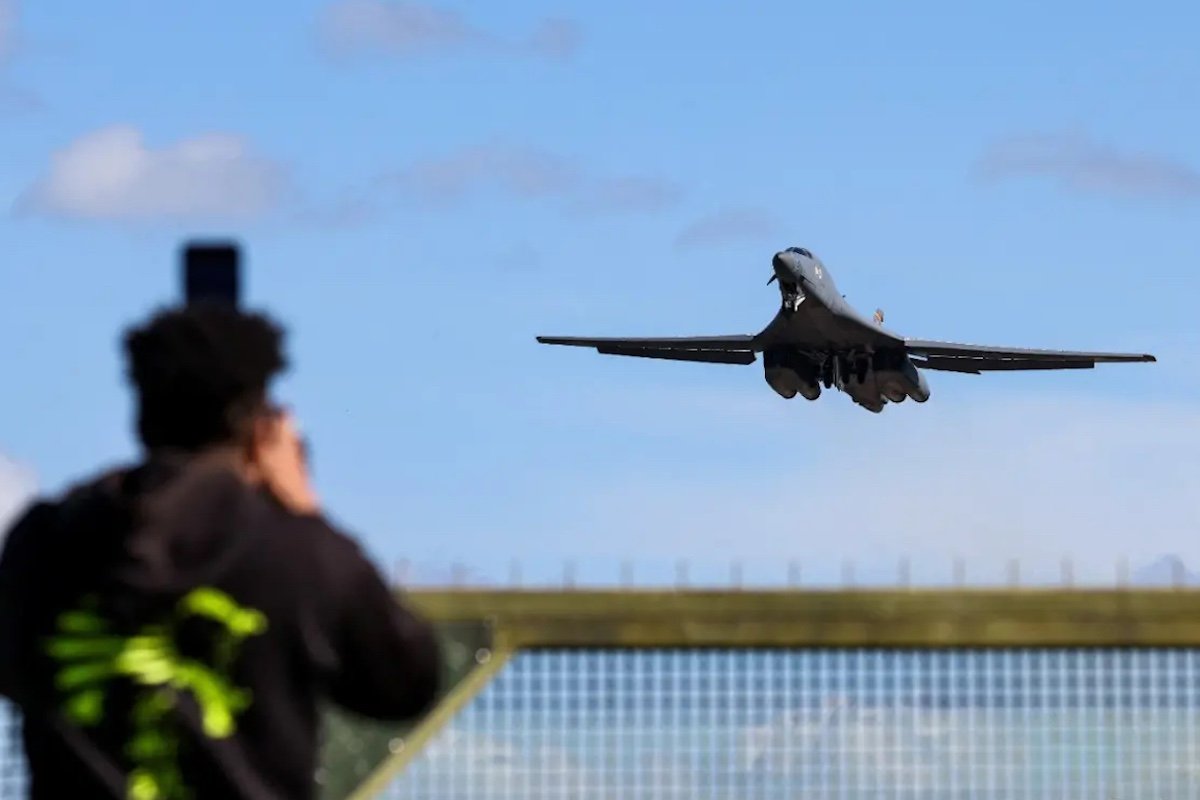

When Indonesians hear the phrase military overflight, the image that often comes to mind is simple: foreign military aircraft freely crossing the skies without permission. It is a powerful image because it directly affects sovereignty, one of the most sensitive elements of foreign and defense policy.
But in the 21st century, military aviation no longer works that way. The real story unfolding across the Indo-Pacific is not about whether countries grant “full overflight access” in an official, legal sense.
It’s about how military access is increasingly constructed through a web of logistics agreements, training agreements, interoperability clauses and expedited clearance procedures that make it possible to fly without ever being described as such.
This is the new access architecture. And Indonesia is now positioned geographically, strategically and diplomatically at its center.
Earlier reports suggested that Washington was seeking access to Indonesian airspace for US military aircraft. The proposal came shortly before Indonesian Defense Minister Sjafrie Sjamsoeddin was scheduled to visit the Pentagon on April 13 to sign the Indonesia-US Major Defense Cooperation Partnership (MDCP) agreement.
In this regard, the Ministry of Foreign Affairs of Indonesia has asked for caution in discussing the proposal. Recent reports indicate that the Defense Minister and retired personnel of the Indonesian National Armed Forces (TNI) are involved in further discussions.
Official statements emphasize that no agreement has been reached, that discussions remain at an early stage, and that Indonesia continues to maintain its long-standing foreign policy of bebas aktiv.
All of this could be entirely true – and still miss the deeper strategic dynamics at play. To understand why, we need to look beyond Indonesia and consider what has happened elsewhere in the region.
In the Philippines, the Enhanced Defense Cooperation Agreement (EDCA) never explicitly granted the US “overflight rights”. There is no clause that says US aircraft can fly freely in Philippine airspace.
Today, however, through access to multiple facilities, pre-positioned logistics, a rotating presence, and routine exercises, US military aircraft can move across the archipelago with an ease that is administrative rather than political.
In Papua New Guinea, a 2023 defense cooperation agreement similarly avoided language on bases or full access. Instead, it provided for the use of designated ports and airfields, logistical cooperation and case access. Strategically, this transformation made Papua New Guinea a critical transit hub between Guam and Australia.
Vietnam, a country wary of sovereignty and allergic to formal alliances, has allowed aircraft carrier visits, defense exchanges and increasingly regular military interactions with the United States — all while steadfastly insisting it has not given up any bases or joined any alliances.
Even among peacetime NATO allies, military flight is rarely “free.” Permits still exist on paper. But through standing agreements, those permits have been pre-authorized to the point where they function as routine administrative permits.
In each of these cases, the host country can honestly say, “We have not granted overflight rights.” And yet, operationally, access has expanded dramatically. This is what defense analysts sometimes describe as “approach without bases, presence without consistency.”
And this is where Indonesia’s role becomes particularly important. Geographically, Indonesia lies on the most efficient air corridors connecting the Western Pacific, the South China Sea, the Indian Ocean and northern Australia.
Without Indonesia, any rapid air movement across this theater requires longer routes, more fuel and greater operational complexity. With Indonesia, the Indo-Pacific air map becomes much smoother. This is not speculation; it is a simple geographical fact.
From the perspective of US military planners concerned with contingencies in Taiwan, the South China Sea or broader Indo-Pacific mobility, Indonesia is the missing piece that fills the regional air corridor.
But that doesn’t mean Washington needs — or even will demand — the “blanket flyover” the public might imagine.
What matters far more are the smaller, less dramatic provisions that rarely grab the headlines, namely logistical support agreements, humanitarian aid and disaster relief cooperation, the frequency of joint training, interoperability mechanisms and faster diplomatic clearance procedures for military aircraft.
Individually, each of them seems harmless. Technically, none infringe on Indonesia’s sovereignty. Politically, none resemble the granting of special foreign military airspace rights.
Collectively, however, they can produce the operational effect of very broad access. That’s why the cautious language used by Indonesian officials in response to recent reports is so interesting.
Phrases such as “requiring caution,” “still under review,” and “no binding agreement” are not disclaimers. They are classic diplomatic signals used when an issue is real, sensitive and still being navigated internally.
We have seen this pattern before in other countries before mainstream defense cooperation frameworks were formed. The key point for Indonesia, then, is not whether it will ever sign a document entitled “overflight agreement”. This is highly unlikely and unnecessary.
The more important question is whether the public is aware that modern military access has been built without ever being labeled as such. Indonesia’s doctrine of “bebas aktiv” has always relied on the careful management of sovereignty, strategic autonomy and balanced relations between great powers.
This doctrine is not automatically threatened by defense cooperation. But it can be quietly tested by cumulative agreements that, over time, change the practical reality of how airspace is used in times of crisis.
This is not an argument against cooperation with the US. Nor is it an accusation that Indonesia is ready to abandon its principles.
It is an argument for strategic awareness. Because in today’s Indo-Pacific, overflight is no longer negotiated in the sky. It is negotiated in logistics clauses, training agreements and field clearance procedures.
And for a country as central as Indonesia, understanding this difference may be more important than debating every single term in every single defense cooperation document.
AD Agung Sulistyo is one from Jakarta scholar specializing in Southeast Asian diplomacy and transnational law.



