
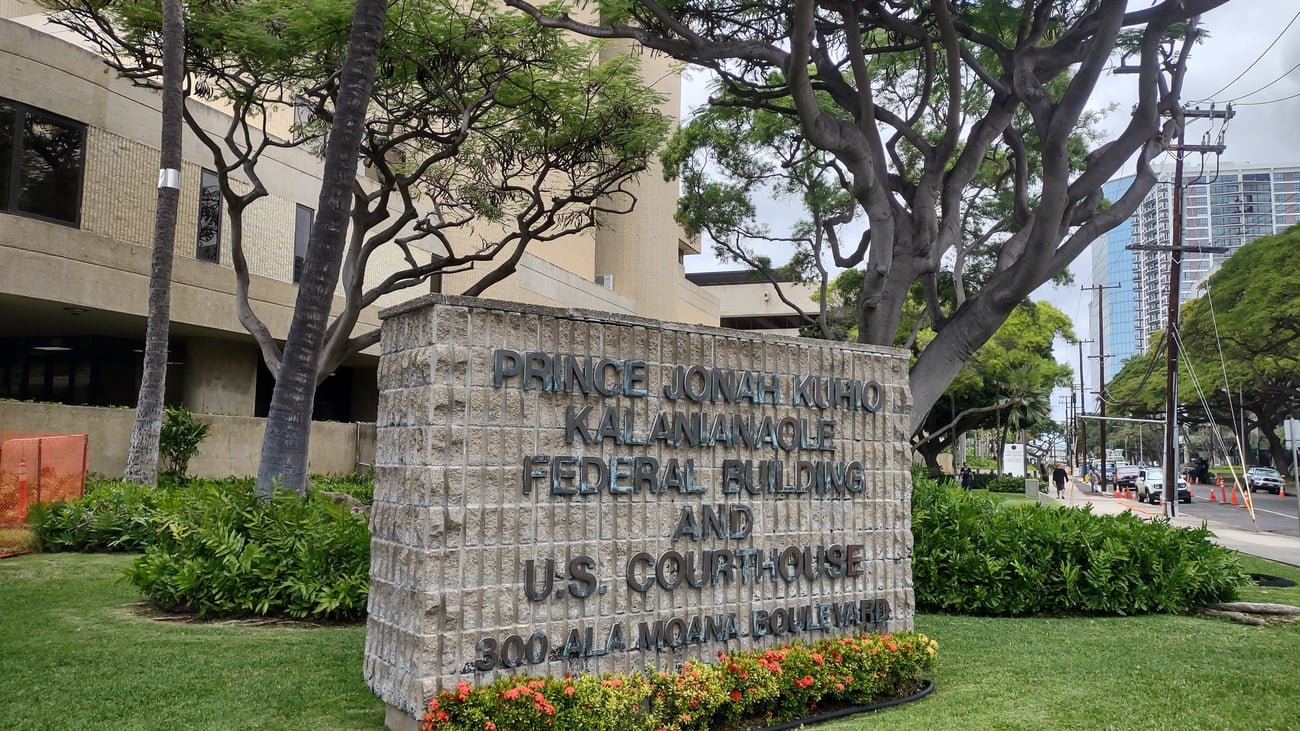

HONOLULU (CN) – Nearly 18 months after Michael Miske died in a federal custody cellThe legal battle over the accused crime boss’s fortune is still very much alive and getting more complicated every week.
On Friday, lawyers for the federal government and the trust that holds Miske’s estate argued before U.S. District Judge Derrick Watson whether prosecutors should be allowed to pursue a new legal theory: that Miske staged his fentanyl overdose death specifically to defraud the government of more than $20 million in assets that a jury had already voted on.
Watson, an appointee of Barack Obama, opposed the government’s attempt to freeze all civil proceedings while a related criminal investigation is underway, suggesting the case could move forward on most issues, even as he weighs an obstruction issue at its core.
“It seems like overkill,” Watson said. “I’m using a bulldozer to kill an ant if I stayed whole.”
Miske was convicted by a federal jury in July 2024 on 13 charges, including racketeering, murder-for-hire and kidnapping. He died at the Honolulu Federal Detention Center in December 2024 before being sentenced, which vacated his sentence.
Prosecutors filed a civil forfeiture complaint in January 2025 and have since claimed that Miske conspired with other inmates to smuggle fentanyl into the facility, taking small doses in the days before his death to make the overdose appear accidental.
Justice Department attorney Stephanie Williamson argued that allowing the civil discovery proceeding would inevitably expose the contours of an ongoing criminal investigation and that the fiduciary’s standing to assert any claim remained an open question related to obstruction claims. She said prosecutors could present additional evidence to Watson ex parte if necessary.
Watson appeared skeptical.
“There are about 250 cases, really probably more like 2,500 cases, that plaintiffs can pursue without touching them, without drawing any fire from the government that it might interfere with the ability to fully investigate what happened in 2024,” he said.
Edward Burch, an attorney representing Miske’s trust, asked the court to ensure that any stay would not block efforts to sell Miske’s properties through a middle sale process, warning that lenders were not being paid and the trust was facing mounting maintenance costs.
He said the two most valuable properties — an 8,206-square-foot, five-bedroom oceanfront property in the Portlock neighborhood on Lumahai Road and a Kailua home on Paokano Loop — had been titled in the Miske Trust since 2010 and 2011, well before the government’s 2024 foreclosure changes to the trust center.
“These two real properties were always in trust regardless of the 2024 amendment,” Burch said. “So even if we assume the best for the government, that the trust somehow has no standing with respect to the other properties, we still have standing with respect to these two.
In addition to the government’s motion for the suspension of the case, also the Friday session directed the government’s offer to file a second amended complaint to add obstruction of justice theory and trust objections to the magistrate judge’s order allowing this amendment.
Much of the argument centered on a narrow question of statutory interpretation: whether a federal forfeiture statute’s use of the word “take” can reach property acquired years before an alleged crime.
Burch argued that it cannot.
“Take means what it means, and it doesn’t mean keep,” Burch said. “Congress, when it enacted this language 26 years ago, created a very comprehensive statute, and there are other places in the statute that authorize the forfeiture of what was broadly intended to be used in a crime or maintained or facilitated. But here, this section specifically limits it to only what is actually taken — it doesn’t say it’s kept, it doesn’t say it’s actually taken, it’s included in it.”
Watson pressed both sides of the issue, pointing to a Florida court decision that the government cited in support of the broader reading of the word “take.” He said the out-of-district ruling was not binding on him and asked prosecutors to explain how the reading was expanded to include “retention.”
Assistant U.S. Attorney Joseph McGinley argued that the government’s theory relied on express or implied language in the statute that Burch had omitted in his briefing, and pointed to an analysis but for support from several cases, including a 2025 Ninth Circuit decision, saying that civil forfeiture reaches property related to criminality even where the owner is not convicted of a crime.
“Precisely because of the conspiracy to obstruct justice that culminated in Mr. Miske’s suicide, the government never obtained legal title to the properties,” McGinley said.
Watson waived a question from the bench, saying he needed no argument whether obstruction of justice could occur through suicide.
“My view is that it can, and there is nothing in the Seventh Circuit case, the only case cited by the plaintiff for the opposite conclusion, that is inconsistent with the theory the government wants to offer in its second amended complaint,” Watson said. “You won’t convince me otherwise.”
Watson did not say when he would rule on the other cases.

Subscribe to our free newsletters
Our weekly newsletter Closing arguments provides the latest on ongoing trials, major litigation and decisions in courts around the US and the world, while monthly Under the lights feeds legal dirt from Hollywood, sports, Big Tech and the arts.



