
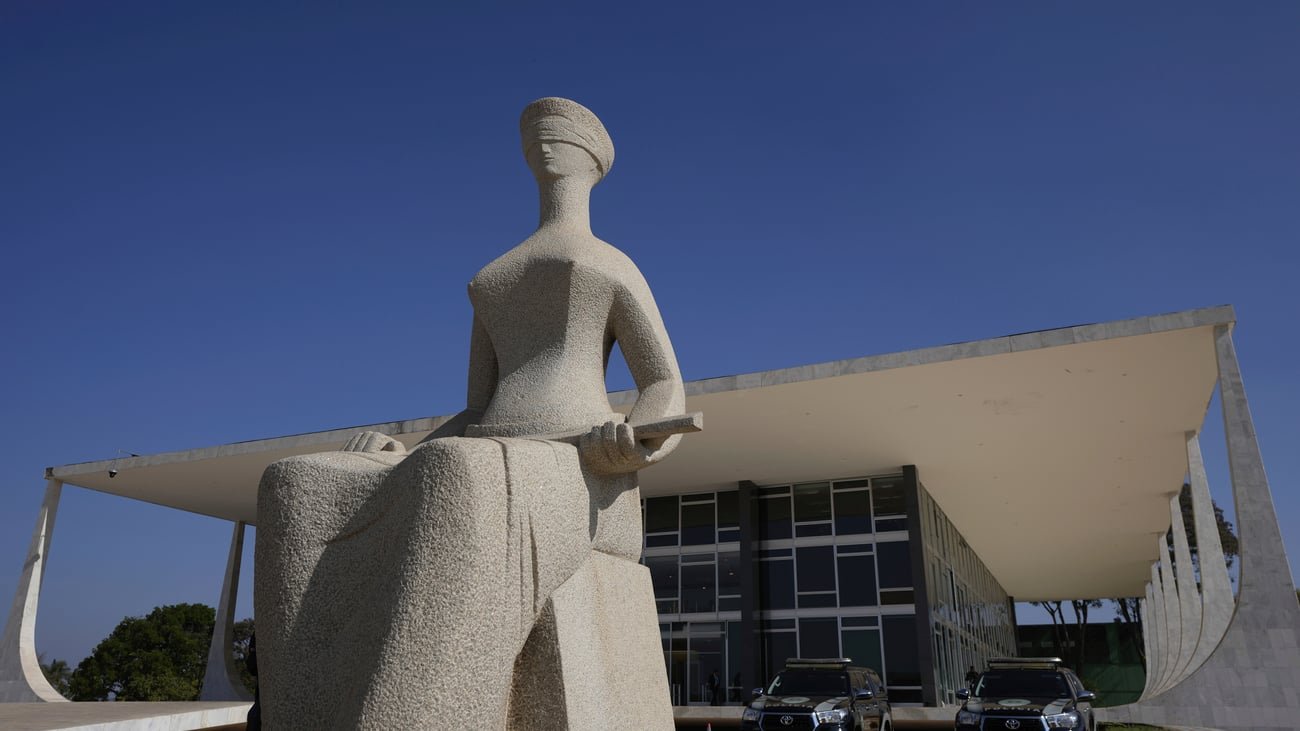

RIO DE JANEIRO (CN) – Brazil’s Supreme Court on Friday unanimously overturned a law in the southern state of Santa Catarina that banned race-based affirmative action policies at public state universities and higher education institutions that receive state funding.
Judge Gilmar Mendes, writing for the country’s highest court, said it already set precedent on race-based affirmative action and found that Santa Catarina’s law unconstitutionally infringed on university autonomy and ignored the racial disparities that persist in the state.
Mendes also concluded that the Santa Catarina law reflected an unconstitutional failure to evaluate relevant facts and legislative presumptions by extinguishing a public policy without any concrete evaluation of its effects and results.
Signed into law in January, the legislation banned race-based affirmative action in student admissions and in the hiring of professors, staff and other employees, while maintaining policies based on economic, disability and attendance criteria in state public high schools.
The law also provided for cancellation of admissions processes, a fine of 100,000 reais (about $20,000) for public notification and cuts to public funding in case of non-compliance.
A day after it was signed, the Court of Justice of Santa Catarina temporarily suspended its effects, preventing the immediate interruption of ongoing admissions processes.
At the same time, the Socialism and Freedom Party, the National Union of Students, and Educafro—a non-profit organization that advocates for black students and other underrepresented groups—asked the Supreme Court to immediately suspend the law and strike it down completely as unconstitutional both formally and substantively.
Rodrigo Sartoti, lawyer for the Socialism and Freedom Party, said the ruling has binding nationwide effect, requiring state courts and public authorities to follow it. He said other state legislatures could still try to pass similar laws, but any such efforts would likely be hit back.
Sartoti said the ruling echoed arguments that the law violates the Inter-American Convention Against Racism, which Brazil has incorporated into its constitutional order and which requires the state to adopt affirmative action policies.
Other challenges were also raised by the Brazilian Bar Association, the Workers’ Party, the Brazilian Communist Party and the National Confederation of Industrial Workers.
The law faced challenges on other fronts as well. The Santa Catarina Public Prosecutor’s Office filed a direct constitutional challenge in state court, and the Federal Prosecutor’s Office for Citizens’ Rights issued a technical opinion saying the statute constituted social reversion and violated international conventions.
Irapuã Santana, a partner at Rio de Janeiro-based BFBM Advogados and a volunteer attorney for Educafro, said the victory was “extremely important” because it reaffirmed affirmative action as a constitutionally protected state policy.
“This attack didn’t break new ground. It just pretended to forget it,” he said.
According to him, the decision reaffirms an already established understanding and helps move the debate to another level, at a time when the court has more clearly recognized that constitutional duty to confront structural racism. “I hope we can now focus on other fronts, such as reparations,” he said.
Established case law
The decision turned on a case the Supreme Court had already decided in 2012, when it upheld race-based affirmative action in college admissions. Since then, that precedent has supported the expansion of affirmative action policies in areas including higher education and public service.
Brazil’s affirmative action system of higher education is one of the country’s main equity policies in recent decades. Structured nationwide under a 2012 law and updated in 2023, it built on and expanded policies that some universities had already begun adopting in the 2000s.
Although public debate often centers on race, the Brazilian model combines income, public school background, and race, with the distribution of electronic games calibrated to each state’s demographic makeup.
The system reshaped the social and racial composition of Brazil’s public universities. The State University of Rio de Janeiro was the first to adopt affirmative action in admissions in 2003, and other universities soon followed.
Data from Higher Education Registration 2024 show that more than 1.4 million students entered through these policies between 2013 and 2024, with 133,078 new students in 2024 alone.
The government of Santa Catarina argued that the state could adopt its own inclusion model focused on socio-economic criteria.
In a foldersent to the Supreme Court in January, the state administration said Santa Catarina has a majority white population and pointed to the Free University program as evidence of its commitment to democratizing access to higher education.
The state attorney general’s office said the law did not repeal affirmative action in general, but simply replaced racial criteria with what it described as objective, universal and controllable criteria.
Racing in Brazil
According to the Santa Catarina government, 81.5% of the state’s population identifies as white, while black and brown residents make up 18.1%. The census argued that percentage was significantly lower than the national average.
However, these figures contradict the 2022 census produced by the Brazilian Institute of Geography and Statistics. According to that survey, 76.3% of Santa Catarina residents identified as white and 23.3% identified as black or brown.
or STUDY from the Center for Research and Data on Racial Inequalities, produced amid controversy, found that the black population in the state remains at a disadvantage in indicators of income, employment and education.
According to the report, the black unemployment rate remained nearly double that of whites between 2012 and 2023, black representation in leadership positions remained well below its share of the population and, in 2023, the median income of black people reached 65.5% of the median income of white people.
Marcelo Henrique Romano Tragtenberg, a professor at the Federal University of Santa Catarina and one of the study’s coordinators, said these figures show an accumulation of disadvantages for black students from basic education to university. He added that removing the racial criterion would make access to higher education even more difficult, with subsequent effects on the labor market.
“People with higher education earn more,” Tragtenberg said. “But today, even with higher education, blacks earn less. So this law limits the black population to secondary education, which will widen the income disparity between blacks and whites in Santa Catarina.”
He also said that policies limited to public school graduates do not necessarily change the percentage of black students in universities, and that proposals similar to Santa Catarina’s have already appeared in at least a dozen states.
“There is a coordinated effort by the Brazilian far right to revoke these policies,” Tragtenberg said. “What’s curious is that the extreme right is not against affirmative action based on income or public schools, but they are against affirmative action based on race, because they don’t recognize that racism exists in Brazil.”
Courthouse News reporter Marília Marasciulo is in Brazil.
Subscribe to our free newsletters
Our weekly newsletter Closing arguments provides the latest on ongoing trials, major litigation and decisions in courts around the US and the world, while monthly Under the lights feeds legal dirt from Hollywood, sports, Big Tech and the arts.



