
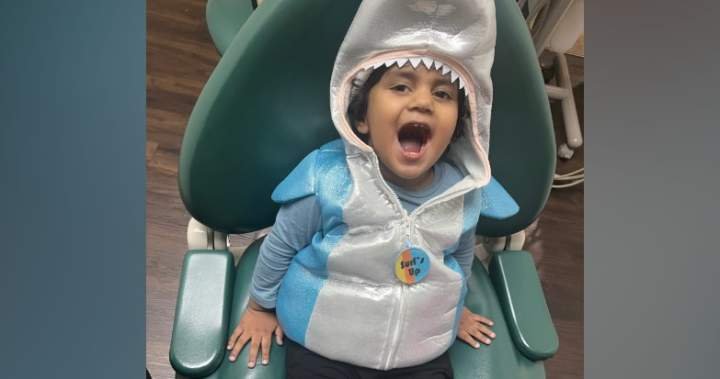

The family of a BC boy with a rare neurodegenerative condition is calling on the government to help them access potential gene therapy treatment.

Navpreet and Stalin Gill told Global News that they started noticing that their now three-year-old son, Gurmoh, had problems with movement around the age of 1.
It wasn’t until he was about three that Gurmoh was diagnosed with Spastic Paraplegia Type 4, which causes stiffness and weakness in the legs.
Their five-year-old daughter does not have the condition, and Gurmoh is believed to be the only case in Canada.
Navpreet said it was devastating news.
“Having a child in your life is the best feeling,” she said. “And, you know, like having the worst diagnosis you can think of, you know, when you get it, it just kills you inside … it just breaks you. It’s horrible.”
Stalin said it has devastated them to know their son will be in pain.
“When he was born, we were thinking what’s going to happen when he’s three, or when are we going to take him to Disney?” he said.
Stalin said that now the question is when they should go to the hospital next.
“He is not able to play with his peers, with children of the same age, because he can’t run fast enough, he can’t walk, he stumbles, he falls down,” he added.

Get weekly health news
Get the latest medical news and health information delivered to you every Sunday.
“And it’s a neurodegenerative disease. It’s progressive. So it’s not something that, oh, stops. It just gets worse every minute, every second, every day. It’s suffering. It’s emotional suffering.”
Navpreet said that as a parent, you have dreams for your child and wonder what sport he can play or whether he likes to dance or run, but she said all this is taken from Gurmoh.
“The specific mutation that he has is considered the most aggressive of, you know, that category and is considered to be more of a complex presentation,” she said.
“What that means is, in addition to his legs, he could end up losing the ability in his arms, his speech, his mental ability, so much so that it will take everything away from him.”

Stalin said they are now racing against time to get gene therapy, but they are facing opposition at every turn.
They are also thousands of dollars for tests, treatments and travel.
He said they contacted the BC government, who said they couldn’t help, so they turned to the federal government.
A team of researchers at McGill University in Montreal has agreed to help treat this condition, as they have treated a similar condition, and develop gene therapy.
But the cost is expected to be around 8 million dollars.
The federal government there is a national strategy for medicines for rare diseaseswhere it has made “up to $1.4 billion in funding available to provinces and territories through three-year agreements to help them provide better coverage and access to selected new drugs for rare diseases on the Common List, other new and existing drugs for rare diseases and screening and diagnostic services.”
Global News has reached out to the federal government to learn more about the funding and how it is being used.
“We are fighting the disease,” Stalin said. “We’re fighting the system, you know, the system that’s supposed to support us, the system that’s supposed to spend money on developing these therapies, making it easier.”
He said it’s hard to open up about their lives and struggles, but they want to help change the system.
“(We want) everyone to understand how difficult it is, for the patients, for their families, for their grandparents, for their uncles, for their aunts,” Stalin added.
“It’s not us involved in this. It’s our whole circle of friends, our whole family, that’s helping us with this. It’s horrible.”
The family has set up a GoFundMe to try and raise money, which will go live on Friday, April 10th.
© 2026 Global News, a division of Corus Entertainment Inc.



