
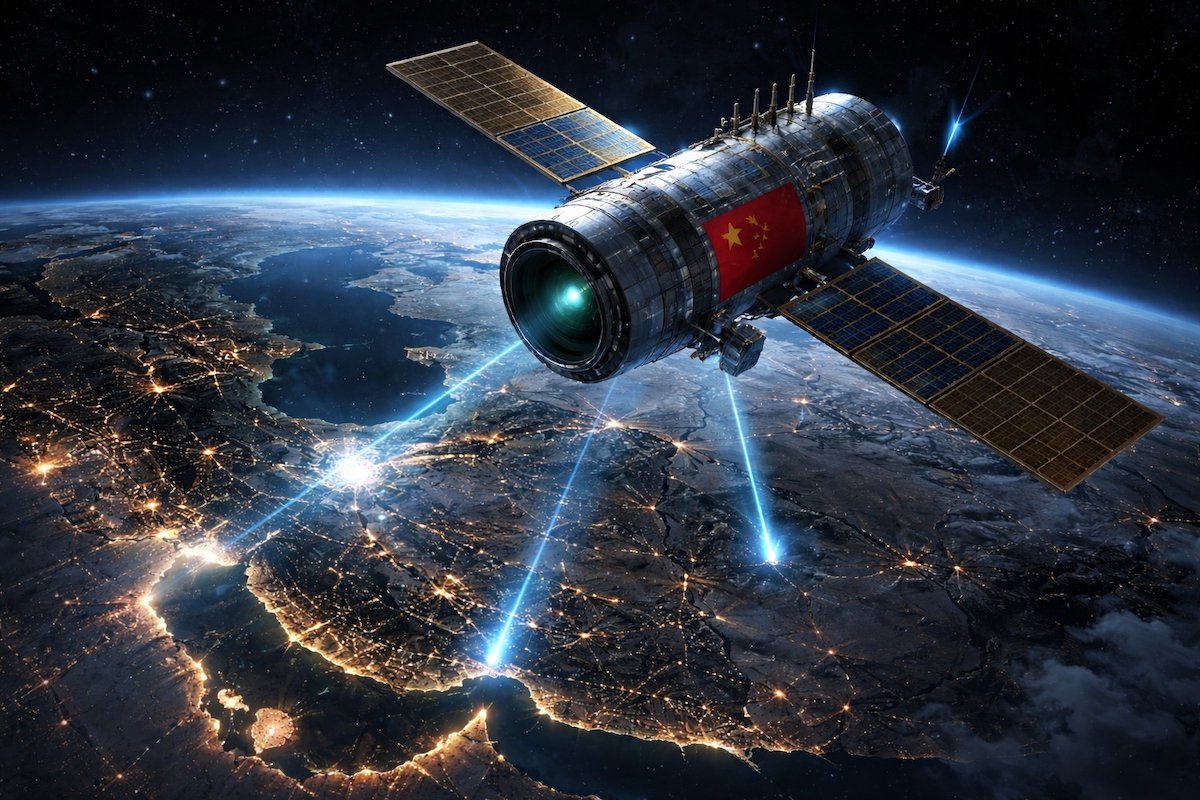

China’s AI-driven intelligence support for Iran is turning the war into a proxy, data-driven conflict in which battlefield advantage increasingly depends on information rather than force.
Washington Post reported Over the weekend, private Chinese technology firms are marketing AI-driven intelligence tools that they claim track and “expose” US military movements in the context of the Iran conflict, underscoring a growing security concern despite China’s efforts to distance itself from the war.
Companies such as MizarVision and Hangzhou-based Jing’an Technology are using artificial intelligence to analyze open-source data, including satellite imagery, flight tracking and transportation information, to map US deployments in the Middle East, including pre-operational construction.
While these firms are not formally part of China’s military, some hold certifications associated with the People’s Liberation Army (PLA) and are part of China’s broader civil-military integration strategy, which has channeled funding into AI-enabled defense applications.
US officials remain divided on the credibility of the firms’ claims, particularly those related to sensitive capabilities such as the interception of secret communications, but warn that their rapid spread reflects a broader effort to expand the reach of China’s intelligence and complicate efforts to cover up US operations.
Illustrating these skills, a Kharon short from March 2026 notes that Jing’an Technology claimed to track US B-2A Spirit stealth bombers during US strikes on Iranian targets, highlighting how such firms use open source AI-driven intelligence (OSINT) that mixes data collection with inference rather than true penetration of classified systems.
According to the summary, Jing’an Technology said its Jingqi platform tracked four B-2 aircraft, “reconstructed” flight paths and “intercepted” communications, but these claims may be overstated, as the audio likely came from publicly available aviation channels and route estimates were based on past operational patterns.
Even if overstated, these claims highlight a critical difference: China is not breaking into classified systems, but extracting actionable intelligence from open source data — lowering the barrier to entry for state-level targeting.
Illustrating this dynamic, Tahir Azad notes in a March 2026 Small Wars Journal (SWJ) ITEM that intelligence support enabled by China’s technology, integrated with satellite intelligence, surveillance and reconnaissance (ISR), navigation systems, radars and electronic warfare capabilities, can increase Iran’s targeting accuracy and operational effectiveness against the US.
Azad argues that Chinese satellite surveillance and integrated intelligence networks can enable Iran to identify and strike high-value targets despite weaker indigenous capabilities, contributing to a modern “kill chain” in which Chinese ISR supports Iranian missile and drone operations.
Taken together, these developments suggest that China’s role extends beyond passive surveillance, forming a functional intelligence layer that links data collection to Iranian offensive capability.
This model operates in the gray area between peace and war, where states combine commercial tools, private actors and open source data to generate actionable intelligence without clear attribution. In practice, Chinese firms release AI-processed information, Russia passes on targeting data, and Iran acts on it – creating a distributed, deniable intelligence network that exploits legal ambiguities while managing escalation.
This emerging intelligence model also carries risks of escalation, as deniable support can gradually blur into direct involvement. Juan Quiroz EVIDENCE in a 2025 Military Review article, that proxy wars are becoming more escalating and increasingly resembling conventional warfare as major powers, in some cases, drop denial and deepen their direct involvement to pursue strategic objectives.
He notes that proxy wars persist because they allow states to avoid the costs of direct conflict—especially under nuclear constraints—but that when vital interests are perceived to be at stake, sponsors may escalate their involvement.
While nuclear deterrence continues to deter direct clashes between great powers, it suggests that the dynamics of modern proxy wars increase the risk of escalation into direct interstate conflict.
This dynamic is not isolated. Max Boot EVIDENCE in a March 2026 article by the Council on Foreign Relations (CFR) that the war has become a secondary front in the Russia-Ukraine conflict, with Russia reportedly providing Iran with satellite imagery and drones that may have supported Iranian targeting of US-linked facilities.
On the other hand, Boot says, Russia benefits strategically by diverting American resources, increasing oil revenues to finance its war in Ukraine, and building on previous military exchanges, allowing Russia to benefit indirectly without direct confrontation.
Beyond the immediate effects of the battlefield, this model also serves long-term strategic purposes. Nadia Helmy notes in March 2026 ITEM for Modern Diplomacy that the war serves as a real-world testing ground for China, allowing it to gather battlefield data on US and Israeli systems and refine its capabilities for future conflicts.
Helmy explains that China uses the battlefield to study the performance of Western weapons systems, radar signatures and operational networks, enabling analysis, reverse engineering and integration of AI into its own systems.
She argues that Iran functions as an indirect proxy, allowing China to study, counter and prepare for US military power without direct confrontation, particularly in anticipation of future conflicts in Taiwan and the South China Sea.
This representative layered structure extends beyond the US-Iran dynamic to the broader regional battlefield. While Iran certainly serves as a proxy for China and Russia against the US, it also conspicuously uses proxies primarily against Israel, its main regional adversary.
As noted by Assaf Orion and other authors in a March 2026 Washington Institute (TWI) for Near East Policy ITEMthe war features Iran using regional proxies such as Hezbollah, Iraqi militias and the Houthis to open multiple fronts and dilute Israeli military focus.
According to the authors, Iran – particularly through the Islamic Revolutionary Guard Corps’ Quds Force (IRGC) in the case of Hezbollah – has helped open additional fronts, with these groups carrying out attacks across Lebanon, Iraq and potentially Yemen. They note that pressure on multiple fronts could strain Israel’s air power, interceptor stockpiles, logistics and resilience while helping to take military pressure off Iran.
The Iran war points to a new model of conflict, in which the confluence of AI-driven data and deniable intelligence networks allow smaller actors to punch above their weight, while major powers quietly prepare for the next high-intensity war.
For China, this is not just about maintaining stability on Iran’s battlefield, but about perfecting a scaled model of proxy warfare in which data — not direct force — becomes the decisive instrument. As these skills develop further, future conflicts may be influenced more by who perceives, analyzes and reacts to information faster than by who fires first.



