
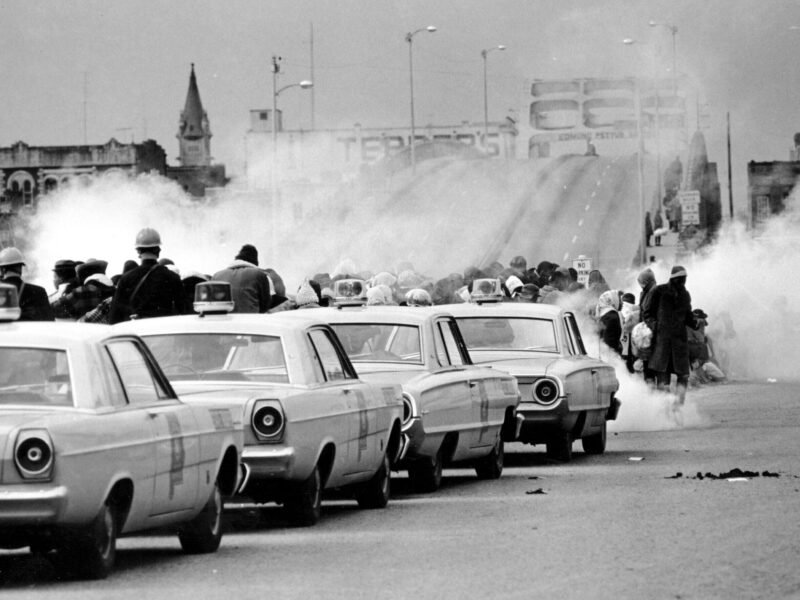

The violence of March 7, 1965, which became known as Bloody Sunday, shocked the nation and helped pass historic legislation that dismantled barriers to voting for black Americans in the Jim Crow South.
SELMA, Ala. (AP) — Sixty-one years after state troopers attacked Civil Rights marchers on the Edmund Pettus Bridge in Selma, thousands are rallying in the Alabama city this weekend amid renewed concerns about the future of the Voting Rights Act.
The violence of March 7, 1965, which became known as Bloody Sunday, shocked the nation and helped pass historic legislation that dismantled barriers to voting for black Americans in the Jim Crow South.
But this year’s anniversary celebrations — events run throughout the weekend and culminate with a memorial march across the bridge on Sunday — come as the U.S. Supreme Court considers a case that could limit a provision of the Voting Rights Act that has helped ensure some congressional and local districts are drawn so that minority voters have a chance to elect the candidate of their choice.
“I’m worried that all the progress we’ve made for the last 61 years is going to disappear,” said Charles Mauldin, 78, one of the marchers who was beaten that day.
Justices are expected to rule soon on a case in Louisiana about the role of race in drawing congressional districts. A decision that bans or limits that role could have sweeping consequences, potentially opening the door for Republican-controlled states to redistrict and undo majority-black and Latino districts that tend to favor Democrats.
Democratic officials, civil rights leaders and others have descended on the southern city to pay tribute to the Civil Rights Movement’s pivotal moment and call for action. Like the marchers on Bloody Sunday, they must keep pressing forward, organizers said.
Former state Sen. Hank Sanders, who helped start the annual commemoration, said the 1965 events in Selma marked a turning point for the country and helped move the United States closer to becoming a true democracy.
“The feeling is a deep fear that we’re going to go backwards — a greater fear than at any time since 1965,” Sanders said.
Rep. U.S. Rep. Shomari Figures won the 2024 election in an Alabama district that was reviewed by a federal court. He said what happened in Selma and the subsequent passage of the Voting Rights Act “was monumental in shaping what America looks like and how America is represented in Congress.”
“I think coming to Selma is a refreshing reminder every year that the progress we’ve gotten since the Civil Rights Movement is not permanent. It’s been under constant attack almost since we got those rights,” Figures said.
In 1965, Bloody Sunday marchers led by John Lewis and Hosea Williams walked in pairs across the Selma Bridge, heading to Montgomery. Mauldin, then 17, was part of the third pairing behind Williams and Lewis.
At the top of the bridge, they could see the sea of law enforcement officers, including some on horseback, waiting for them.
But they continued. “Being afraid was not an option. And it wasn’t that we weren’t afraid, but we chose courage over fear,” Mauldin recalled in a phone interview.
“We were all hit. We were stomped on. We were tear gassed. And we were brutalized by the state of Alabama,” Mauldin said.
Subscribe to our free newsletters
Our weekly newsletter Closing arguments provides the latest on ongoing trials, major litigation and decisions in courts around the US and the world, while monthly Under the lights feeds legal dirt from Hollywood, sports, Big Tech and the arts.



